The best scratching post for cats is not one universal design. A tall vertical post may be perfect for a cat that stretches up a sofa arm, while another cat may strongly prefer a flat cardboard pad or an angled scratcher.
The right choice matches how your cat naturally scratches. It also provides enough usable scratching space, stays secure under pressure, fits a useful location in your home, and has a surface your cat wants to use.
This means choosing for the cat in front of you—not simply buying the tallest post, the most expensive material, or the design that looks best with your furniture.
Quick Answer
The best scratching post for your cat should:
- match your cat’s preferred vertical, horizontal, or angled scratching position;
- provide enough usable height or length for a comfortable stretch;
- remain stable when your cat leans, pulls, and scratches;
- offer a texture your cat finds satisfying;
- fit somewhere your cat is likely to use it;
- have safe, durable construction without exposed or easily detached parts; and
- suit your cat’s size, age, mobility, and household circumstances.
Sisal, cardboard, carpet, rough fabric, and wood-like surfaces can all be suitable. No material is best for every cat, and some cats benefit from access to more than one type.
Start With Your Cat’s Scratching Preferences
Before comparing products, spend a little time watching your cat.
The surfaces your cat already chooses provide useful clues:
- Scratching sofa arms, chair legs, door frames, or other upright objects may suggest a preference for vertical scratching.
- Scratching rugs, carpets, or mats may point toward a horizontal scratcher.
- Scratching the sloped edge of furniture or changing position while scratching may make an angled option worth trying.
- Choosing woven upholstery may indicate an interest in firm fabric or sisal.
- Choosing cardboard boxes or rough natural surfaces may suggest a preference for cardboard or wood-like textures.
Also notice how your cat uses the surface. Does your cat reach high and extend the whole body, crouch over a flat area, or lean forward at an angle? Does the cat scratch in long strokes or concentrate on a small patch?
These observations cannot guarantee that a particular product will be accepted, but they give you a more useful starting point than appearance or marketing claims.
If your cat already owns a suitable post but consistently avoids it, the problem may involve its location, condition, or introduction rather than the need to buy another one. That situation is covered in Why Doesn’t My Cat Use the Scratching Post?
Vertical, Horizontal, or Angled: Which Type Fits?
The main scratching-post types support different body positions. None is automatically superior.
Vertical Scratching Posts
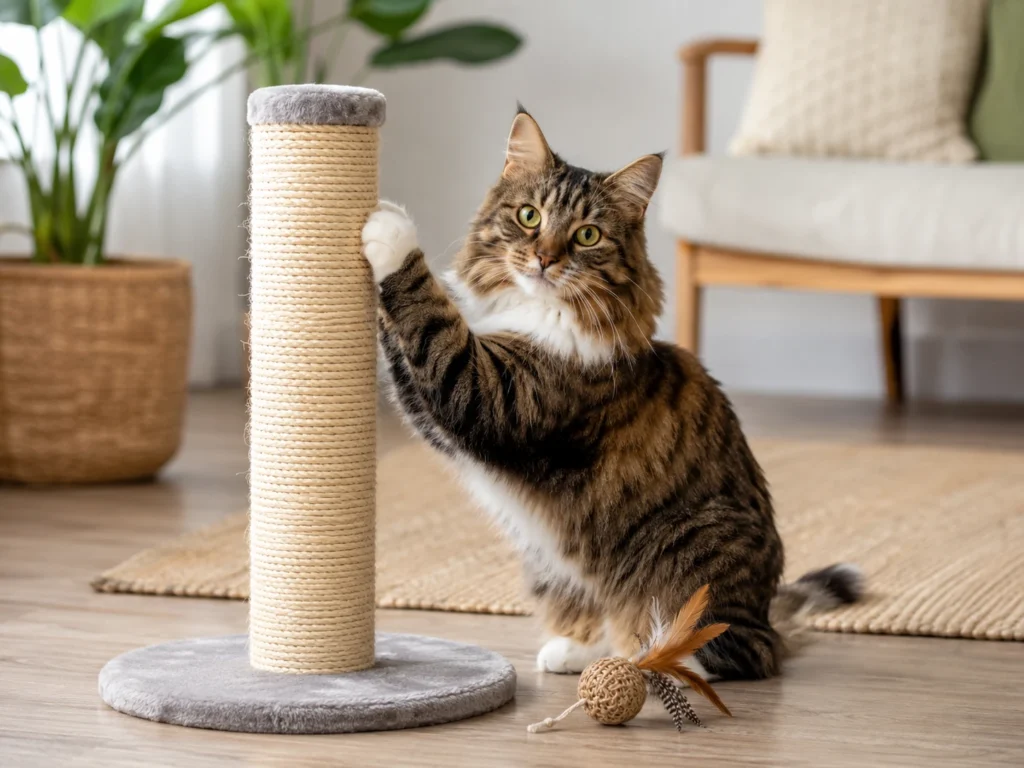
A vertical post suits cats that like to stand on their hind legs, reach upward, and pull down through the scratching surface.
Look for a post with a continuous scratchable area long enough for your cat’s normal movement. Decorative caps, platforms, or bare sections should not be counted as usable scratching height.
Stability becomes especially important with a vertical design. A cat pulling near the top can place considerable leverage on the structure. A narrow or lightweight post may look tall enough but still rock, slide, or tip during use.
Vertical posts are often practical beside sofas, near doorways, or close to sleeping areas. However, their bases may occupy more floor space than photographs make obvious, so check the complete dimensions before buying.
Horizontal Scratching Pads
Horizontal pads suit cats that scratch carpets, rugs, mats, or other flat surfaces. They can also be easier for cats that find upright stretching uncomfortable.
Check the usable length and width rather than judging the product by its total footprint. Your cat should be able to stand securely and make a natural forward scratching movement without immediately reaching the end of the material.
Lightweight pads should have a nonslip base, secure holder, or another design feature that prevents them from skating across the floor. A pad that moves under the paws may be less comfortable and less satisfying than the fixed carpet or rug it is intended to replace.
Angled Scratchers
An angled scratcher provides a position between upright and flat. It may suit a cat that leans forward while scratching, changes between positions, or appears uncomfortable reaching fully upward.
The angle itself does not make the scratcher better. The structure still needs sufficient usable length and a firm base. Some lightweight triangular or ramp-style products can shift, collapse, or lift at one end when a cat pulls against them.
An angled model can also be a useful compromise where a full-height post will not fit, but space-saving should not come at the expense of stability or accessibility.
Check the Usable Height or Length
Product descriptions often emphasize overall dimensions, but part of that measurement may include the base, frame, platform, border, or decorative sections.
What matters to your cat is the area that can actually be scratched.
For a vertical post, compare the usable scratching height with the space your cat needs to reach upward and extend comfortably. Your cat should not have to keep the shoulders compressed because the scratchable section ends too soon.
For a horizontal or angled scratcher, look for enough length to support the cat’s body position and forward paw movement. A compact pad may work for a kitten or a cat that uses short strokes but feel restrictive to a long-bodied adult.
There is no single dimension that suits every cat. Body size, stretching style, and scratching position all affect the decision. Avoid relying on labels such as “large” or “adult”; check the actual measurements.
If buying for a kitten, consider how well the product will work once the kitten reaches adult size. A small post that is stable and usable today can become unnecessarily restrictive surprisingly quickly.
Stability and Safe Construction Come First
A scratching resource must remain secure while the cat stretches, grips, and pulls. A satisfying material cannot compensate for a structure that feels unstable or contains unsafe components.
What a Stable Scratcher Should Do
A freestanding post or pad should sit level on the floor without rocking. The base should remain planted when moderate pressure is applied from different directions.
Before buying, consider:
- the size and shape of the base;
- how the upright section connects to the base;
- whether the product is likely to slide on your flooring;
- whether the scratchable section can twist or rotate;
- whether a large or athletic cat could overpower the structure; and
- whether any wall attachment required for stability is practical in your home.
A wall-mounted scratcher can provide useful height without a large floor base, but it is only secure when attached correctly to a suitable surface. Check the manufacturer’s installation requirements before buying, particularly if you rent or cannot drill into the wall.
There is no reliable universal minimum base size or product weight. Stability depends on the complete design, the flooring, the attachment method, and the cat using it.
Construction Problems to Reject
Inspect display products carefully and enlarge online product photographs where possible. Do not buy a scratcher with:
- sharp or unfinished edges;
- exposed staples, screws, nails, or other fasteners;
- splintered wood or brittle components;
- loose coverings, trim, rope, or fabric;
- gaps that could catch a paw or claw;
- a base that is visibly warped or uneven;
- poorly aligned parts or weak connection points; or
- components that detach easily during normal handling.
If the product arrives damaged, unstable, or materially different from its description, do not let your cat use it while deciding whether to return it.
Once a safe post has been in use for some time, normal wear becomes a separate question. When Should You Replace Your Cat’s Scratching Post? explains how to distinguish acceptable wear from damage that needs repair or replacement.
Which Scratching Surface Is Best?
Cats differ in the textures they prefer. The Ohio State University Indoor Pet Initiative and FelineVMA both recommend considering the individual cat’s existing scratching habits rather than assuming one material will suit every cat.
Material also affects price, mess, noise, durability, and the kinds of structures available.
Sisal Rope and Sisal Fabric
Sisal is common on vertical posts and some angled scratchers. Its rough texture gives the claws a surface to pull against, and many cats find it satisfying.
Sisal rope is usually wound around a central post. Check that the winding is tight, evenly attached, and continuous across the useful scratching area. Large gaps, loose ends, or visible fasteners are reasons to choose a different product.
Sisal fabric creates a flatter scratching plane. Some cats may prefer that continuous surface, while others enjoy the ridges created by rope. Neither construction is automatically better.
Corrugated Cardboard
Corrugated cardboard is widely used in horizontal pads and angled scratchers. It is often lightweight, relatively inexpensive, and easy to replace.
Some cats strongly prefer the shreddable texture. Others show little interest in it. Cardboard can also produce loose pieces and dust, which may influence where you want to place it.
Check whether the cardboard insert sits securely in its frame. A loose pad that lifts or slides during use may be less practical than a heavier holder or a design with a nonslip underside.
Carpet and Rough Fabric
Carpet or firm fabric can appeal to cats that already scratch similar textile surfaces. It is available on posts, pads, ramps, and cat towers.
Look closely at how the material is attached. The covering should be firm, without loose folds, exposed backing, projecting fasteners, or damaged loops.
Some owners prefer to offer a surface that feels different from household carpet or upholstery, while others find that matching an established texture improves acceptance. The cat’s response is ultimately more informative than a general rule.
Wood and Bark-Like Surfaces
Some cats enjoy scratching firm wood or bark-like textures. These surfaces may be incorporated into commercial scratchers or purpose-built natural designs.
Choose a product intended for animal use and inspect it for splinters, sharp edges, unstable branches, unknown coatings, or rough connection points. A natural appearance does not guarantee safe construction.
Wood may be less forgiving than cardboard or fabric if the design is poorly finished, so the complete product matters more than the material name.
Make Sure the Scratcher Fits Its Intended Location
A good scratching post still needs a realistic place in the home.
For a detailed room-by-room placement framework, see Where Should You Put Your Cat’s Scratching Post?
Cats often scratch near resting areas, commonly used routes, entrances, and socially important parts of their territory. A product that only fits in an isolated corner may be a poor purchase, even if its materials and construction are otherwise excellent.
Before ordering, measure:
- the complete base or holder, not only the scratching section;
- the available floor or wall area;
- the space your cat needs to approach and use the scratcher;
- clearance from doors, furniture, curtains, and walkways; and
- the space required for any wall brackets or anchoring hardware.
Avoid placing a scratcher where people regularly trip over it, where a door can strike it, or where another cat can easily block access.
Portability may matter if you need to move the scratcher for cleaning or occasionally reposition it. However, a portable product must still remain secure during use. Very light construction is not an advantage if the scratcher slides or tips.
Choose for Your Individual Cat
The same product will not suit every life stage, body size, or household.
Kittens
A kitten needs a stable scratching outlet, but buying the smallest available post is not always economical or useful.
Choose a structure that is safe at the kitten’s current size and likely to remain tall or long enough as the cat grows. Check especially carefully for loose components, exposed fasteners, and gaps where small paws could become trapped.
A full-size post can be suitable for a kitten if it is stable, accessible, and safely constructed.
Large or Athletic Cats
A large, long-bodied, or powerful cat needs proportionately more usable scratching space and a structure that remains secure under stronger pulling.
Check the complete dimensions, attachment method, base design, and any manufacturer weight or installation guidance. Do not assume that a tall post is strong merely because it looks substantial in a product photograph.
For these cats, a securely mounted vertical panel or a well-built cat tower may sometimes provide better stability than a narrow freestanding post.
Senior Cats and Cats With Limited Mobility
Scratching preferences can change with age, stiffness, pain, reduced strength, or impaired balance.
A horizontal pad or gently angled scratcher may be more comfortable than a tall vertical post. It should be accessible without jumping or climbing and remain stable on a nonslip surface. Placing it near a favored resting area can reduce unnecessary movement.
FelineVMA’s home-modification guidance specifically recommends accessible horizontal scratching options when upright stretching is painful.
A new preference does not necessarily indicate illness. However, a sudden reduction in scratching or an abrupt change in movement should not be dismissed as normal aging.
Multi-Cat Homes
Cats living together may prefer different angles, surfaces, and locations. One excellent vertical post does not automatically meet the needs of a cat that prefers cardboard on the floor—or of a cat that cannot approach the shared post without passing another cat.
When comparing products, consider who will use each resource and whether every cat can reach it freely. Scratching areas may need to be separated so one cat cannot control access.
Choosing the right individual products is only part of that decision. How Many Scratching Posts Does a Cat Need? covers quantity, distribution, and access in one-cat and multi-cat households.
A Practical Pre-Purchase Checklist
Before buying a scratching post, confirm that:
- The angle matches a scratching position your cat is likely to use.
- The scratchable section provides enough usable height or length.
- The structure should remain stable during full-body stretching and pulling.
- The surface resembles a texture your cat has shown interest in or gives your cat a useful new choice.
- The complete product fits a meaningful and accessible location.
- The design has no exposed fasteners, sharp edges, weak joints, unsafe gaps, or loose coverings.
- The product suits your cat’s adult size, strength, age, and mobility.
- Replacement inserts or parts are available if the design depends on them.
- Installation, anchoring, cleaning, and eventual replacement are practical for your home.
- The retailer has a reasonable return policy in case the product arrives damaged or unsuitable.
If you remain uncertain between two types, your cat’s existing scratching angle is usually the best first deciding factor. Surface preference is important, but a familiar material at an unwanted angle may still be a poor match.
When a Cat Tower May Be the Better Choice
A cat tower can combine scratching, climbing, resting, hiding, and elevated observation in one structure. It may be a practical choice when you need several functions and have enough space for a stable unit.
However, a tower should not be treated as a scratching post automatically. Some towers have only short, partly covered support columns that do not allow a full stretch. Platforms may interrupt the usable scratching area, and a lightweight tower may move more than a dedicated post.
Evaluate the tower’s scratching surfaces using the same criteria:
- preferred angle;
- usable height or length;
- surface texture;
- stability;
- accessibility; and
- safe construction.
If climbing, resting, and scratching all matter to the purchase, What Makes A Good Cat Tower? provides the broader selection framework.
When a Change in Scratching Needs Veterinary Attention
Buying a different scratcher can accommodate a known preference, but it should not be used to explain away possible pain or illness.
Contact your veterinarian if your cat:
- suddenly stops scratching or scratches much less;
- previously stretched upward but abruptly avoids doing so;
- limps, moves stiffly, or avoids putting weight on a paw;
- has a broken, bleeding, swollen, or unusually thick claw;
- reacts painfully when a paw or leg is touched;
- has overgrown claws alongside reduced activity; or
- shows another marked change in behavior or mobility.
A more accessible horizontal or angled scratcher may form part of a comfortable setup, but it does not replace assessment when a change is sudden or accompanied by signs of discomfort.
Sources
- Ohio State University Indoor Pet Initiative — Scratching
- FelineVMA Cat Friendly Homes — Living with a Clawed Cat
- FelineVMA Cat Friendly Homes — Preventing Unwanted Behaviors
- FelineVMA Cat Friendly Homes — Home Modifications for Your Cat
- AAHA/AAFP — 2021 Feline Life Stage Guidelines
Helpful Related Guides
If you need help after choosing the product:
- Why Doesn’t My Cat Use the Scratching Post? explains what to check when a suitable-looking post is being ignored.
- Why Does My Cat Scratch the Furniture? covers the behavior and a practical redirection approach.
- How Many Scratching Posts Does a Cat Need? helps determine quantity and distribution.
- When Should You Replace Your Cat’s Scratching Post? provides a condition-based inspection framework.
- What Makes A Good Cat Tower? covers multifunctional climbing, resting, and scratching structures.
FAQ
Final Thoughts
The best scratching post is the one your cat can use naturally, comfortably, and securely.
Start with your cat’s preferred scratching angle. Then compare usable height or length, stability, surface, placement, footprint, and construction. Finally, adjust the choice for your cat’s size, age, mobility, and access within the household.
A product does not need to be elaborate or expensive to work well. It needs to make sense from your cat’s point of view.