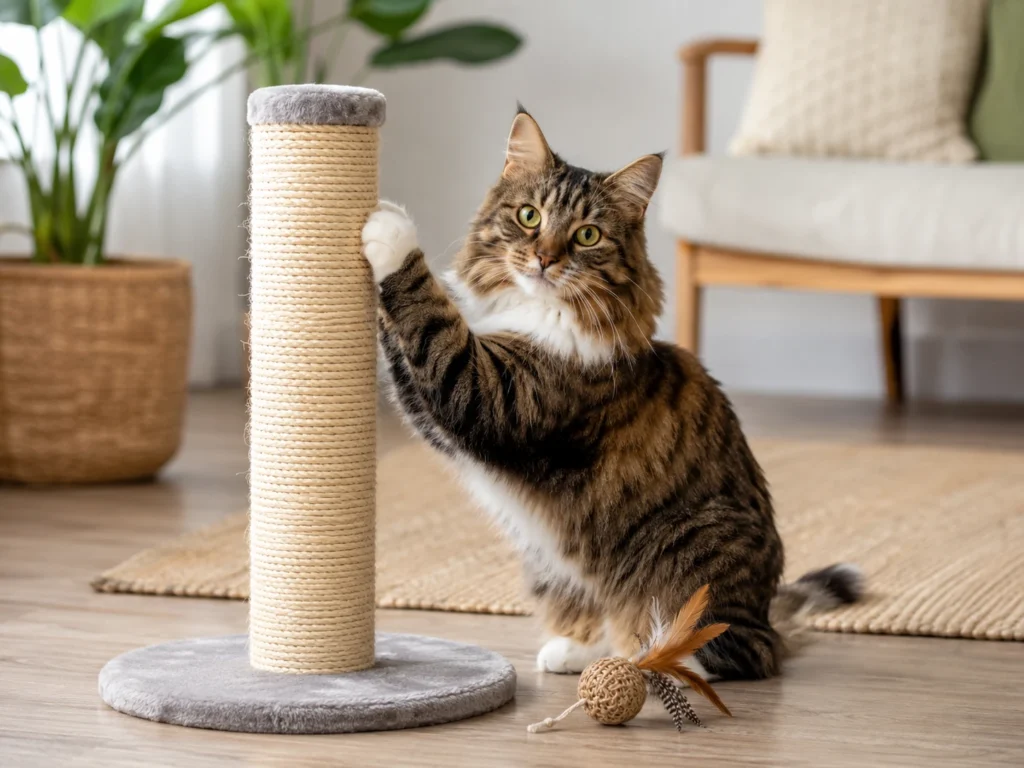
A well-used scratching post can look surprisingly rough. Sisal becomes fuzzy, cardboard develops deep grooves, and fabric may look faded or heavily scratched. That does not necessarily mean the scratcher has reached the end of its useful life.
Cats often value worn scratching surfaces because they provide good grip and carry familiar visual and scent marks. Replacing a favorite post simply because it looks untidy can remove a resource your cat still finds useful.
The important question is not, “How old is this scratching post?” It is, “Is it still stable, functional and safe?”
Quick Answer
There is no universal schedule for replacing a cat’s scratching post. A lightly used scratcher may remain serviceable for years, while a heavily used favorite can deteriorate much sooner.
You can usually keep a worn scratching post if:
- The base, frame and attachments remain secure.
- It stays stable while your cat stretches and pulls against it.
- The scratching surface still provides useful resistance.
- Ordinary fraying has not developed into long loose strands, detached sections or hazardous loops.
- No staples, nails, screws, wire, sharp edges or splintered components are accessible.
- Your cat continues to use it comfortably.
Limited repair may be reasonable when the underlying structure is sound and the repair can restore secure construction without introducing sharp, toxic, detachable or entangling components.
Replace the resource when it has become unstable, structurally weak, severely unraveled, unable to provide a useful scratching surface or difficult to repair safely.
Scratching Posts Do Not Have a Fixed Lifespan
How quickly a scratching resource wears out depends on several factors:
- How often it is used
- Whether it is a primary or secondary scratching location
- The cat’s size and scratching intensity
- The material and construction quality
- Whether several cats share it
- Moisture, movement and general environmental wear
- Whether the scratching surface is replaceable or built into a larger structure
A cardboard scratcher used several times a day may wear down rapidly. A secondary sisal post in a quiet room may remain usable much longer. A scratching panel built into a cat tower may still look acceptable even though the tower’s base or joints have weakened.
This variation is why an invented six-month, one-year or two-year replacement rule would not be useful. Condition and function matter more than the date of purchase.
Use the Keep, Repair or Replace Decision
A simple three-part decision can help you avoid replacing a safe favorite too early or leaving a hazardous resource available for too long.
Keep It
Keep the scratching post when the wear is mainly cosmetic and the resource remains stable, secure and useful.
The ASPCA specifically advises against discarding a favorite scratching post merely because it has become unsightly. Cats may prefer shredded or familiar-looking surfaces because they can grip the material and recognize the resource.
Moderate fuzziness, scratch marks, shallow cardboard channels and faded fabric can all be signs of normal use rather than failure.
Repair It
Consider a limited repair when:
- The underlying base and frame remain strong.
- The damaged component can be restored or replaced completely.
- The finished surface will remain tight and secure.
- All fasteners and joins will be inaccessible during use.
- No loose ends, sharp edges, exposed adhesive or detachable pieces will remain.
- You can confidently test the finished resource for stability.
Replaceable cardboard inserts or manufacturer-supplied scratching panels are straightforward examples. Re-tightening original enclosed hardware according to the product’s instructions may also be reasonable.
Repair becomes a poor choice when it requires improvisation around weakened wood, cracked supports or severely damaged joints. If you cannot restore the resource without leaving accessible fasteners, loose material or uncertain structural strength, replacement is safer.
Replace It
Replace the scratching post or affected component when:
- It rocks, slides, twists or threatens to topple during use.
- The base is cracked, warped, weakened or separating.
- A vertical post has become loose at its connection with the base.
- A tower platform, joint or load-bearing component moves unexpectedly.
- Rope, carpet or fabric has detached substantially from the structure.
- Long loose strands or loops could catch around a claw, paw or leg.
- Staples, nails, screws, wire or sharp edges are exposed.
- Wood is severely splintered, cracked or breaking apart.
- Cardboard has collapsed, become damp or no longer offers usable resistance.
- The surface rotates, bunches or slips rather than staying firm beneath the claws.
- The resource cannot be cleaned after contamination or moisture damage.
- A safe repair is uncertain.
An unsafe scratching resource should be removed promptly. Do not keep it available merely to make the transition to a new post more gradual. If the scratching surface forms part of a cat tree, How to Clean a Cat Tree explains routine maintenance and the point at which contamination, mold, water damage, or instability makes cleaning insufficient.
How to Inspect a Scratching Post
Inspect the whole resource rather than looking only at the most visibly scratched area. Do this while your cat is elsewhere so you can move and test it without encouraging them to approach.
Check the Base
Place the scratcher on its normal surface and press it gently from different directions.
The base should remain flat and resist tipping, rocking or sliding. Look underneath it for cracks, loose feet, water damage, warped boards or fasteners beginning to pull through the material.
Cats Protection recommends a scratching post with a heavy, stable base that will not wobble or topple during use. This matters because a cat may pull hard while extending their body through a full scratching movement.
A post that seems stable under light contact may still move when a larger cat stretches against it. Watch the resource during normal use as well as testing it by hand.
Check the Frame and Joints
Hold the base steady and gently test the post, panel or supporting frame.
A small amount of movement in a product designed to flex is different from a loose joint that clicks, rotates or becomes progressively less secure. Check where the upright section meets the base and where scratching panels connect to larger pieces of cat furniture.
Stop using the resource if a joint is opening, a platform is tilting or a structural component appears cracked.
Check Every Attachment
Inspect the top, bottom, sides and underside where possible.
Look for:
- Staples or staple ends
- Nail or screw heads
- Wire
- Broken clips
- Sharp plastic
- Detached edging
- Splintered wood
- Hardened or exposed adhesive
- Loose fittings that a cat could pull free
Run your eyes closely over the surface before touching it. Do not slide an unprotected hand across heavily damaged material where a hidden fastener may be exposed.
Check the Scratching Surface
A usable surface should remain firmly attached and provide resistance when the cat pulls against it.
Wear is not automatically a problem. The more useful questions are:
- Does the material remain attached to the structure?
- Can the cat still get a satisfying grip?
- Does the surface stay in place under pressure?
- Are loose strands short and contained, or long and accessible?
- Are any hard or sharp components becoming exposed?
- Is the damage spreading into the frame or base?
If the answer reveals a loss of function or a developing hazard, repair or replacement is appropriate.
How Wear Differs Between Materials
Different scratching materials deteriorate in different ways. The same visual standard should not be applied to all of them.
Sisal Rope or Fabric
Sisal commonly becomes fuzzy with use. Moderate fuzziness can remain functional and attractive to a cat.
Look more closely when:
- Rope sections begin slipping or rotating around the post.
- Wide areas have unraveled.
- Long loose strands hang from the surface.
- The inner post or fasteners are exposed.
- The rope has separated enough to create gaps or loops.
- The cat can no longer pull against a firm surface.
A small amount of surface fraying may be normal. Mobile rope, extensive unraveling or exposed construction requires action.
Cardboard
Corrugated cardboard is designed to be gradually destroyed. Scratched channels, loose crumbs and an untidy appearance are expected.
Replace the insert or scratcher when:
- Most usable ridges have been crushed flat.
- Large layers are separating.
- The structure collapses or bends during use.
- The scratcher slides because its form has broken down.
- It has become wet, heavily soiled or difficult to keep hygienic.
- Your cat repeatedly searches for another surface because the cardboard no longer provides resistance.
Some cardboard products have reversible or replaceable inserts. Using those features can extend the life of the surrounding frame.
Carpet and Fabric
Carpet and fabric can remain useful after visible wear, but deterioration may be less obvious than with cardboard.
Inspect for:
- Long pulled threads
- Enlarging loops
- Detached strips
- Fabric lifting away from the backing
- Exposed staples or hard backing
- Bunched material that moves under the cat
- Frayed edges that the cat can pull farther apart
Cats Protection notes that overgrown or painful claws may catch on carpets and other fabrics. If a cat begins snagging repeatedly, inspect both the scratching surface and the cat’s claws rather than assuming only one is responsible.
Wood
Scratches and shallow grooves are normal on a suitable wooden scratching surface. They may make the surface more appealing.
Replace or professionally rebuild the resource if the wood develops:
- Deep structural cracks
- Severe splintering
- Pieces that break away
- Exposed sharp edges
- Rot, swelling or moisture damage
- A weakened connection to the base
Do not apply paint, varnish, wood treatment or adhesive simply to improve the appearance. Any material used around a scratching surface must be appropriate for an object a cat will repeatedly touch, claw and investigate closely.
Scratching Surfaces Built into Cat Furniture
When a scratching surface forms part of a tower, climber or larger piece of furniture, inspect the entire structure.
A worn rope section may be replaceable while the tower itself remains sound. However, a damaged upright may also support platforms or sleeping areas. Movement at the base, leaning supports, loose platforms or weakened joints can create a larger fall or collapse risk.
Use When Should You Replace a Cat Tree? for the condition-led decision about the existing complete structure. For a broader overview of desirable tower features, see What Makes A Good Cat Tower?.
When Is Repairing a Scratching Post Reasonable?
A repair is reasonable only when it produces a secure final resource—not merely a better-looking one.
Good candidates for limited repair include:
- Replacing a removable cardboard insert
- Installing a compatible manufacturer-supplied panel
- Replacing a scratching component designed to be removed
- Tightening original enclosed hardware according to the manufacturer’s instructions
- Correcting a small surface problem when the supporting structure is completely sound
After any repair, test the base, joints, attachments and surface again. Check that nothing can rotate, detach or become accessible when the material is pulled.
Avoid improvised repairs that leave staples, nails, screws, wire, cable ends, sharp plastic or hardened adhesive within reach. Loose rope wrapped over damaged rope may hide rather than correct the underlying problem. Repairing a cracked structural post cosmetically does not restore its original strength.
If you are uncertain whether the repair can withstand full-force scratching, replace the affected component or the entire resource.
How to Introduce the Replacement
When the old scratching post is still safe, place the replacement beside it rather than immediately taking the familiar one away.
Where possible, match the qualities your cat already values:
- The same vertical, horizontal or angled orientation
- A similar texture
- Enough length for the cat’s normal scratching movement
- Strong resistance and stability
- The same useful location
The Feline Veterinary Medical Association’s Cat Friendly Homes guidance emphasizes that cats have individual preferences for scratching shapes and materials. A technically good replacement may still be rejected if it differs too much from the familiar resource.
Allow your cat to investigate and use the new scratcher voluntarily. Calm play nearby, praise or catnip for cats that respond to it may help, but do not force the cat’s paws against the surface.
Once the new resource is being used reliably, you can remove the old one. There is no required number of transition days; the cat’s behavior and the old post’s continuing safety should guide the timing.
If the old resource is unsafe, remove it immediately and put the replacement in the same location if possible. Safety takes priority over gradual transition.
If your cat ignores an otherwise safe replacement, Why Doesn’t My Cat Use the Scratching Post? covers placement, height, orientation, material and encouragement in more detail.
Do Not Accidentally Remove an Important Scratching Option
Before removing a post, consider what role it serves in the home.
A heavily used post beside a sleeping area may be more important than a lightly used scratcher in a spare room. Removing it can leave the cat without an acceptable option at the location where they naturally want to scratch.
In a multi-cat home, the resource may be used by more than one cat or may allow a quieter cat to scratch without approaching another cat’s preferred area.
Review How Many Scratching Posts Does a Cat Need? if removing one resource would change the household’s distribution of useful scratching options.
When possible, put the safe replacement in place before retiring the old resource.
Special Considerations for Different Cats
Kittens
A small post that worked for a young kitten may become too short or light as the kitten grows. Replacement may be necessary even if the material itself remains in good condition.
The new resource should accommodate the cat’s current size and remain stable during more energetic scratching and climbing.
Senior Cats and Cats with Limited Mobility
A senior cat may prefer a lower, horizontal or gently angled scratcher rather than stretching high against a vertical post.
Do not assume that reduced use always means the post has worn out. Changes in mobility, balance or comfort can alter how a cat scratches. A stable surface that does not slide is especially important for a cat with limited strength or joint movement.
Heavily Used Favorite Posts
Favorite posts need more frequent inspection because repeated pulling can loosen joints or attachments gradually. Their worn appearance may be part of their appeal, so preserve them while they remain safe and functional.
Introducing a replacement alongside the favorite before it reaches structural failure can make the eventual transition easier.
Lightly Used Secondary Scratchers
Low use does not guarantee good condition. A secondary scratcher may still develop moisture damage, warping, loose fittings or instability over time.
Inspect it periodically even if its scratching surface looks almost new.
When the Problem May Not Be the Scratching Post
A sudden change in scratching behavior deserves attention, particularly when the post itself remains stable and usable.
Contact a veterinarian if your cat:
- Suddenly stops or becomes reluctant to scratch
- Limps or avoids placing weight on a paw
- Reacts painfully when a paw or leg is touched
- Has a broken, bleeding, swollen or damaged claw
- Develops very thick or overgrown claws
- Repeatedly catches their claws in surfaces
- Becomes less active, stiff or hesitant to stretch
- Shows a marked change in behavior or mobility
Cat Friendly Homes explains that behavior and mobility changes can be important signs of pain, especially because cats may hide discomfort. Cats Protection also advises veterinary assessment when claws change or may be growing into the paw pads.
Routine claw care can help some cats, but it does not replace the need for suitable scratching resources. If claw maintenance is the concern, follow How to Trim Your Cat’s Nails Safely rather than attempting to solve it by removing the scratching post.
Sources
- ASPCA: Destructive Scratching
- Cats Protection: Scratching
- Cat Friendly Homes: All You Need to Know About Scratching Posts
- Cat Friendly Homes: How Do I Know If My Cat Is in Pain?
- Cat Friendly Homes: Degenerative Joint Disease in Cats
- Cats Protection: How to Trim Cat Claws
Helpful Related Guides
- How Many Scratching Posts Does a Cat Need?
- Why Doesn’t My Cat Use the Scratching Post?
- Why Does My Cat Scratch the Furniture?
- What Makes A Good Cat Tower?
- How to Trim Your Cat’s Nails Safely
Final Thoughts
Replace a scratching post because it has stopped being safe or functional—not simply because it looks well used.
A fuzzy sisal surface, deeply scratched cardboard pad or visibly marked wooden panel may still be exactly what your cat wants. Keep it while the structure remains stable, the material stays securely attached and no hazardous components are exposed.
Repair limited wear only when the finished result will be fully secure. Replace the resource when damage affects stability, grip, attachments or structural strength.
When the old post remains safe, introduce the replacement beside it and let familiarity develop naturally. When the old post is unsafe, remove it promptly and provide a suitable alternative in the same important location.