There is no universal research-backed number of scratching posts that suits every cat and every home. The right number depends on whether the available scratchers are stable, accessible, appropriately distributed and matched to how each cat prefers to scratch.
For one cat, begin with at least one genuinely suitable scratching resource. In many homes, two useful options in different locations provide a stronger starting setup, especially if the cat uses several rooms or enjoys more than one scratching orientation.
For multiple cats, avoid relying on one shared scratching station. Provide several separated resources so that one cat cannot easily block another cat’s access.
The goal is not to reach a numerical quota. It is to give every cat convenient access to scratching surfaces they will actually use.
Quick Answer
A practical starting approach is:
- One cat in a small, single-level home: At least one excellent scratching resource may be sufficient if it is accessible, well matched and regularly used. A second option can provide another location or scratching style.
- One cat using several rooms or floors: Consider scratching resources in more than one regularly used area.
- A cat that scratches both vertically and horizontally: Provide at least one suitable option for each preferred orientation.
- Multiple cats: Provide multiple scratching resources in separated locations rather than expecting every cat to share one station.
- Cats with different ages, sizes or mobility levels: Make sure each cat has an option they can reach and use comfortably.
These are starting points, not fixed rules. A household with four marketed “scratching posts” may still have inadequate provision if three wobble, sit together in one corner or are never used.
Why Counting Physical Posts Can Be Misleading
A scratching post should count only if it functions as a useful resource for the cat.
A short, unstable post hidden in a room the cat rarely enters does not become valuable simply because it appears on a household inventory. Likewise, several scratchers grouped beside one another may offer different textures, but they still serve only one part of the home.
It helps to distinguish between a scratching surface and a scratching station:
- A scratching surface is the material and orientation the cat can scratch.
- A scratching station is the location where that surface is available.
A stable cat tower might include several scratching surfaces, but they are all concentrated at one station. That can provide useful variety without giving the cat access in another room or allowing a less confident cat to avoid a companion guarding that area.
Count both suitability and distribution—not just objects.
What Qualifies as a Useful Scratching Resource?
A scratching resource may be:
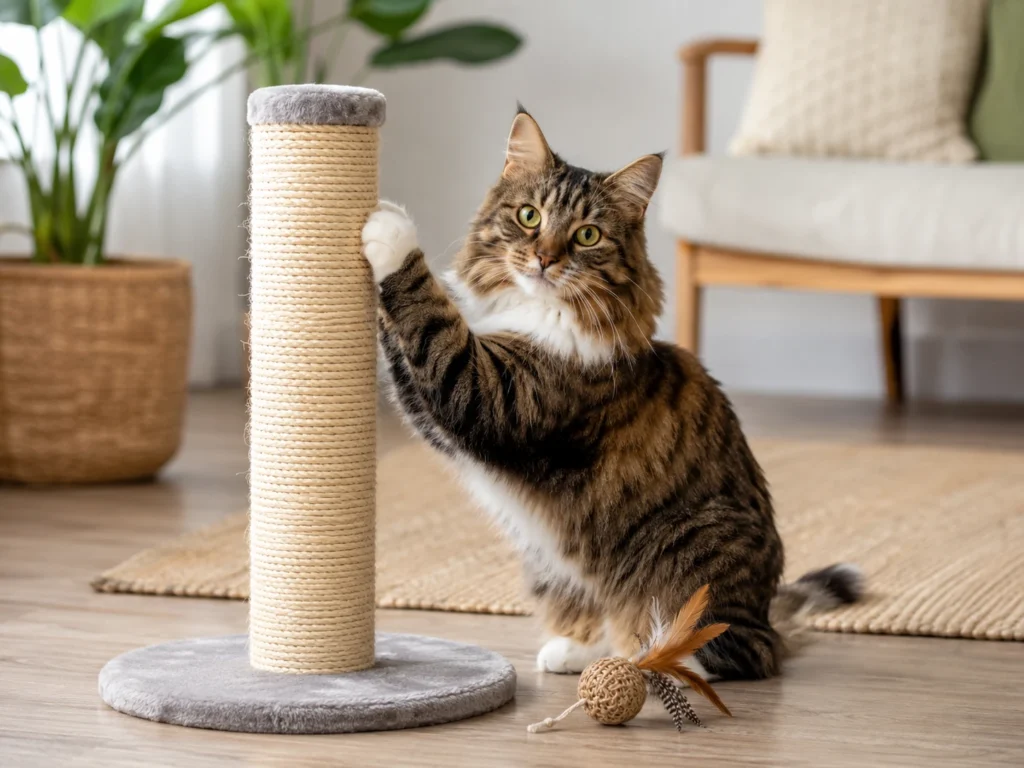
- a vertical scratching post;
- a horizontal scratching pad;
- an angled scratcher;
- a securely mounted scratching panel; or
- an accessible scratching surface incorporated into stable cat furniture.
To count as genuinely useful, it should meet several basic conditions.
It Is Stable Enough for Its Intended Use
Cats pull against scratching surfaces with considerable force. A vertical post that rocks or tips and a horizontal pad that slides across the floor may feel unsafe or unsatisfying.
Stability is especially important for tall posts and scratching surfaces built into cat towers. A product that looks substantial but moves whenever the cat leans against it may not function as a reliable resource.
It Allows a Comfortable Scratching Movement
A cat that likes to stretch upward needs a post tall enough to use without crouching awkwardly. A cat that prefers scratching rugs or carpets may be better served by a secure horizontal surface.
Cat Friendly Homes recommends offering different scratching options because preferences for size, shape and texture vary between individual cats.
This does not mean every household needs every possible type. Watch how your cat scratches and provide options that fit the patterns you actually observe. If the current resource is unsuitable, What Type of Scratching Post Is Best for Your Cat? provides a practical framework for comparing angles, dimensions, materials, stability, and placement before buying another one.
It Remains Easily Accessible
A scratcher does not provide reliable access if it is:
- behind a closed door for much of the day;
- difficult for the cat to approach;
- available only on another floor;
- positioned where another cat regularly blocks the route; or
- located somewhere the cat rarely spends time.
A resource should be available when the cat is likely to want it, not only when someone remembers to open a particular room.
It Is Safe and in Usable Condition
Do not count a scratcher as suitable if it has:
- an unstable or damaged base;
- exposed staples or sharp fasteners;
- sharp or broken edges;
- loose pieces that could be swallowed;
- hanging cords or strands that create an entanglement risk; or
- a surface so badly damaged that it can no longer be used safely.
Avoid applying essential oils, heavily fragranced products or other potentially unsafe substances to attract the cat. A suitable resource should work through its location, stability, material and design.
How Many Scratching Resources Should One Cat Have?
One well-matched scratching resource is the minimum practical provision for one cat. Whether that is enough depends on the cat and the home.
A single resource may work in a compact home when:
- the cat spends most of their time in one connected area;
- the scratcher is available throughout the day;
- it supports the cat’s preferred scratching style;
- the cat uses it regularly and comfortably; and
- there is no evidence that another location or orientation is needed.
However, two separated options are often a more useful starting setup than one. They can cover different parts of the home or allow the cat to choose between vertical and horizontal scratching.
This does not require filling every room with cat furniture. The second resource should have a clear purpose rather than being added simply to increase the total.
For example, it might provide:
- access in another regularly used room;
- an option on another floor;
- a horizontal alternative to a vertical post;
- easier access beside a preferred resting area; or
- a safer, more comfortable option for a cat whose mobility is changing.
When One Cat May Need More than One Option
Some cats use scratching for several purposes in different parts of their territory. One resource may not conveniently serve all of those situations.
The Cat Uses Several Areas of the Home
A scratcher in the living room may not help a cat who spends much of the night in a bedroom or regularly uses a different floor during the day.
You do not automatically need one post in every room. Instead, look for meaningful zones in the cat’s routine. If a cat regularly rests, plays or moves through two separate parts of the home, access in both areas may be useful.
The Cat Has More than One Scratching Style
Some cats consistently scratch upright surfaces. Others prefer flat or angled surfaces. Some use more than one orientation.
If your cat scratches a vertical post but also seeks out rugs or horizontal furniture, the current post may satisfy only part of their preference. In that case, adding a horizontal resource is more useful than buying another identical upright post.
One Resource Is Not Always Available
Closed doors, visitors, children, dogs, household activity or temporary furniture changes can make a normally useful scratcher difficult to reach.
An additional resource provides an alternative when the primary location is unavailable or feels uncomfortable.
The Cat Scratches in Several Meaningful Places
Scratching in several parts of the home does not automatically mean the cat needs an enormous number of posts. It does suggest that one centralized station may not be serving every relevant area.
If furniture scratching is the main concern, Why Does My Cat Scratch the Furniture? explains the behavior and how to redirect it without punishment.
Why Distribution Matters as Much as Quantity
The Feline Veterinary Medical Association’s environmental-needs guidance identifies scratching areas as key environmental resources and recommends providing important resources in multiple, separated locations.
Three scratching posts placed side by side may provide a useful choice of materials, but they do not offer access in three different parts of the home. They can also be guarded as one group in a multi-cat household.
Think about distribution in terms of:
- the rooms the cat regularly uses;
- separate floors;
- sleeping and resting areas;
- active family spaces;
- whether doors sometimes restrict access;
- each cat’s preferred territory; and
- whether another animal can control the route.
Where Should You Put Your Cat’s Scratching Post? explains how to choose meaningful locations using resting areas, household routes, existing scratching targets, and multi-cat access.
Several scratchers can share one room when they serve different orientations or preferences. However, they should not be mistaken for fully separated resources.
How Many Scratching Posts Do Multiple Cats Need?
There is no reliable calculation based only on the number of cats. A harmonious pair living in an open home may share some resources comfortably, while two cats with social tension may need more separation and more individual choice.
A simple “one post per cat” rule can reveal obvious undersupply, but it does not prove that the setup is adequate. Two posts placed together can still be treated as one guarded station. Conversely, a large, stable scratching structure may offer several surfaces but remain inaccessible if one cat controls the surrounding area.
Instead, ask:
- Can every cat reach a suitable scratching resource without passing another cat at close range?
- Could two cats use different scratching resources at the same time?
- Are resources distributed across the areas used by different cats or social groups?
- Can a less confident cat approach and leave without being cornered?
- Does each cat have access to their preferred orientation and height?
- Are there alternatives if one cat blocks a route or occupies a favored station?
FelineVMA guidance on intercat tension notes that staring, blocking and stalking can limit access to environmental resources. These behaviors may be subtle. A cat does not need to fight openly to make another cat reluctant to approach.
In a multi-cat home, start with multiple separated scratching stations and observe how the cats use them. Add another when a cat appears to wait, avoid a location, use an unsuitable household surface instead or remain limited to one part of the home.
Do not force cats to share as a test of whether they get along. Easy access matters more than proving that one scratching post can technically accommodate everyone.
Can a Scratching Surface on a Cat Tower Count?
Yes. A stable, accessible scratching surface incorporated into suitable cat furniture can count as a scratching resource.
It should:
- remain stable when the cat pulls against it;
- provide enough usable surface for the intended scratching movement;
- be accessible without a difficult climb;
- suit at least one of the cat’s preferred orientations; and
- be positioned where the cat can use it comfortably.
A cat tower may combine scratching, climbing, resting and observation in one useful structure. What Makes A Good Cat Tower? explains how to assess its stability, size and scratching surfaces.
For distribution purposes, however, one tower remains one localized station. It does not provide an alternative elsewhere in the home, and it may not be enough by itself in a multi-cat household.
Kittens, Senior Cats and Changing Needs
The right number and type of scratching resources may change throughout a cat’s life.
Kittens
Kittens grow quickly and may experiment with several scratching styles. A small resource that works temporarily may become too short or light as the kitten becomes larger and stronger.
Provide stable, age-appropriate options and reassess them as the kitten grows. Do not assume that the resource bought during the first few months will remain suitable for adulthood.
Senior Cats and Cats with Limited Mobility
Older cats may still want to scratch but find a tall vertical stretch uncomfortable. Joint stiffness, weakness or difficulty moving between floors can make a formerly useful resource less accessible.
Cat Friendly Homes’ mobility guidance recommends convenient horizontal scratching options for cats that may find tall vertical posts painful to use.
An accessible horizontal pad near a resting area may therefore count as a more useful resource than an impressive post the cat can no longer use comfortably. In a multi-level home, the cat may also benefit from scratching access on the floor where they now spend most of their time.
Changing Preferences
A cat may begin using a different orientation, room or material over time. Household changes can also alter which resources feel convenient or secure.
Treat the current setup as something to observe, not a permanent calculation. A resource that was once adequate may no longer meet the cat’s needs after a move, mobility change, new pet or change in the rooms the cat can access.
Sudden reluctance to scratch should not be dismissed as a preference change. Visible pain, limping, damaged claws, repeated paw licking or a marked behavioral change warrants veterinary assessment.
Signs the Current Provision May Be Insufficient
The household may need another resource—or a better-matched one—if:
- the cat uses one scratcher but continues scratching suitable-looking surfaces elsewhere;
- the cat regularly scratches both vertically and horizontally but has only one orientation available;
- the only useful scratcher is inaccessible for part of the day;
- the cat uses several floors but has scratching access on only one;
- one cat watches, follows or blocks another near the scratching station;
- a less confident cat scratches only when another cat is absent;
- one scratching resource receives heavy use while the others are consistently ignored;
- a senior cat approaches a post but appears unable to stretch or balance comfortably;
- the cat’s preferred resource has become unsafe or badly damaged; or
- the household has several marketed scratchers, but none is stable, accessible or appropriately sized.
Furniture scratching alone does not prove that the total number is too low. The available resource may instead be unsuitable. Why Doesn’t My Cat Use the Scratching Post? covers the detailed checks for location, texture, height, stability and orientation.
How to Test an Additional Scratching Resource
Do not remove a scratching resource the cat already uses merely because you want to test another one. The existing surface carries familiar scent and has already proved its value.
Give each new resource a specific job:
- Location gap: Add access in another regularly used area.
- Orientation gap: Offer horizontal or angled scratching alongside an existing vertical post.
- Mobility gap: Provide a lower, easier-to-reach option.
- Social-access gap: Place another resource away from a cat that blocks or guards the original.
- Availability gap: Add access outside a room that is sometimes closed.
Introduce one purposeful change and observe which cats use it, when they use it and whether it reduces an access problem. An unused new resource does not necessarily mean no additional option was needed; it may mean that particular surface was poorly matched.
Keep successful resources in place unless they become unsafe. Familiar, regularly used scratching surfaces are more valuable than achieving a tidy arrangement or replacing everything with matching products.
If a familiar resource looks heavily worn, When Should You Replace Your Cat’s Scratching Post? explains how to distinguish harmless cosmetic wear from damage that requires repair or replacement.
A Final Scratching-Resource Check
Instead of asking whether you have reached the correct number, ask:
- Does every cat have easy access?
- Are the resources stable and safe?
- Do they support the orientations the cats actually use?
- Are meaningful parts of the home covered?
- Are separate options available where competition could occur?
- Can kittens, senior cats and mobility-limited cats use them comfortably?
- Are the cats using the resources without being forced?
- Is any cat showing pain or a sudden change that needs veterinary attention?
If the answer is yes throughout, the current number may be sufficient. If one question reveals a clear gap, add or adapt a resource to solve that gap rather than buying scratchers without a plan.
Helpful Related Guides
- Why Does My Cat Scratch the Furniture?
- Why Doesn’t My Cat Use the Scratching Post?
- What Makes A Good Cat Tower?
- How Can I Keep an Indoor Cat Entertained?
- How to Trim Your Cat’s Nails Safely
Sources
- FelineVMA: Your Cat’s Environmental Needs
- FelineVMA: Claw Counseling—Living Alongside Cats with Claws
- FelineVMA: Intercat Tension Guideline Brief
- Cat Friendly Homes: Living with a Clawed Cat
- Cat Friendly Homes: Home Modifications for Your Cat
Final Thoughts
A cat does not need a particular number of objects labeled “scratching post.” They need reliable access to scratching surfaces that are safe, stable, comfortable and appropriate for how they use the home.
For one cat, begin with at least one excellent resource and consider a second separated option when another location or scratching style would serve a clear purpose. For several cats, provide multiple distributed resources and pay close attention to blocking, competition and individual preferences.
Let the cats’ access and observed use guide the final number. A few well-chosen resources in meaningful locations are more valuable than a large collection that wobbles, remains inaccessible or goes unused.