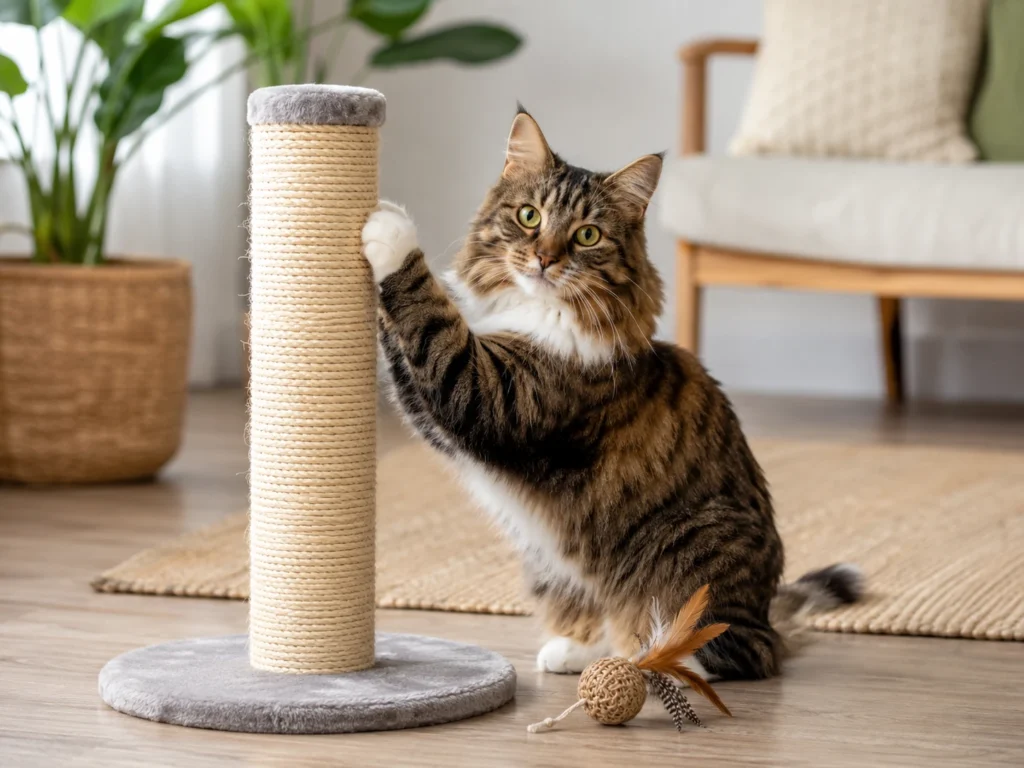
Putting a scratching post in the room is not enough. It needs to be in a place that already matters to your cat.
The best starting point is usually beside a surface your cat already scratches, near a favorite sleeping area, or in a part of the home your cat visits regularly. In a multi-cat home, every scratching resource should also be reachable without another cat controlling the approach.
Placement is not a fixed rule for every home. It is a practical test: start with your cat’s existing habits, choose a safe and accessible location, and watch what happens.
Quick Answer
Good places for a cat scratching post include:
- Directly beside furniture, carpet, or another surface your cat already scratches.
- Near a favorite bed or resting place, especially if your cat scratches after waking.
- In a living area where your cat spends time with people.
- Along a familiar route between resting, play, and social areas.
- Near a doorway or window if the location feels secure rather than tense.
- In a separate, easy-to-approach location when another cat might block access.
Do not hide the post in an unused corner simply because it looks tidier there. Keep it stable, leave enough space for a comfortable approach and full scratching movement, and make sure it does not obstruct a door or become a trip hazard.
Start With Your Cat’s Existing Scratching Map
Before moving furniture or buying another post, watch where your cat already scratches.
For several days, note:
- The exact surfaces your cat chooses.
- Which rooms those surfaces are in.
- Whether scratching happens after waking, during play, or when entering an area.
- Whether your cat stretches vertically, leans at an angle, or scratches horizontally.
- Which approach and exit route the cat uses.
- Whether another cat, dog, person, or household activity interrupts access.
This gives you a placement map based on behavior rather than guesswork.
Suppose your cat scratches the same sofa arm after sleeping on the sofa. The useful clue is not only the sofa fabric. The location connects a resting place, a familiar object, and a routine the cat repeats. A post in a distant spare room may offer a suitable surface but still miss the reason that area is attractive.
The same principle applies when a cat scratches a hallway rug, bedroom doorway, or chair near a window. Ask what the location provides and place the alternative where it can serve the same moment.
The Best Places to Put a Scratching Post
Beside an Existing Scratching Target
If your cat scratches the sofa, bed, carpet, door frame, or another unwanted surface, place the scratching post or pad directly beside that target.
“Nearby” should mean close enough to be an obvious alternative. A post across the room may not compete with the surface your cat already reaches automatically. For a sofa arm, position the post beside the scratched end of the sofa rather than beside the opposite end. For carpet scratching, place a secure horizontal pad over or immediately next to the chosen area.
This starting point is consistent with Cats Protection’s scratching guidance, which recommends placing the alternative next to the area already being scratched.
The scratching option should also match the movement your cat makes. A vertical post is unlikely to replace a rug if the cat prefers scratching flat surfaces. If the current product does not match your cat’s angle, size, or texture preference, What Type of Scratching Post Is Best for Your Cat? explains how to choose a better fit.
You may not want the post to remain beside the furniture forever. Start where it is most likely to be understood and used. Once the new habit is reliable, you can test a gradual move.
Near a Sleeping or Resting Area
Cats often stretch and scratch after waking, so a scratching resource near a favorite bed, sofa, chair, or sleeping perch can be especially useful.
FelineVMA’s guidance for living with a clawed cat specifically recommends placing a scratcher near the sleeping area when unwanted scratching occurs there.
It does not need to touch the bed. It does need to be available on the cat’s normal route away from that resting place. Avoid positioning it behind furniture, on the far side of a closed door, or somewhere the cat must jump or squeeze through a narrow gap to reach.
If your cat sleeps in several parts of the home, observe which resting area is most strongly associated with scratching. You do not automatically need a post beside every bed. Place resources where they answer a real pattern.
In a Socially Important Part of the Home
A scratching post often works better in a room the cat actually shares with the household than in an isolated utility room or unused corner.
Living rooms, family rooms, home offices, and bedrooms can all be suitable when the cat spends time there. A position near the edge of the activity area is often practical: the resource remains part of the room without sitting in the middle of a walkway.
The goal is not to choose the busiest possible spot. A cat should be able to approach, scratch, and leave without being startled by a swinging door, stepped over by people, or crowded by a dog. Look for a location that is socially relevant but physically comfortable.
Along Familiar Routes and Room Transitions
Some cats scratch as they move between important parts of their routine. A resource may work well near the boundary between a resting area and a living area, beside the route from a bedroom into a hallway, or near the transition between a play area and a quiet area.
Do not block the route itself. Leave enough open space for the cat to pass on either side and enough room to stretch without hitting furniture. A post wedged into a narrow passage may technically be visible but still feel awkward to use.
Room-transition placement is particularly worth testing when the cat scratches a door frame, the corner of a wall, or furniture at the edge of a room.
Near a Window or Door—Only When It Feels Secure
Windows and doors can be meaningful locations, and some cats choose to scratch near them. However, they are not automatically good positions.
Watch the cat’s body language and the surrounding activity. A window may be uncomfortable if unfamiliar cats regularly appear outside. An exterior door may bring unpredictable noise, smells, or foot traffic. An internal doorway may become a point where one cat waits for another.
Use the location when your cat approaches and scratches comfortably. Choose a calmer alternative if the cat hesitates, crouches, watches the outside intensely, avoids turning their back, or is repeatedly interrupted.
A Practical Room-by-Room Placement Map
| What You Observe | Strong Starting Location | What to Check |
|---|---|---|
| Scratching one sofa arm | Directly beside that end of the sofa | Match the scratching angle and keep the base clear of feet |
| Scratching after waking | Near the favored bed or resting place | Put it on the cat’s natural route away from the bed |
| Scratching a rug or carpet | A secure horizontal pad on or beside the chosen area | Prevent sliding and avoid creating a raised trip edge |
| Scratching a door frame | Beside the frame without obstructing the doorway | Check door swing, foot traffic, and whether the cat feels exposed |
| Scratching in the bedroom at night | Near the sleeping area or bedroom exit | Keep access available when the door is closed |
| Scratching near a window | Beside the selected window if the cat appears relaxed | Watch for tension caused by outdoor cats or sudden noise |
| Scratching in several household zones | Separate resources in the meaningful zones | Decide distribution from actual use, not a post-per-room rule |
| One cat avoids the shared post | A separate station on another route or in another area | Make sure the cat can approach and leave without being blocked |
Use the map as a starting framework, not a promise that one location will suit every cat. The result that matters is voluntary, comfortable use.
Placement in a Multi-Cat Home
Several cats may share some resources peacefully, but one apparently central scratching station does not guarantee equal access.
FelineVMA’s environmental-needs guidance supports distributing important resources so cats can reach them without competition or perceived threats.
A cat can control a resource without an obvious fight. Staring, waiting in a doorway, following, blocking a narrow route, or occupying the surrounding area may be enough to keep a less confident cat away.
When placing scratching resources, ask:
- Can each cat reach a suitable scratcher without passing another cat at close range?
- Can the cat leave in more than one direction?
- Are all the scratchers grouped into one easily controlled station?
- Do different cats spend time in different rooms or social areas?
- Does each cat have access to a comfortable scratching angle?
- Does one cat wait until another has left before approaching?
Separate placement is more useful than simply lining several posts up together. If you need to decide how many distinct resources the household requires, How Many Scratching Posts Does a Cat Need? provides the quantity and distribution framework.
Avoid putting a post in a dead-end corner where a cat can be trapped. A quieter cat may prefer a less busy location, but that location should still be part of the cat’s normal territory and have a clear approach and exit.
Placement for Kittens, Senior Cats, and Cats With Limited Mobility
Kittens
Place a kitten’s scratching resource somewhere easy to reach during normal play, rest, and exploration. The structure should remain stable if the kitten climbs or launches onto it, and it should not sit beside a fragile object, hot appliance, open stair edge, or unstable piece of furniture.
A full-size post can be suitable when it is secure and accessible. Do not rely on a lightweight kitten post that tips when used energetically.
Keep cords, blind pulls, electrical cables, and small detachable objects away from the scratching area. The post should provide an acceptable activity without creating another hazard beside it.
Senior Cats and Cats With Limited Mobility
An older cat may continue to value the same location while needing a more accessible scratching position.
Cats Protection’s guidance for elderly cats recommends accessible scratching mats or lower-gradient options when an older cat struggles to stretch upward, along with keeping essential resources on the level the cat can use comfortably.
Place the resource:
- Close to a favorite resting place.
- On the floor or level where the cat spends most of their time.
- On a secure, nonslip surface.
- Along a short, unobstructed route.
- Away from stairs the cat finds difficult.
- Somewhere the cat does not need to jump, climb, or balance narrowly to use it.
A horizontal pad or gently angled scratcher may be more comfortable than a tall vertical stretch. Preserve the useful location even if the type of resource changes.
Do not assume that reluctance to use a familiar post is simply part of aging. A sudden change in scratching, stretching, balance, or movement may indicate discomfort and deserves veterinary attention.
How to Test Whether a Location Works
Keep the test simple. Place the resource in the chosen location and give your cat time to investigate it voluntarily.
Watch for:
- Approaching without hesitation.
- Sniffing, touching, stretching against, or scratching the resource.
- Repeated use at similar times of day.
- Comfortable full-body movement.
- Easy access and departure.
- Reduced use of the unwanted surface beside it.
You can reward voluntary interest with calm praise, a small treat, petting if your cat enjoys it, or a brief play session. Do not place your cat’s paws on the post, hold the cat against it, or punish use of another surface. Those actions do not help you judge whether the location is genuinely acceptable.
If the cat ignores the post, check the placement first: Is it close enough to the existing target? Is it available at the relevant time? Can the cat approach freely? Does a door, person, dog, or another cat interrupt access?
Then check the resource itself. Location cannot compensate for a post that wobbles, slides, is too short, or presents the wrong scratching angle.
How to Move a Scratching Post Gradually
Once your cat uses the post reliably, you may be able to move it toward a more convenient position.
Cats Protection advises moving a scratching post gradually after the cat begins using it. Move it a small distance, then allow time for the cat to continue using it. The useful distance and pace depend on the cat, the room, and how established the habit is. If use drops, return the post to the last successful position and wait before trying a smaller change.
Keep the final location connected to the reason the original position worked. A post that began beside the sofa may move to the nearby edge of the living area. Moving it immediately into an isolated room changes much more than its floor position.
Do not remove the established resource or relocate every scratching option at once. A gradual, reversible test gives you clearer information and avoids taking away a surface your cat already trusts.
Common Placement Mistakes
Hiding the Post
A post placed behind a chair, in a storage room, or in a part of the home the cat rarely enters may be convenient for people but irrelevant to the cat.
Choosing Appearance Over Access
A location may look balanced in the room while leaving too little space for the cat to stretch, approach, or leave comfortably.
Blocking a Door or Walkway
A post should not be struck by a door, squeezed between moving furniture, or placed where people regularly trip over its base.
Grouping Every Resource Together
Several scratchers in one corner provide surface choice but not access in different areas. In a multi-cat home, the whole group can also be controlled as one station.
Moving the Post Too Soon
If a post has just started to replace furniture scratching, a large immediate move can break the connection. Wait for reliable use and relocate it gradually.
Ignoring Changes in the Household
A location that once worked may become less useful after a move, new furniture, a closed door, a new pet, a change in sleeping habits, or reduced mobility. Reassess placement when the cat’s routes and routines change.
When Placement Is Not the Real Problem
A well-chosen location cannot fix every scratching-post issue.
The resource may still be unsuitable because it is unstable, too short, too small, worn, or different from your cat’s preferred angle or surface. Why Doesn’t My Cat Use the Scratching Post? covers the complete troubleshooting process when placement changes are not enough.
If the main problem is damage to a sofa, chair, carpet, or bed, Why Does My Cat Scratch the Furniture? explains the behavior and how to redirect it without punishment.
A stable cat tower can sometimes provide a useful scratching station alongside climbing and resting features. However, it still needs enough usable scratching surface and an accessible position. What Makes A Good Cat Tower? covers the broader tower-selection decision.
When a Change in Scratching Needs Veterinary Attention
Placement changes are appropriate when the current setup is inconvenient or poorly matched. They should not be used to explain away a sudden loss of normal behavior.
Cats Protection’s arthritis guidance advises veterinary assessment for possible pain and mobility changes rather than assuming they are simply part of aging.
Contact your veterinarian if your cat:
- Suddenly stops scratching or scratches much less.
- Abruptly avoids stretching upward.
- Limps, moves stiffly, or avoids putting weight on a paw.
- Has a broken, bleeding, swollen, overgrown, or unusually thick claw.
- Reacts painfully when a paw or leg is touched.
- Shows another marked change in movement or behavior.
An accessible horizontal or angled scratcher may make the home easier to use, especially for a senior cat, but it does not replace an assessment when pain or illness may be involved.
Sources
- FelineVMA Cat Friendly Homes — Living With a Clawed Cat
- FelineVMA Cat Friendly Homes — Preventing Unwanted Behaviors
- FelineVMA — Your Cat’s Environmental Needs
- Cats Protection — Why Do Cats Scratch?
- Cats Protection — Elderly Cats
- Cats Protection — Arthritis in Cats
Helpful Related Guides
- What Type of Scratching Post Is Best for Your Cat?
- How Many Scratching Posts Does a Cat Need?
- Why Doesn’t My Cat Use the Scratching Post?
- Why Does My Cat Scratch the Furniture?
- What Makes A Good Cat Tower?
FAQ
Final Thoughts
Put your cat’s scratching post where scratching already fits into the cat’s day.
Start beside an existing target, near a favorite sleeping area, or in a regularly used social or transition zone. Then check stability, approach space, household traffic, mobility, and whether another cat can block access.
The best placement is not the one that follows a universal room rule. It is the safe, meaningful location your cat chooses to use comfortably and repeatedly.