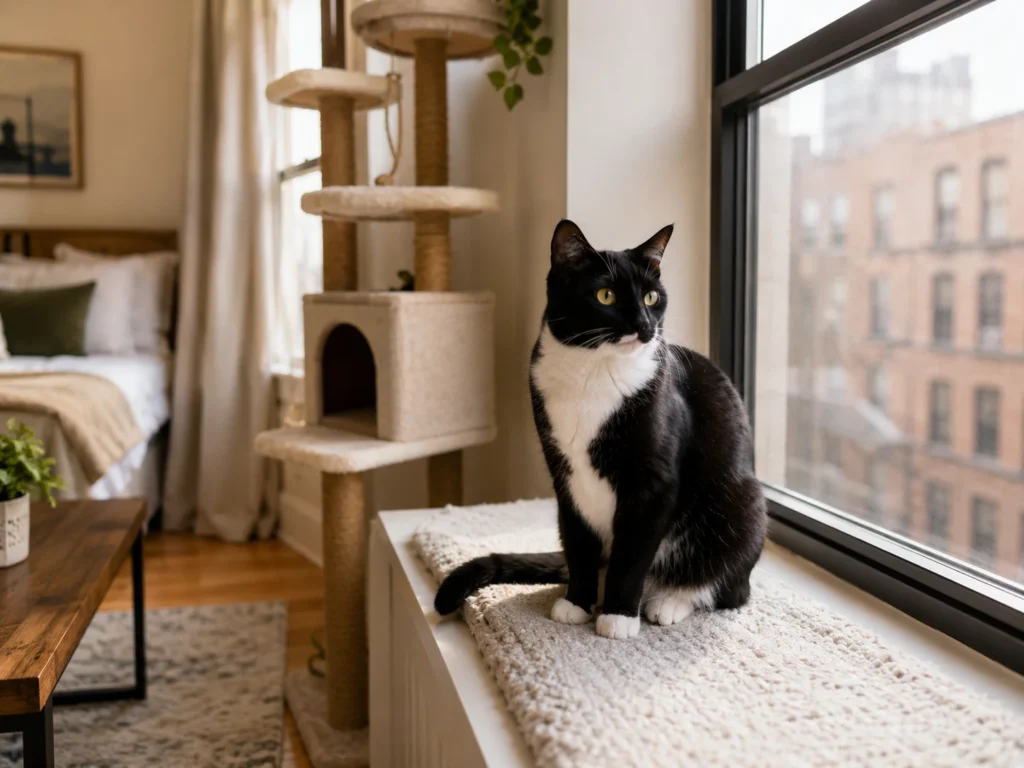
To help your cat adjust to rearranged furniture, keep familiar essentials and resting choices reachable, keep cats clear while objects move, and check the finished room before allowing exploration. Afterward, respond to the specific route or resource that is no longer working rather than repeatedly changing the whole room.
A sofa can stay in the same room while its new position changes how a cat reaches a bed or litter box. PDSA lists moved furniture, changed sleeping places, and lost access to a favorite hiding spot among possible stressors. That does not mean every cat will be upset.
The sequence below is Catcredo’s practical synthesis of feline environmental guidance and household safety precautions, not a tested adjustment protocol. It has no fixed settling deadline. Changes in eating, drinking, toileting, or movement need attention in their own right; see when to call your veterinarian rather than assuming the rearrangement explains them.
Before You Move Anything
Start by noticing how each cat uses the room now. Follow their ordinary movements with your eyes without calling them through a route or interrupting a rest. An optional photo or quick sketch can help you remember where things were; it is a household memory aid, not a health assessment.
- Routes: Which doorway and approach does the cat use to cross the room or reach another area?
- Essentials: Can the cat reach food, water, litter facilities, and scratching opportunities without a new obstruction?
- Resting places: How does the cat get to and leave a chosen bed or perch? Does another piece of furniture form part of that existing route?
- Retreats: Can the cat enter and leave a familiar hiding place, including when people are using the room?
Plan the smallest practical change that meets your household’s needs while retaining useful familiar options. “Manageable” means you can keep the cats clear during the work and leave them with usable access afterward. It does not mean moving one item per day or following a prescribed distance.
Look beyond whether an item still fits. A chair might now narrow a doorway, sit across the approach to a litter box, or leave a previously sheltered bed beside a busy path. Work out what will remain available before moving anything. You do not need to preserve an unsafe old arrangement simply because it is familiar.
The FelineVMA and iCatCare environmental-needs brochure emphasizes retreat, separated resources, and the cat’s freedom to choose interactions. Applying those principles here means keeping essentials accessible and food, water, and litter locations separate, rather than crowding everything into one newly convenient corner.
Keep ordinary feeding and household routines reasonably consistent. Retain suitable familiar bedding or other resting options, while continuing necessary cleaning. PDSA suggests rotating beds and blankets through washing so something familiar remains available; this is no reason to keep contaminated fabric or delay needed hygiene.
Preserve a usable approach to an existing retreat. If the rearrangement means you need another one, creating safe hiding places for your cat is a separate setup task worth completing before the move.
Keep Cats Clear While Furniture Moves
Before anyone lifts or pushes furniture, account for every cat and agree with the household how the moving area will stay clear. A familiar separate room can be an option if it is suitable for that cat, with water, litter facilities, a retreat, and their usual feeding needs met. Cats who are uncomfortable together need separate arrangements; do not put them together just to empty the living room.
Secure doors and windows against escape, and tell helpers which doors must remain closed. An open doorway, a distraction, or the expectation that a cat will come when called is not a dependable way to keep them out of the work. If you cannot arrange suitable separation without forcing or restraining the cat, postpone the move and make a different plan.
Check underneath, inside, and behind the item while it is stationary. Cats Protection specifically warns owners to check beneath a reclining chair before closing it. Do not operate a mechanism to find out whether a cat is inside, reach into moving parts, or encourage the cat to inspect furniture while it moves.
If a cat is missing or hiding in the item, stop. Do not pull them out or shift the furniture around them. Resume only when you have located every cat and can keep them safely clear. Furniture-moving, assembly, and installation methods belong to the product’s instructions and appropriate practical help, not to this cat-care sequence.
Check the Finished Layout Before Allowing Access
Keep cats away while you inspect the completed arrangement. Their willingness to walk into the room cannot establish that the furniture is safe.
- Stability and installation: Check that each item is in its intended position and that any required securing remains correct after the move. Follow the exact manufacturer’s instructions. Do not assume that every item needs the same anchoring method.
- New hazards: Look for newly exposed moving mechanisms, places a cat could become trapped, and objects or rug edges affecting furniture stability. Keep cats out if a concern is unresolved; do not use the cat to test a gap.
- Approaches: Check the route to each essential resource and familiar resting choice. Include what happens when a door opens or someone sits in the moved chair.
- Choice: Make sure a cat can leave the area and reach another suitable resting place without being cornered or having to pass another cat at the only available opening.
For example, IKEA directs owners to the individual product information and assembly instructions for wall-attachment requirements. Its tip-over guidance also identifies uneven floors and rugs as possible stability problems. These are manufacturer cautions, not a certification of your room or a universal safe gap, passage width, or jump height. If you are unsure about stability or installation, get competent help before restoring access.
Let Your Cat Choose How to Explore
Once the work and safety checks are complete, let your cat investigate or continue using another comfortable area. Do not carry them on a tour, place them on the moved furniture, pull them from a retreat, corner them, or block their way out. Avoid using food to draw them through a narrow or uncomfortable approach. Access to essentials should not depend on completing an exploration exercise.
Watch ordinary use rather than looking for an impressive first reaction. Can this cat reach and use their essentials, move through the room, withdraw, and choose where to rest? Check each cat separately in a multicat home. A resource that one cat uses easily may be difficult for another to reach.
If access remains usable, let the room stay steady instead of making more changes to obtain a particular response. If you find a specific obstruction, address it using the checks below. These observations help you assess the layout; they cannot rule out illness or pain, and a cat does not need to use every moved item for the room to offer useful choices.
Adjust the Part That Is Not Working
Your Cat Pauses at a Changed Route
Stand back and look at the route without coaxing the cat through it. Has a chair narrowed the opening? Does the path now pass close to another cat or end at a closed door? Preserve a usable alternative and give the cat room to withdraw. A pause alone does not tell you that the cat is afraid.
If there is an identifiable physical obstruction, keep cats clear while making a targeted correction, then repeat the finished-layout checks. If you cannot see an obstruction, do not keep moving everything in search of an instant response. New difficulty moving, ongoing avoidance, or other concerning changes deserve veterinary advice.
A Familiar Resting Place Is No Longer Used
Check both the destination and its approach. The bed may be unchanged while the route to it has disappeared, or the surrounding furniture may now leave it exposed to household traffic. Retain another accessible resting choice rather than insisting that the cat use the old favorite. A changed preference does not, by itself, identify the cause.
Illustrative example: An armchair is moved away from the route a cat previously used to reach a familiar resting spot. The owner notices the missing approach and checks whether restoring it is safe and practical. If it is not, they keep another suitable resting option accessible rather than placing the cat up high or demanding a longer jump. This illustrates an access decision, not a guaranteed solution.
If the resting place is on a cat tree and its position also needs reconsidering, use the fuller guide to where to put a cat tree. Do not turn an access problem into an improvised climbing or furniture-installation project.
One Cat Can Obstruct Another
Look at who can actually reach each resource. Two resting places beyond one narrow approach may offer little independent choice if one cat occupies that approach. Keep useful resources and resting options separated so another cat does not have to pass closely to gain access. Do not bring the cats together there to test the arrangement.
Correct an obvious obstruction and preserve accessible alternatives. If a cat continues to be prevented from reaching essentials, or the cats show distress or conflict, seek veterinary advice and qualified behavioral help as appropriate. More furniture moves are not an intercat-treatment plan.
An Older Cat or a Cat With Mobility Problems Loses Access
Preserve previously suitable access where it remains safe, especially any arrangement agreed with your veterinarian. Cornell’s older-cat guidance emphasizes easy access to essentials without requiring stairs. For cats with diagnosed osteoarthritis, VCA recommends accessible essentials and resting areas, with individual modifications discussed with the veterinarian.
Do not make a newly difficult climb the only way to reach a necessary resource. Keep an accessible option available and ask for individualized advice if the existing plan no longer works. New reluctance to jump or move is not automatically a layout preference or an inevitable part of aging; it needs veterinary attention. This guide does not prescribe ramps, step heights, or rehabilitation.
You Have Already Rearranged the Room
Begin with the finished-layout safety check and each cat’s present access to essentials, retreats, and resting places. You do not have to reconstruct the entire old room. Use what you remember about the previous routes to identify a particular lost approach or obstruction, then correct that part if it can be done safely.
Before moving anything again, repeat the cat-accounting and separation steps. Keep ordinary routines and useful alternatives available. If the problem is a change in the cat’s health or everyday functioning rather than an identified obstruction, contact your veterinarian instead of continuing to rearrange.
When to Call Your Veterinarian
A furniture change does not establish why a cat is hiding, eating less, toileting differently, or moving less. Cats Protection recommends speaking to a veterinarian first about out-of-character behavior. Check access, but do not let a layout adjustment delay that conversation.
- Unable to pass urine: This is an emergency requiring immediate veterinary attention. If you suspect a blocked bladder, contact a veterinarian for an emergency appointment. Other new urinary problems also need prompt veterinary contact. Cats Protection’s urinary guidance explains this urgency; do not wait to see whether moving the litter box helps.
- Not eating: Contact your veterinarian immediately, in line with Cornell’s advice on appetite loss. Reduced appetite also warrants veterinary advice rather than being dismissed as settling in.
- Suddenly drinking more or less: Arrange a veterinary check, as advised in Cats Protection’s drinking guidance. Restoring water access does not explain away the change.
- Increased hiding, new movement difficulties, distress, or other unusual behavior: Seek veterinary advice. Increased hiding also merits a health check; it should not be treated as harmless simply because furniture moved.
Do not impose a waiting period for your cat to “get used to it,” punish the behavior, or assume that putting the furniture back will resolve a medical or behavioral problem. Describe what changed in the room and what changed for the cat to your veterinarian. Further behavioral support may be appropriate after veterinary assessment.
Sources
View Sources and References
PDSA: Recognising Stress in Cats
FelineVMA and iCatCare: Your Cat’s Environmental Needs, Practical Tips for Cat Caregivers (2026 PDF)
Cats Protection: Managing Cat Behaviour (2025 PDF)
Cats Protection: Moving House With a Cat: Advice for Every Stage of the Move
Cats Protection: Moving House (2025 PDF)
Cats Protection: Keeping Your Cat Safe in the Home
IKEA Australia: Do I Need to Attach Furniture to My Wall?
IKEA Belgium: Make Sure Your Furniture Cannot Tip Over
Cornell Feline Health Center: Loving Care for Older Cats
VCA Animal Hospitals: Helping Your Cat With Osteoarthritis
Cats Protection: Managing Cat Behaviour
Cats Protection: Urinary Problems in Cats
Cornell Feline Health Center: Anorexia