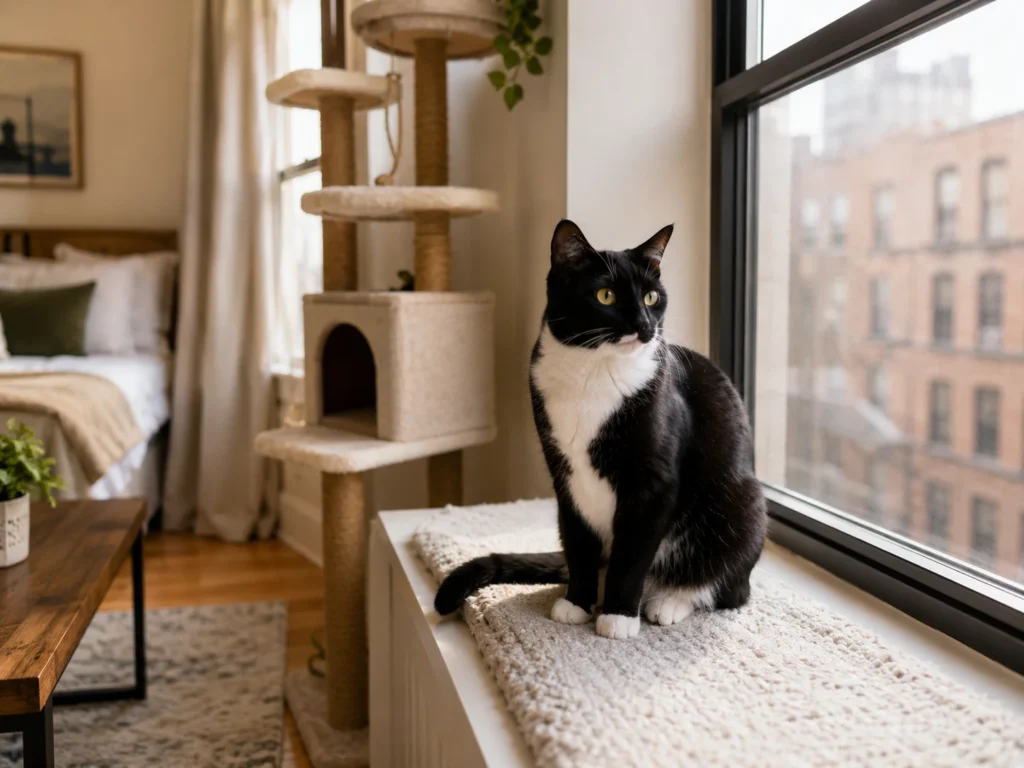
Should you walk your cat on a leash? Only if your individual cat appears to enjoy controlled outdoor exploration and you can provide a quiet, manageable environment.
Cats do not universally need walks, and many will find unfamiliar outdoor sights, sounds, smells, people, or dogs stressful. For a healthy, confident, curious cat that already moves comfortably in a secure harness and leash indoors, a cautious outdoor trial may provide interesting scents, movement, and opportunities to explore.
The important question is not simply whether your cat can wear a harness. It is whether their behavior shows that they feel willing, secure, and able to retreat once they are outside.
Quick Answer: Is Leash Walking Right for Your Cat?
Leash walking may be worth considering when your cat voluntarily investigates new spaces, recovers quickly from mild surprises, already moves naturally in a harness indoors, and can start in a calm area away from traffic, dogs, crowds, and other hazards.
Pause or choose another option if your cat freezes in the harness, repeatedly tries to escape, becomes highly agitated around unfamiliar sounds or people, has a health or mobility concern, or would need to enter an unpredictable public environment.
The goal is not to complete a route, cover a particular distance, or teach your cat to walk like a dog. A successful outing might consist of your cat stepping outside, sniffing one area, watching the surroundings, and returning to safety when they choose.
What Leash Walking Can—and Cannot—Offer
Possible Enrichment for Some Cats
Outdoor environments contain changing scents, textures, sounds, air movement, and visual activity that are difficult to reproduce fully indoors. A confident cat may enjoy sniffing plants, watching insects, investigating surfaces, or simply sitting in a new but controlled space.
This kind of exploration may provide enrichment because the cat can gather information and make choices. However, the benefit depends on how the individual cat experiences the outing. Exposure to more stimulation is not automatically positive if the cat feels trapped, frightened, or unable to retreat.
Research into secure outdoor enclosures has found positive owner-reported welfare changes for some cats, but this does not prove that leash walking produces the same results. Direct research on the welfare effects of walking cats on leashes remains limited.
Why It Is Not a Guaranteed Welfare Benefit
An indoor cat is not necessarily deprived because they do not go for walks. Cats can receive exercise, mental stimulation, opportunities to climb, hunting-style play, food-based enrichment, resting choices, and visual access to the outdoors without leaving the home.
Leash walking also retains risks that indoor enrichment does not. A harness may reduce some freedom of movement while leaving the cat exposed to dogs, vehicles, loud noises, weather, parasites, infectious agents, toxins, and escape opportunities.
Walking should therefore be treated as one optional form of enrichment, not an essential part of responsible cat care.
Is Your Cat a Suitable Candidate?
Suitability cannot be decided by breed, age, or a single behavior. Consider your cat’s usual confidence, response to novelty, health, mobility, previous experiences, and the environment available to you.
Signs Controlled Exploration May Suit Them
A cat may be a reasonable candidate when they:
- voluntarily investigate unfamiliar but manageable objects or spaces;
- remain responsive to you while exploring;
- recover promptly after a mild, distant sound or movement;
- can move, turn, sit, and change direction naturally while wearing a harness indoors;
- accept a lightweight leash indoors without fighting, freezing, or becoming preoccupied with it;
- show relaxed or neutral posture while approaching an open doorway or other controlled boundary; and
- can return to a familiar carrier, room, or hiding place when they want to withdraw.
No single sign proves that a cat will enjoy being outside. Curiosity at a window or door may reflect interest in one familiar view rather than readiness for an unpredictable environment.
Reasons to Pause or Choose Another Option
Leash walking may be unsuitable if your cat:
- regularly hides from unfamiliar people, animals, or ordinary outdoor sounds;
- panics when movement is restricted;
- crawls, falls to one side, freezes, or repeatedly backs out of the harness;
- bolts when a door opens;
- becomes defensive when frightened or restrained;
- takes a long time to recover after a startling event;
- has pain, weakness, breathing difficulty, poor stamina, or impaired balance; or
- would need to begin near traffic, uncontrolled dogs, crowds, or other unavoidable hazards.
Reluctance is not disobedience. There is no welfare reason to make a frightened cat complete leash-walking training simply because the activity appeals to the caregiver.
Previous Outdoor Cats and Multi-Cat Households
A cat that previously roamed outdoors may show strong interest in going outside, but that history does not guarantee comfort on a leash. Some former outdoor cats find restraint frustrating or react strongly when they cannot move in their preferred direction.
A previously fearful or poorly socialized cat may gain confidence over time, but outdoor walking should not be used as a test of whether they have become “brave enough.” Persistent fear deserves respect, and severe reactions may require professional assessment.
In a multi-cat household, assess each cat separately. One cat may enjoy calm exploration while another prefers a window perch or secure enclosure. Do not take several cats out together simply because one has responded well.
Kittens, Senior Cats, and Cats With Disabilities
Age alone does not determine suitability.
Kittens can be curious and adaptable, but their preventive-care needs, small size, developing behavior, and ability to fit securely into equipment require particular care. Ask your veterinarian when outdoor exposure is appropriate for your kitten rather than relying on a universal age.
Senior cats may still enjoy gentle exploration, but arthritis, reduced vision or hearing, chronic disease, and lower tolerance for heat, cold, or exertion can change what is comfortable. New hesitation, stiffness, or reduced stamina should not automatically be attributed to age.
A disabled cat is not automatically excluded. The surface, distance to retreat, balance demands, and consequences of a sudden threat all require individual consideration. A standard walking harness should not be used as a mobility or lifting aid unless a veterinarian has recommended appropriate support.
Cats with chronic health conditions should be assessed by their veterinarian before starting outdoor activity.
Harness Readiness Is Not Outdoor Readiness
A cat should already be comfortable wearing a secure harness and moving with an attached leash indoors before outdoor walking is considered. If your cat has not reached that stage, begin with How to Get Your Cat Used to a Harness.
Indoor readiness means more than tolerating the equipment while remaining still. Your cat should be able to walk, turn, change posture, investigate, and return to familiar activities without persistent crouching, freezing, biting at the harness, or trying to escape from it.
Even then, the outdoors presents a separate challenge. A cat that moves comfortably in a quiet room may become frightened by wind, dogs, traffic, voices, machinery, unfamiliar people, or wildlife.
Recheck the harness before every outing because fit can change with growth, weight, coat condition, and movement. No harness is escape-proof, particularly when a frightened cat twists or reverses suddenly.
Before the First Outing
Check Health and Preventive-Care Readiness
Outdoor access can change a cat’s exposure to parasites and infectious disease. The relevant risks depend on your cat’s health, age, location, local parasite patterns, contact with other animals, and the places they will visit.
Before making walks routine, ask your veterinarian whether your cat’s vaccination status and parasite-control plan are appropriate for the proposed exposure. The answer should be individualized; an indoor cat stepping into a private enclosed courtyard may face different risks from one visiting shared parks or areas used by unfamiliar animals.
Veterinary guidance is particularly important for kittens, senior cats, cats with chronic disease, cats taking medication, and cats with pain, breathing, mobility, immune, skin, or sensory concerns.
Check the Harness, Leash, Identification, and Retreat
Attach the leash to a secure cat harness, not to a collar. A collar concentrates restraint around the neck and should not be used to control a cat on a walk.
Use a manageable fixed-length leash that allows some exploration without creating a long, uncontrolled radius. Retractable leashes can introduce sudden tension, allow the cat to reach hazards before you can respond, and create frightening noise if the handle is dropped.
Never tether a cat to a post, fence, tree, or other object, and never leave a leashed cat unattended. Keep the leash in the hand of a focused adult throughout the outing.
Identification remains important even when a harness is used. Check that your cat’s microchip registration and contact details are current. A microchip is not a tracking device and cannot stop an escape, but it can help identify your cat if they are found.
For visible identification in addition to the chip, Should Your Cat Wear a Breakaway Collar? explains the separate benefits, risks, and suitability checks.
Plan a retreat before going outside. This may be an immediate route back indoors or a familiar secure carrier. If your cat is not already comfortable with one, getting your cat used to a carrier should be a separate indoor process.
Choose a Quiet, Controlled Location and Exit Plan
The first location should be the least challenging outdoor space available, not the most exciting destination. A private enclosed courtyard, secure garden, or quiet area immediately beside the home is usually more appropriate than a sidewalk, public park, beach, or busy communal space.
Before bringing your cat out, check for:
- nearby roads, parking areas, bicycles, or moving vehicles;
- loose or approaching dogs;
- unfamiliar cats or other animals;
- people who may approach or attempt to touch the cat;
- machinery, construction, gates, or sudden loud sounds;
- gaps, dense vegetation, or structures where the leash could become trapped;
- toxic plants, pesticides, fertilizers, rodenticides, antifreeze, or unknown substances;
- standing or contaminated water;
- wildlife activity; and
- hot, cold, wet, sharp, slippery, or otherwise unsuitable surfaces.
Choose mild, settled weather and a time when the area is quiet. If you intend to use shared or public land, check any applicable local rules first.
If reaching the location requires crossing an uncontrolled area or traveling in a vehicle, transport your cat in a closed, secure carrier rather than carrying them in your arms. A startled cat can leap or twist away before a person can react.
How to Try a First Outdoor Session
Begin at a Familiar Threshold
Prepare the area and retreat route first. Put the harness and leash on indoors, check the attachment points, and observe your cat moving normally before opening access to the outdoor space.
If you are using a carrier, place the closed carrier securely in the selected area before opening it. Orient the entrance so your cat can return without crossing around you or the leash.
Do not carry your cat bodily into the middle of an unfamiliar environment and place them down. Being held removes their control over the approach and may leave them exposed when released.
Let Your Cat Choose Whether and Where to Explore
Open access only when the surroundings remain quiet. Give your cat the opportunity to look, sniff, and decide whether to move forward.
A cautious first session can follow this sequence:
- Remain still and allow your cat to observe from the doorway or carrier.
- Let the cat choose whether to step out. Do not pull on the leash or place them outside.
- Follow at a comfortable distance if they begin exploring.
- Keep the leash slack while preventing access to gaps, roads, animals, or hazardous materials.
- Pause when your cat pauses and allow them to investigate at their own pace.
- End the session if the environment changes, your cat becomes concerned, or they choose to retreat.
Food can be offered if your cat normally enjoys it, but do not use food to lure a frightened cat farther into an environment they are trying to avoid.
Keep Expectations Small
Do not impose a route, distance, pace, or universal time target. Cats often explore by stopping, sniffing, observing, retracing their path, and returning to a familiar point.
Your cat may remain near the doorway or carrier for several outings. That can be a valid choice rather than incomplete progress.
End while your cat is still coping comfortably. Longer exposure is not necessarily better, and repeatedly extending an outing until the cat becomes distressed can create a negative association with the equipment or environment.
Read the Cat, Not the Clock
A cat’s behavior should decide whether the outing continues. Look at the entire body and the surrounding context rather than relying on one movement, facial expression, or response to food.
Signs of Voluntary, Comfortable Exploration
Reassuring signs may include:
- choosing to leave the retreat without being pulled or placed outside;
- fluid, coordinated movement rather than crawling or remaining rigid;
- sniffing and visually investigating the environment;
- neutral or gently changing ear and tail positions;
- pausing and then resuming exploration without pressure;
- remaining responsive to familiar sounds or the caregiver; and
- returning toward the carrier or doorway without panic.
These signs must still be interpreted together. A cat can sniff while worried, accept food while conflicted, or sit still while overwhelmed.
Signs of Fear, Shutdown, or Sensory Overload
Stop or help your cat retreat if you see:
- sustained freezing or a rigid, flattened posture;
- crouching with the belly held close to the ground;
- a tightly tucked or rapidly lashing tail;
- flattened ears or ears repeatedly scanning in different directions;
- marked pupil dilation combined with tension or repeated scanning;
- persistent attempts to hide;
- frantic backing, twisting, rolling, or pulling against the harness;
- repeated escape attempts;
- agitated or distressed vocalization;
- sudden defensive swatting, biting, or redirected aggression;
- open-mouth breathing, heavy panting, drooling, weakness, or poor coordination; or
- remaining unresponsive and unable to resume normal behavior after a trigger has passed.
Freezing deserves particular care. A motionless cat may be behaviorally inhibited because they feel unsafe. Stillness or passive compliance should never be treated as proof of relaxation without other reassuring body-language and recovery signs.
For more help interpreting the whole cat, see Cat Body Language: What Common Cat Signals Mean and How Can I Tell If My Cat Is Stressed?.
If Your Cat Panics or Tries to Escape
Do not chase, shout, jerk the leash, pull your cat forward, or lift them by the harness. Sudden restraint can intensify panic and may help a twisting cat slip out of poorly fitting equipment.
Keep hold of the leash and prevent access to immediate hazards without creating unnecessary tension. Reduce stimulation, remain calm, and bring the familiar carrier entrance or route indoors within easy reach if it is safe to do so.
If your cat cannot respond normally or the harness begins to shift, prioritize getting them into a secure enclosed space using the least force necessary. Do not grab the tail or legs.
After a panic response, suspend further outings rather than immediately trying again. Review the trigger, equipment, location, and your cat’s recovery. Repeated panic or escape behavior is a strong reason to abandon leash walking or seek professional guidance.
If your cat gets loose, do not rely on recall alone or assume they will remain nearby. Follow the broader guidance in Is Your Cat Going To Run Away? (And What You Can Do).
Risks a Leash Does Not Remove
Dogs, Vehicles, People, and Noise
A leash limits where your cat can move, but it does not control the environment. An approaching dog, revving vehicle, dropped object, running child, or unfamiliar person can close the distance before your cat has time to retreat.
Avoid areas where dogs may be loose or where passing dogs cannot be kept at a safe distance. Do not expect your cat to “get used to” traffic, crowds, or repeated frightening encounters through exposure.
Move back to safety if conditions change. Finishing a planned route is never more important than the cat’s welfare.
Wildlife, Toxins, Weather, and Surfaces
Do not allow your cat to chase, catch, or make contact with wildlife. Wild animals can injure a cat, carry parasites or infectious agents, and be harmed by predation.
Prevent drinking from puddles, ponds, discarded containers, or other unknown water sources. Keep the cat away from toxic plants, mushrooms, garden chemicals, pesticides, fertilizers, rodenticides, antifreeze, garbage, and animal remains.
Check the weather and walking surface immediately before each outing. Cats can overheat, become chilled, or injure their paw pads on excessively hot, cold, sharp, or chemically treated ground. Shade and water do not make extreme conditions appropriate.
Open-mouth breathing, collapse, severe weakness, vomiting, loss of coordination, a bite, suspected poisoning, or another injury requires prompt veterinary attention.
Parasites and Infectious-Disease Exposure
Even brief outdoor access can expose a cat to fleas, ticks, mosquitoes, intestinal parasites, contaminated soil or water, animal waste, and infectious agents carried by other cats or wildlife.
The relevant risks vary substantially by region and lifestyle. Ask your veterinarian to review your cat’s preventive-care needs rather than following a universal online schedule or choosing products without professional guidance.
A harness and leash may reduce roaming, but they do not create a biological barrier against parasites or infection.
When Leash Walking Is Not the Right Choice
Stop pursuing leash walks when your cat repeatedly declines to leave their retreat, shows escalating fear, struggles against the equipment, attempts to flee, remains distressed after returning indoors, or no suitably controlled location is available.
One difficult outing does not necessarily establish a permanent conclusion, especially if an unexpected dog or noise caused the reaction. However, repeated reluctance should be respected. The aim is to offer enrichment, not to train the cat to endure something they consistently dislike.
Management remains necessary even after many calm outings. Continue checking equipment, surroundings, weather, health, and behavior every time. Familiarity does not eliminate escape or environmental risk.
Safer Indoor and Enclosed Alternatives
A cat that does not enjoy leash walking still has many ways to explore, exercise, observe, and make choices.
Alternatives include:
- interactive hunting-style play with suitable wand toys;
- food puzzles, foraging activities, and hidden treats;
- stable cat trees, shelves, and climbing routes;
- cardboard boxes, tunnels, hiding places, and rotating safe objects;
- secure window views and a properly installed cat window perch;
- short, responsive play sessions based on your cat’s age and stamina, as explained in How Much Playtime Does a Cat Need Each Day?; and
- a secure catio, enclosed balcony, screened porch, or genuinely cat-contained garden where appropriate.
If an enclosure is the option you are considering, our guide to whether you should get a catio for your cat covers access, retreat, weather, supervision, and the upkeep the space will need.
These are not consolation prizes for a cat that “failed” at walking. For many cats, familiar territory with well-designed enrichment provides more choice and less stress than visiting unfamiliar outdoor places.
When to Ask a Veterinarian or Behavior Professional
Talk to your veterinarian before beginning if your cat has a chronic condition, pain, reduced mobility, impaired vision or hearing, breathing or heart concerns, skin problems beneath the harness, poor stamina, a compromised immune system, or an uncertain vaccination or parasite-control history.
Arrange veterinary assessment if a previously willing cat suddenly resists the harness, moves differently, tires more quickly, becomes unusually irritable, or appears painful. A behavior change may have a medical contributor.
A qualified reward-based feline behavior professional can help when a cat shows persistent panic, shutdown, defensive aggression, or severe sensitivity to handling or outdoor stimuli. Professional help should protect choice and reduce fear; it should not involve flooding, punishment, leash corrections, or forcing the cat through distress.
Helpful Related Guides
- How to Get Your Cat Used to a Harness
- How Can I Tell If My Cat Is Stressed?
- Cat Body Language: What Common Cat Signals Mean
- Is Your Cat Going To Run Away? (And What You Can Do)
- Cat Window Perches: Safety and Setup
Final Thoughts
You should walk your cat on a leash only when the activity appears to suit that individual cat and the environment can be kept reasonably controlled.
For a confident, healthy cat that already moves comfortably in a harness, voluntary outdoor exploration may offer worthwhile enrichment. For a cat that freezes, panics, struggles, or prefers familiar territory, stopping is the right decision—not a training failure.
Let behavior guide the plan. Keep the cat’s choices small but meaningful, preserve access to retreat, and remain prepared to replace walking with indoor or securely enclosed enrichment whenever that better protects their welfare.
Sources
- FelineVMA: Indoor/Outdoor Lifestyle Position Statement
- FelineVMA: Teaching Your Cat to Walk on a Harness and Leash
- FelineVMA: Safe Outdoor Access Options for Cats
- AAFP/ISFM Cat Friendly Veterinary Interaction Guidelines
- Merck Veterinary Manual: Treatment of Behavior Problems in Animals
- AAHA/AAFP Feline Lifestyle Risk Assessment
- AAHA/AAFP Feline Vaccination Guidelines
- Companion Animal Parasite Council: General Guidelines
- American Veterinary Medical Association: Microchipping FAQ
- Cornell Feline Health Center: Feline Heat Safety
- U.S. Food and Drug Administration: Potentially Dangerous Items for Your Pet
- Introducing a Controlled Outdoor Environment Impacts Positively in Cat Welfare and Owner Concerns
- Cats Protection: Should I Walk My Cat on a Harness and Lead?