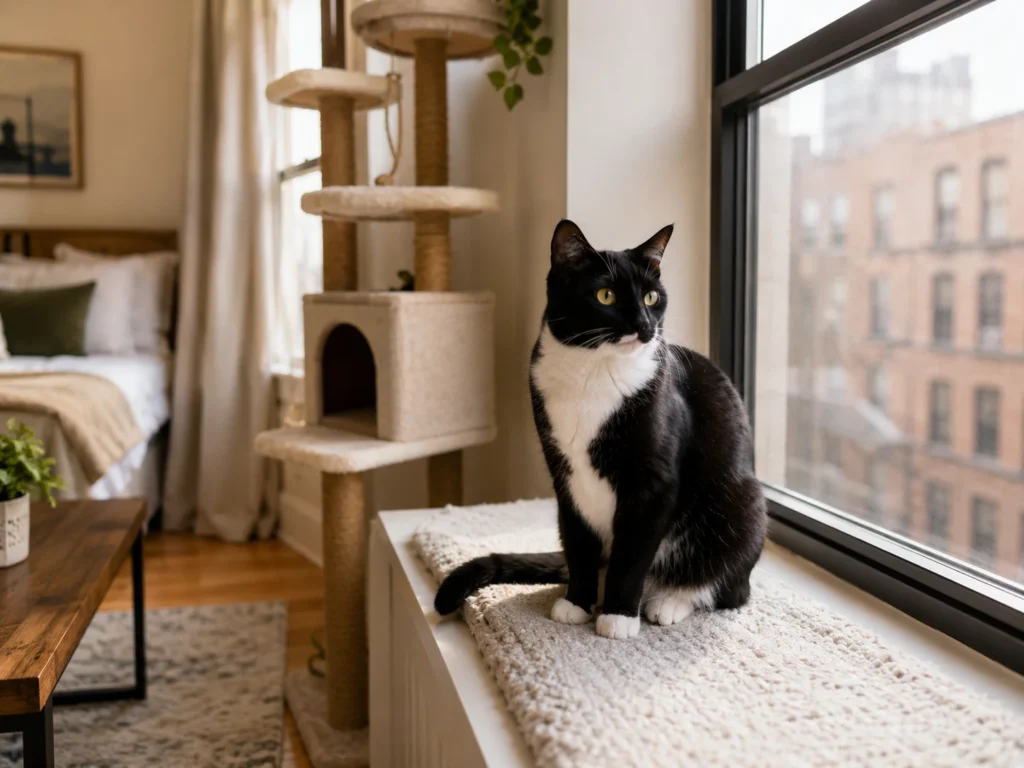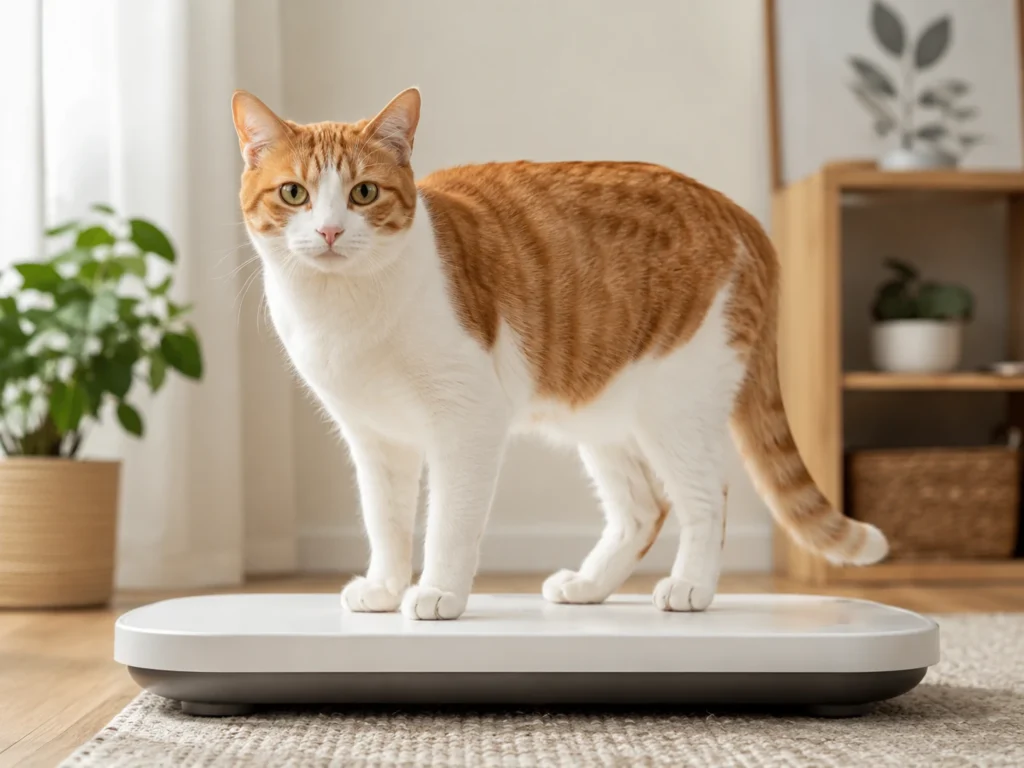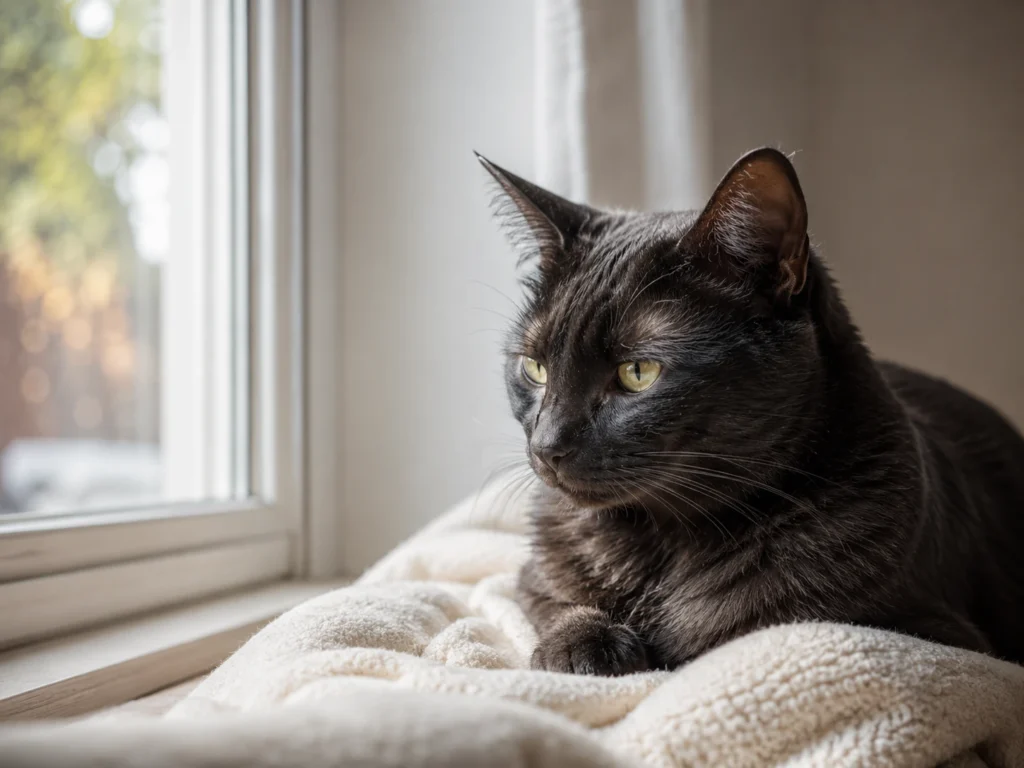
A cat window perch can provide a comfortable resting place with an elevated view, but its safety depends on much more than whether it feels steady immediately after installation. The perch, attachment system, mounting surface, window or wall, access route and cat must all be compatible.
Choose a perch that is large enough for your cat, follow the instructions for that exact product and remain within every stated weight and usage limit. Test the complete installation before allowing access, supervise the first uses and continue inspecting it throughout its life. A perch that was secure when first installed can become unsafe after movement, cleaning, wear, damage or changes to its mounting surface.
Not every cat needs or wants a window perch. Some prefer lower furniture, a freestanding cat tree or another resting place with a view. If a freestanding tree is the better option, choosing where to put the cat tree requires the same attention to stability, access routes, windows, heat, household traffic, and the individual cat. The aim is to provide a suitable choice, not to persuade a reluctant cat to use a particular product.
What Makes a Cat Window Perch Safe?
A safe setup is a complete system rather than a single product. It includes:
- a perch that is appropriately sized and rated for the cat or cats using it;
- an attachment method that suits the intended glass, window, sill, frame or wall;
- correct installation using all required parts;
- a stable route onto and away from the perch;
- a closed or properly secured window arrangement;
- a surrounding area without cords, loose strings, sharp objects or entrapment points;
- regular inspection, cleaning and maintenance; and
- a cat who can reach, occupy and leave the perch comfortably.
Cats often value elevated places because they provide observation, distance and choice. You can read more about that wider behavior in Why Do Cats Like High Places?. This guide focuses specifically on the practical safety and setup of a window perch.
Choose a Perch That Fits Your Cat and Home
Begin with the cat who will use the perch and the place where you intend to install it. A good-looking design is unsuitable if it is too small, exceeds its rated load, cannot be attached as instructed or leaves the cat with an awkward jump.
Check the Usable Resting Area
Look at the actual surface available to the cat, not merely the product’s outer dimensions. Your cat should be able to settle without hanging precariously over an edge or being forced into one position. The surface should not fold, tilt or distort excessively under normal use.
Consider your cat’s body length, build, preferred resting positions and confidence on elevated surfaces. A cat who likes to stretch out may need more room than one who normally curls into a compact sleeping position.
Use the Manufacturer’s Weight and Usage Limits
There is no universal safe weight limit for cat window perches. Products differ in their materials, construction, attachment systems and intended mounting surfaces.
Check the limit stated for the exact model and confirm whether it applies to the complete perch, each level or another part of the design. In a multi-cat home, consider the combined weight of every cat who might climb onto it simultaneously. Do not assume that cats will wait their turn.
A cat may also jump onto a perch rather than settle onto it gently, so a printed weight rating is only one part of the decision. Correct attachment, suitable access and continued inspection still matter.
Compare the Main Attachment Methods
| Perch type | What must be checked | Common limitations |
|---|---|---|
| Suction-mounted | The exact glass surface, cup condition, cleaning method, cup placement, straps or supports and installation sequence | Residue, damaged cups, incomplete seals, movement and reinstallation after cleaning can affect the setup |
| Windowsill-mounted | Sill depth, strength, shape, brackets, clamps, fasteners and whether the window can still close and latch properly | Some sills are too narrow, uneven, decorative, damaged or unsuitable for the supplied hardware |
| Wall-mounted | Wall construction, fixing points, brackets, fasteners, required anchors and the manufacturer’s instructions for that structure | Drywall, wooden studs, masonry and other structures may require different installation methods |
| Frame-, track- or clamp-mounted | The exact frame or track dimensions, clamping surfaces, window operation and all supplied locking parts | Window profiles vary, and an apparently similar frame may not be compatible with the product |
Hybrid and less-common designs need the same product-specific approach. Do not add adhesive, screws, brackets, replacement cups or other modifications unless the manufacturer approves them for that model.
Check the Location Before Installing Anything
Inspect the complete area before opening the package or drilling a hole. Confirm that the perch can be installed without damaging the window, preventing it from closing securely or creating a new hazard.
Check the following:
- Is the glass, sill, frame or wall compatible with the stated attachment method?
- Is the surface intact, clean and free from loose material?
- Can every required attachment point be positioned exactly as instructed?
- Will the window still close and latch securely?
- Is there enough room for the cat to enter, turn and leave?
- Is there a stable intermediate surface if the perch is too high for one comfortable jump?
- Could a door, curtain, blind, window handle or moving sash strike the cat or perch?
- Are blind cords, curtain cords, loose strings and electrical cables out of reach?
- Could another cat block the approach or exit?
- Will the cat still have access to shade, water and a cooler resting place?
If the intended location fails one of these checks, choose another location or another type of perch. A freestanding option may be more suitable where the window or wall cannot safely accept a mounted product. What Makes A Good Cat Tower? explains what to consider when choosing that kind of alternative.
Install the Perch According to Its Exact Instructions
Read the complete manual before beginning. Identify every part and confirm that nothing is missing, damaged or substituted. Installation advice for one perch should not be transferred automatically to another.
Suction-Mounted Window Perches
Suction designs generally require clean, suitable glass and clean, undamaged cups. Follow the manufacturer’s directions for preparing and drying both surfaces. Household cleaners can leave residue, while unapproved chemicals may affect some materials, so use only the cleaning method specified for the product.
Position every cup in the required orientation and make sure the full rim is seated against the glass. If the design includes support straps, cables, braces or lower cups, attach and tension them exactly as directed. Do not omit a part because the platform seems stable without it.
Inspect each cup for cracks, hardening, distortion, cuts or damaged edges. A cup that cannot form a complete seal should be replaced with the correct approved part before the perch is used.
Windowsill-, Frame- and Clamp-Mounted Perches
Measure the sill, frame or track rather than estimating its size. The mounting surface must provide the contact area and support required by the product.
Fit all brackets, clamps, pads, locking pieces and fasteners in the stated positions. Tighten them as instructed, but do not improvise extra force that could damage the hardware, sill or frame. Confirm that the window can close and latch without pressing against the perch or its fittings.
Wall-Mounted Perches
Wall construction determines which fixings and installation method are appropriate. A screw suitable for a wooden stud is not automatically suitable for drywall, masonry or another structure.
Use the product’s instructions for the specific wall type. If the instructions do not cover your wall, the structure is damaged or you cannot locate suitable fixing points, obtain qualified installation advice. Do not guess at anchors or rely on decorative wall material to carry the load.
Before drilling, also check for concealed electrical cables, plumbing and other building services. If their locations are uncertain, stop and seek appropriate help.
Test the Complete Setup Before Your Cat Uses It
Once installed, examine the perch from above, below and both sides. Confirm that all supports are correctly aligned and that straps, brackets, fasteners and attachment points are fully engaged.
Use the stability test specified by the manufacturer. If the instructions call for a settling period, locking step or recheck, complete it before allowing access.
During a careful manual check, support the perch while applying gradual pressure in the directions a cat might load it. Watch for:
- lifting or peeling at the edge of a suction cup;
- sliding, twisting, rocking or uneven movement;
- a bracket pulling away from its surface;
- a fastener turning or loosening;
- straps becoming slack or changing position;
- fabric, stitching or a frame stretching abnormally; and
- sounds that suggest cracking, splitting or movement inside the wall or frame.
Do not exceed the stated limit or invent an extreme load test. If the manufacturer does not provide a clear test or the result leaves you uncertain, contact the manufacturer or choose another setup.
Supervise the first few uses. A perch may respond differently when a cat jumps from the side, climbs from below or turns around on it. Stop access immediately if any attachment moves.
Let Your Cat Investigate Without Pressure
Allow your cat to approach the new perch voluntarily. Some cats investigate immediately, while others need time to become comfortable with a new object, smell or route.
You can place a familiar blanket on the perch if the product allows it and the blanket cannot slide, bunch up or interfere with the attachments. A small treat placed on the access surface may encourage investigation, but do not lift or place a reluctant cat onto the perch.
Watch how your cat gets on and off. The route may look easy to a person while requiring an awkward turn, long jump or slippery landing for the cat. If your cat repeatedly hesitates, scrambles, slips or jumps toward an unsafe surface, change the route or discontinue that location.
Provide a Safe Entry and Exit Route
A perch should not become a dead end. Ideally, the cat can approach and leave without squeezing behind curtains, crossing a narrow unstable object or passing another cat at close range.
A stable chair, broad shelf, cat step or sturdy piece of furniture can provide an intermediate level. Make sure the access item cannot roll, tip, fold or slide when the cat launches from it. A non-slip surface may help where paws would otherwise land on smooth furniture.
Keep the landing area below reasonably clear. A fall onto a hard-edged table, heater, glass object or sharp decoration could cause more harm than a fall onto an open floor.
Cats who regularly enjoy observing activity outdoors may spend considerable time near windows. Why Does My Cat Sit by the Window All Day? covers that behavior in more detail.
Adapt the Setup to the Individual Cat
Kittens
A kitten’s lower body weight does not make every perch suitable. Kittens may climb unpredictably, squeeze through small gaps, chew loose material or launch themselves at speed. Check for entrapment spaces and removable parts, supervise early use and follow any minimum-age or usage restrictions from the manufacturer.
Senior and Less-Mobile Cats
Prioritize easy access over maximum height. A lower perch with broad steps or a gentle, stable ramp may be more usable than a dramatic high position. Add non-slip surfaces where necessary and make sure the cat does not need to twist or jump down onto a slippery floor.
Do not force a senior cat to keep using a formerly favorite perch. Comfort, vision, balance and mobility can change, and another resting place may now be more appropriate.
Heavier and Larger Cats
Confirm both the rated load and the usable dimensions. A perch may technically support a cat’s stated weight while still being too narrow or awkward for that cat to use comfortably.
Choose a design intended for the cat’s size, ensure every component remains within its limit and do not reduce the decision to a single number. If no suitable product clearly covers the intended use, choose a broad freestanding platform instead.
Multi-Cat Homes
Calculate the possible combined load, even if you expect only one cat to use the perch. Cats may share unexpectedly or one may jump up before the other leaves.
Also watch for competition. Blocking, staring, chasing or guarding the route can turn one attractive perch into a contested resource. Separate resting places and more than one route can reduce the chance that one cat controls access. If the window is especially popular, provide another observation or resting option elsewhere rather than crowding multiple cats onto one structure.
Control Window, Screen and Surrounding Hazards
Keep the Window Secure
The safest default beside an indoor perch is a fully closed and latched window. Never leave an unsecured window open because a perch appears to keep the cat away from the gap.
An ordinary insect screen should not be treated as structural support, guaranteed fall protection or reliable escape prevention. Screens can be loose, damaged, poorly fitted or pushed from their frames. Childproof window guards may also leave gaps that a cat can pass through.
If ventilation is required, use a properly fitted cat-appropriate barrier or screening system designed for the exact window and inspect the entire installation. The perch itself must remain independently supported by its approved attachment points.
Tilt-and-turn and other partly open windows can create narrowing gaps in which a cat may become trapped. Prevent access unless a suitable protective system fully controls the opening. Do not assume that a partially open position is safe because the gap looks too small.
Secure Cords and Loose Material
Tie up or remove blind cords, curtain cords and other loops that could catch around a neck, leg or body. Keep loose strings, electrical cables and hanging decorations away from the perch.
Check whether curtain fabric can catch claws or obstruct the cat’s exit. Move breakable objects, unstable plant pots and sharp decorations from the access and landing areas.
Manage Sunlight and Heat
A sunny perch may be pleasant, but the cat must be able to leave it freely. Provide access to fresh water, shade and a cooler resting place, particularly during hot weather.
Observe how conditions change during the day. A comfortable location in the morning may receive intense direct sun later. Window glass can also create an enclosed-feeling hot area when curtains or blinds restrict airflow around the perch.
Excessive panting, drooling, weakness, vomiting, diarrhea or collapse can indicate a heat emergency. Move the cat to a cooler area and contact a veterinarian immediately.
Inspect the Perch Throughout Its Life
Do not wait for the perch to fall before checking it. Use the manufacturer’s inspection and maintenance schedule, supported by frequent brief visual checks.
Complete a fuller inspection:
- after initial installation and the first uses;
- after the perch has been removed or repositioned;
- after cleaning the perch, window or mounting area;
- after strong temperature changes;
- after a cat lands unusually hard or multiple cats use it together;
- after nearby building, window or furniture work;
- whenever a cup, bracket, strap or fastener appears different; and
- at every interval specified by the manufacturer.
Some suction-perch manufacturers require the cups and glass to be removed, cleaned and reinstalled on a regular schedule. Follow the schedule for your exact product rather than assuming that a cup can remain untouched indefinitely.
During each inspection, check:
- every suction cup, clamp, bracket, anchor and fastener;
- support straps, cables, stitching and fabric;
- the platform, frame and joints;
- the glass, sill, frame or wall around each attachment;
- the entry, exit and landing surfaces; and
- the window latch, screen, cords and nearby hazards.
A quick push on the platform does not replace this inspection. Look closely at the individual parts that prevent the perch from moving.
Clean and Maintain the Perch Carefully
Block access while the perch is being cleaned or partially dismantled. Remove washable covers only as instructed and use the approved washing and drying method. A damp cover, incorrectly refitted sleeve or twisted support can change how the perch carries the cat.
For suction designs, clean the cups and glass using the product’s specified materials. Inspect the cups while they are removed and replace damaged ones with compatible approved parts. Reinstall every component and repeat the complete stability check before returning the perch to use.
For bracketed or wall-mounted designs, check fasteners without adding unauthorized hardware or overtightening parts. If an anchor turns, pulls out or damages the surrounding material, stop using the perch until the mounting problem has been correctly repaired.
Do not cover damaged fabric with another blanket, tie a broken strap in a knot or use improvised glue or tape as a permanent repair. Contact the manufacturer about replacement parts or replace the perch.
When Should You Stop Using a Window Perch?
Remove access immediately if you find:
- a suction cup lifting, cracking, hardening, deforming or repeatedly losing its seal;
- a clamp, bracket, anchor or fastener that is loose, bent, missing or pulling away;
- unexpected rocking, sliding, twisting or sagging;
- a cracked, distorted or damaged platform or frame;
- torn fabric, open seams, frayed straps or exposed internal material;
- sharp edges, protruding hardware or possible entrapment points;
- damage to the supporting glass, sill, frame or wall;
- a window that no longer closes and latches correctly;
- a missing instruction-required component;
- an unknown or exceeded weight limit; or
- any failure whose cause has not been identified and corrected.
If a perch detaches, do not simply press it back into place and continue using it. Remove the cat, inspect every component and determine why the failure occurred. Replace damaged or unreliable parts and reinstall only when the exact product instructions support doing so.
If your cat falls or may have been injured, contact a veterinarian promptly. Breathing difficulty, collapse, severe pain, inability to walk, uncontrolled bleeding or major trauma requires emergency veterinary care.
When a Cat Suddenly Stops Using a Familiar Perch
A cat may reject a perch because it moved, developed an unfamiliar smell, became unstable, received stronger sunlight or was blocked by another cat. Inspect the setup and surrounding area first.
However, a sudden reluctance to jump, climb or use other familiar elevated places can also accompany pain, reduced mobility, vision changes, balance problems or illness. Look for changes such as stiffness, limping, hesitation on stairs, altered grooming, reduced activity, hiding or sensitivity to touch.
If the change is sudden, persists or appears alongside other physical or behavioral changes, arrange veterinary advice. Do not assume that the cat is being stubborn or simply losing interest.
Helpful Related Guides
- Why Do Cats Like High Places?
- Why Does My Cat Sit by the Window All Day?
- What Makes A Good Cat Tower?
- How Can I Keep an Indoor Cat Entertained?
- Is My Cat Bored?
Sources
- ASPCA — High-Rise Syndrome: Lifesaving Tips for Cat Parents
- Cats Protection — Keeping Your Cat Safe
- AAFP and ISFM — Feline Environmental Needs Guidelines
- Cat Friendly Homes — Home Environment Modifications
- Cornell Feline Health Center — Feline Heat Safety
- K&H Pet Products — Kitty Sill EZ Window Mount Instruction Manual
- TRIXIE — Wall-Mounted Cat Furniture Assembly Instructions
Final Thoughts
A cat window perch is safest when it suits the individual cat, the complete mounting system is compatible with its supporting surface and every installation step is followed. Safe access, a secure window, freedom from nearby hazards and continued inspection are just as important as the platform itself.
Choose conservatively, test before use and stop at the first sign of movement or damage. If the window cannot accept a suitable perch, another elevated or window-level resting place can provide the same opportunity without forcing an unsuitable installation. For broader ideas that go beyond one resting spot, see How Can I Keep an Indoor Cat Entertained?.