Quick Answer
To keep your cat off kitchen counters, first prevent access while cooking or when dangerous items are present. Then remove food and other rewards from the counter, provide a stable alternative perch outside the cooking zone, and reward your cat for using it before they jump up.
Reacting after every jump is less effective than making the counter unrewarding and teaching your cat where to go instead. Improvement is realistic, but no training method can guarantee that an accessible counter will never be visited when nobody is watching. Some level of ongoing management may still be necessary.
Start With Immediate Kitchen Safety
Training takes repetition. A hot burner, boiling pan, sharp knife, or spilled cleaning product can cause harm in seconds. Whenever an immediate hazard exists, management must come before behavior training.
During Cooking and Food Preparation
If practical, keep your cat out of the kitchen while burners, ovens, hot cookware, knives, boiling liquids, cleaning chemicals, or exposed food are in use. Closing a door is the simplest option in some homes. In an open-plan home, your cat may need to spend the busiest part of meal preparation in another safe, comfortable room.
This should be calm management rather than punishment. Settle your cat before cooking begins and provide appropriate access to water, a resting place, and any other resources needed for the time involved.
If your cat unexpectedly reaches the counter during cooking, stabilize the hazard first. Turn off a burner, move a pan only if doing so is safe, or step between the cat and the dangerous area. Avoid chasing the cat around hot cookware or reaching across boiling liquid to grab them.
If your cat is comfortable being handled and can be lifted safely, support their body and place them away from the danger. Do not scruff, drag, corner, or struggle with them. A frightened cat may jump unpredictably, making the situation more dangerous for both of you.
When You Cannot Supervise
Before leaving the kitchen, check that:
- Food, crumbs, grease, and dirty dishes have been cleared away.
- Knives, skewers, breakable objects, and small items are stored securely.
- Cookware and cooking surfaces have cooled completely.
- Cleaning products are closed and stored where the cat cannot reach them.
- Trash, food packaging, and compost containers are inaccessible.
- No dripping tap, open container, or interesting food smell is rewarding another visit.
A switched-off stovetop may remain hot for some time. Do not assume it is safe simply because cooking has finished.
Why the Counter Keeps Paying Off
Cats do not jump onto counters because they are spiteful, dominant, or intentionally unhygienic. They repeat behaviors that provide something useful, interesting, or rewarding.
Kitchen counters can offer several rewards at once:
- Food: Crumbs, cooking residue, uncovered ingredients, dirty plates, and food packaging can all make investigation worthwhile.
- Smells: A surface may remain interesting even after the visible food has gone.
- Attention: Talking, chasing, lifting, or negotiating with the cat can turn a jump into a reliable way to make people respond.
- Height: Cats often value elevated positions because they provide a wider view and some distance from activity at floor level. This is explored further in Why Do Cats Like High Places?
- Warmth: Sunlight, nearby appliances, or residual cooking heat may make part of the kitchen attractive.
- Novelty: Bags, groceries, running water, moving utensils, and changing smells give a curious cat something new to inspect.
The counter does not need to provide a reward every time. An occasional scrap of food can be enough to keep a cat checking. Unpredictable rewards are particularly persistent because the next visit might pay off even if the previous few did not.
Remove the Rewards From the Counter
Training will be much harder if the counter still provides food. Clear it consistently rather than only after your cat has already found something.
Put ingredients away, wipe up crumbs and spills, rinse food residue from dishes, and secure bread, fruit, treats, packaging, and waste. Pay attention to less obvious rewards such as grease around a pan, water in the sink, or a spoon used to prepare cat food.
If you prepare your cat’s meals on the counter, the sounds and smells of that routine may draw them into the kitchen. Keep their feeding area separate from the food-preparation surface. If necessary, assemble their meal while they wait at their alternative station or outside the kitchen.
Human responses also matter. One person may calmly redirect the cat while another laughs, pets them, or offers food to persuade them down. From the cat’s perspective, the behavior still works. Everyone in the household should follow the same basic routine.
Removing rewards does not mean ignoring immediate danger. It means making routine counter visits quiet, predictable, and unsuccessful while making the alternative location consistently worthwhile.
Choose a Safer Alternative Perch
If the counter gives your cat height, a view of the household, or proximity to you, simply removing access leaves those needs unanswered. A good alternative offers some of the same benefits in a safer place.
Make It Genuinely Useful
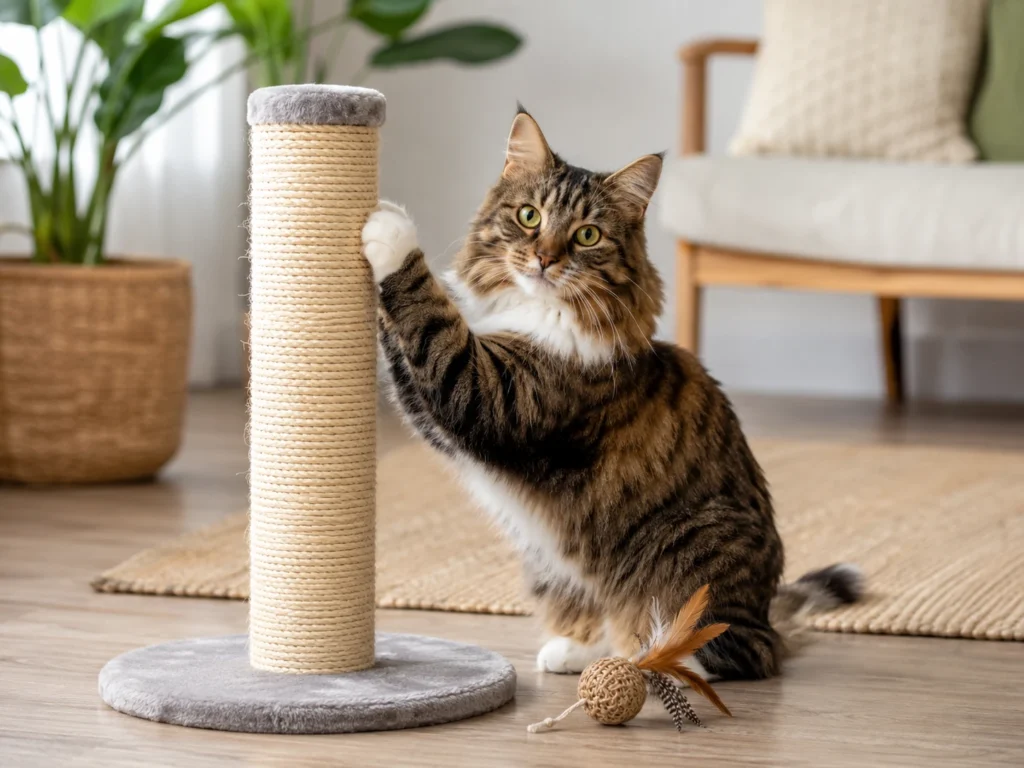
The alternative might be a sturdy cat tree, a properly installed shelf, or another stable elevated surface intended for the cat. It should:
- Support the cat’s full weight without tipping, sliding, or wobbling.
- Have enough room for the cat to stand, turn, sit, or settle comfortably.
- Provide secure footing rather than a slippery surface.
- Be easy for that particular cat to reach.
- Offer a view of the activity the cat wants to observe.
- Remain available consistently, not only during formal training sessions.
A perch hidden in an isolated corner may be safe but useless if your cat jumps onto the counter to watch you. Position matters as much as height. For broader placement guidance, see Where Should You Put a Cat Tree?
Keep It Outside the Hazard Zone
Do not place the alternative beside a stove, sink full of hot water, knife block, food-preparation surface, cleaning station, or place where hot cookware is carried. It should not create an easy launching route straight onto the counter.
In a small kitchen, the best location may be just outside the doorway or at the edge of an adjoining room, where the cat can see you without entering the working area. If there is no safe elevated location, a clearly trained floor station outside the kitchen is better than an unsafe perch inside it.
The alternative does not make active cooking safe without supervision. It gives your cat an appropriate place to choose while management continues to protect them from immediate hazards.
Teach Your Cat to Use the Alternative
Begin when the kitchen is quiet and no food is being prepared. Your first goal is to make the alternative valuable before asking your cat to use it around distractions.
Build Value Before Cooking
- Let your cat investigate the station without being placed or held on it.
- Reward a glance, approach, sniff, or paw placed on the surface.
- Gradually reserve rewards for getting fully onto the station.
- Once your cat steps onto it readily, reward remaining there briefly.
- Release them before they become restless, then repeat later.
Deliver the reward on the station so the valuable location is clear. Use very small treats or part of your cat’s normal food allowance. How to Use Treats for Cat Training Without Overfeeding explains how to account for training rewards without relying on food restriction.
Keep practice brief and voluntary. Several successful repetitions are more useful than continuing until your cat walks away or becomes frustrated.
Add a Marker, Target, or Station Cue
A marker tells your cat exactly which action earned the reward. This can be a clicker or a short, consistent word such as “yes.” Mark the moment your cat reaches the station, then provide the reward there.
You can also teach the cat to follow a target, such as touching their nose to the end of a target stick. This provides a calm way to guide them toward the station without pushing or carrying them. Full conditioning instructions are available in How to Clicker Train Your Cat.
When your cat is moving to the station reliably, add a short cue such as “place” immediately before the movement. Do not repeat the cue continuously. If the cat does not respond, make the exercise easier rather than raising your voice.
For a portable floor-level station, our guide to teaching your cat to go to a mat explains voluntary arrivals, a brief stay, and a clear release; kitchen hazards still need their own management.
Practice Around Kitchen Activity Gradually
Once the behavior is reliable in a quiet room, introduce ordinary kitchen activity in small steps. You might open a cupboard, move a cold pan, or prepare a drink while rewarding the cat for remaining on the station.
Increase distraction only while your cat is succeeding. Preparing an entire meal may be too difficult at first. During genuinely hazardous cooking, return to physical management rather than testing unfinished training.
Reward the Alternative Before the Jump
The most useful moment to intervene is before your cat reaches the counter.
Watch for the approach: entering the kitchen, looking upward, stretching against a cabinet, or preparing to jump. Cue the station while your cat is still on the floor and reward them for going there. With repetition, arriving in the kitchen can become a signal to use the alternative rather than inspect the counter.
During safe kitchen tasks, reinforce the cat periodically for remaining settled. The intervals can gradually become less frequent as the routine becomes familiar.
Do not wait for a counter jump every time before producing a treat at the station. Some cats may learn a longer sequence in which jumping onto the counter is the first step toward earning food. Practice the station from the floor and reward it at times when no counter attempt has occurred.
What to Do When Your Cat Jumps Onto the Counter
Even with good management, occasional jumps are likely. Respond calmly and consistently.
If there is no immediate danger, use the station cue or target you have already taught. Reward the cat after they reach and remain at the correct location. Keep your voice and movements neutral.
If the cat does not yet understand the cue, guide them toward a safe route down without chasing, shouting, clapping, or looming over them. In an urgent situation, a food lure may help move the cat away from danger, but repeated counter visits should not become the normal way to obtain treats.
Afterward, look for the reason the jump succeeded. Was food accessible? Was the station blocked, unstable, occupied, or too far away? Did the cat receive an exciting reaction? Treat the incident as information about the setup rather than proof that the cat is being disobedient.
Why Punishment and Startle Deterrents Are Poor Solutions
Spraying water, shouting, hitting, chasing, or deliberately frightening a cat does not teach them which location is acceptable. It may instead teach them that people become unpredictable near the kitchen.
Owner-operated punishment also depends on the owner being present. The cat may learn to avoid the counter when a particular person is nearby while continuing to use it when the room is empty.
Do not casually use essential oils, concentrated fragrances, electrical or shock devices, deliberately unstable coverings, pressure devices, or products designed to startle the cat. These methods can introduce exposure, injury, or fear risks without teaching a useful alternative behavior.
The practical objective is not to make the kitchen frightening. It is to prevent access when safety requires it, remove the rewards that maintain the behavior, and make another location easier and more rewarding to choose.
Plan for Setbacks and Unsupervised Access
Progress is rarely perfectly linear. A visitor may leave food out, a new appliance may create warmth, or a single successful raid may renew your cat’s interest. Return to stricter management and easier station practice rather than escalating your response.
Behavior learned in one situation may not transfer automatically to another. A cat who stays on their perch while you make coffee may still struggle when meat is being prepared or several people are moving around the kitchen.
When nobody is present, training cues and rewards are unavailable. Keep counters clear, secure hazards, and restrict access when practical. If the kitchen cannot be closed, plan on environmental management remaining necessary even after supervised behavior improves.
Adapt the Plan for Different Cats and Homes
Kittens are naturally exploratory and may have limited impulse control. Make hazard prevention especially strict, provide legal climbing opportunities, and use very short training sessions.
Senior cats and cats with limited mobility may need a lower station, wider surfaces, secure footing, or intermediate steps. Do not require repeated high jumps. A new reluctance to jump, stiffness, or change in movement warrants veterinary attention.
Multi-cat households may need more than one station. A single perch can become difficult to use if another cat occupies it, blocks the approach, or guards the route. Provide sufficient space and avoid requiring cats with a strained relationship to share a small platform.
Small or open-plan homes may not have room for an elevated station inside the kitchen. Use the nearest genuinely safe location with a useful view, even if that means placing the station in an adjoining area.
Keep Food-Preparation Surfaces Clean
Clean the counter before preparing food, just as you would after any other household use. Remove visible debris and wash the surface using hot, soapy water or another method suitable for the material. Follow the cleaning product’s label and never mix products unless the instructions explicitly allow it.
Additional sanitizing may be appropriate after raw meat, poultry, seafood, or eggs have contacted a surface. That is standard food-safety practice rather than evidence that a cat’s presence creates an exceptional contamination emergency.
Avoid fear-based claims about cat paws or household bacteria. Consistent cleaning, safe food handling, and keeping the cat away from exposed food are proportionate precautions.
When Food Seeking Needs a Veterinary Check
Some cats investigate counters because they have learned that food sometimes appears there. However, a sudden or unusually intense increase in hunger or food seeking should not automatically be treated as a training problem.
Arrange veterinary assessment if the change occurs alongside:
- Weight loss or unexpected weight gain.
- Increased thirst or urination.
- Vomiting or diarrhea.
- Changes in activity, sleep, coat condition, or behavior.
- Weakness, restlessness, or other physical signs.
Conditions including hyperthyroidism and diabetes can affect appetite, weight, thirst, and urination. The article Why Is My Cat Always Hungry? explains the broader assessment without turning counter training into a medical diagnosis.
When to Get Behavior Help
Seek professional help if consistent management and reward-based training are not creating a workable routine, the behavior continues to create serious safety risks, or attempts to intervene lead to fear or aggression.
Begin with your veterinarian when the behavior is new, escalating, or accompanied by another change. Once medical causes have been considered, look for a qualified professional who has specific experience with cats and uses reward-based methods. Ask how they assess behavior and which techniques they intend to use before agreeing to a plan.
Helpful Related Guides
- Why Do Cats Like High Places?
- How to Clicker Train Your Cat
- How To Promote Good Cat Behaviors
- How to Use Treats for Cat Training Without Overfeeding
- Why Is My Cat Always Hungry?
Final Thoughts
Keeping a cat off kitchen counters is not about winning a contest of wills. The counter may provide food, attention, height, warmth, or a useful view, and an occasional reward can keep the behavior going.
Start by managing genuine kitchen hazards. Keep the counter clear, provide a stable alternative outside the cooking zone, and reward your cat for choosing it before a jump occurs. When mistakes happen, respond calmly and adjust the environment rather than frightening or punishing the cat.
Training can substantially improve the routine, but accessible counters may still require management when nobody is watching. A safe, repeatable system is a more realistic goal than a promise that your cat will never jump up again.
Sources
- Treatment of Behavior Problems in Cats — MSD Veterinary Manual
- AAFP and ISFM Feline Environmental Needs Guidelines — American Association of Feline Practitioners and International Society of Feline Medicine
- Understanding Cat Behavior — Cats Protection
- Four Steps to Food Safety: Clean, Separate, Cook, Chill — FoodSafety.gov
- Emergencies and First Aid in Cats — Blue Cross
- The Essentials of Essential Oils Around Pets — ASPCA
- Hyperthyroidism in Cats — Cornell Feline Health Center
- Feline Diabetes — Cornell Feline Health Center
- Finding a Good Cat Behaviourist — Cats Protection