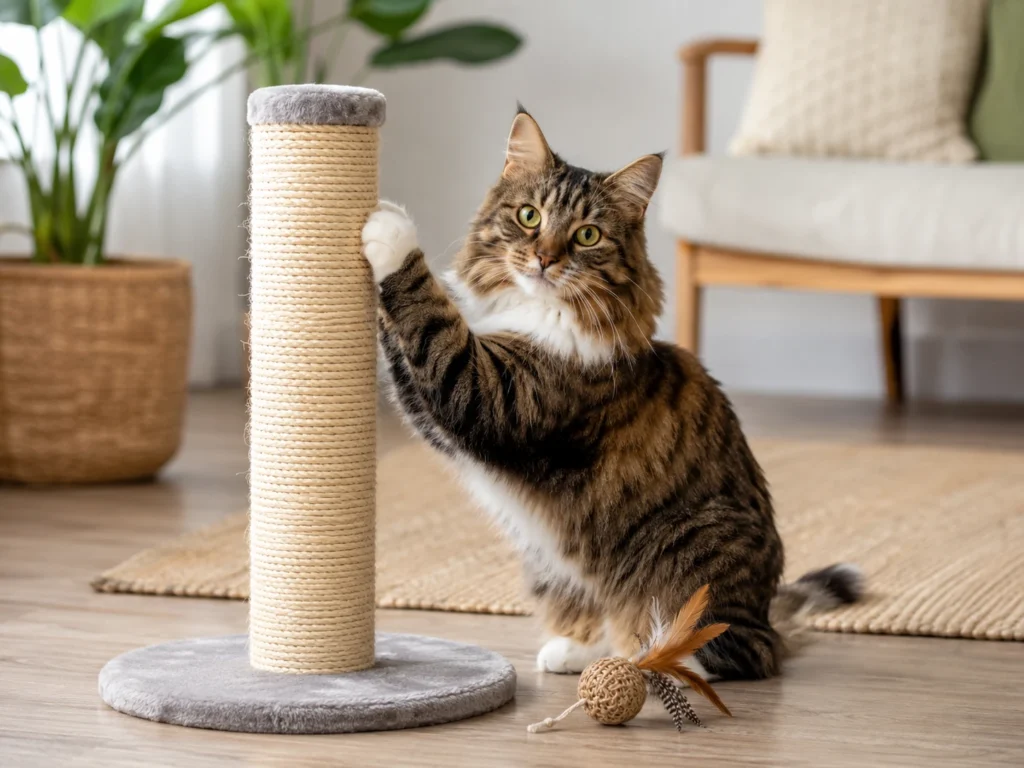
To introduce a new cat to your resident cat, keep them physically separated at first, give each cat secure access to essential resources, and progress through scent, visual, and supervised contact only while both cats are coping. If tension increases, return to an earlier successful stage instead of pushing forward.
The aim is not to make the cats become friends on a deadline. Safe coexistence—where both cats can eat, rest, use the litter box, move around, and retreat without persistent pressure—is a successful outcome. Some cats later form a close relationship; others remain comfortable but largely independent.
Important: If the cats have already had repeated physical fights, caused injuries, persistently stalk or block one another, or cannot use the home safely, a basic new-cat introduction plan may not be sufficient. Arrange veterinary assessment and seek help from a qualified feline behavior professional.
If the new housemate is a dog, use the separate guide to introducing a cat to a dog, which covers dog control, protected retreat, and the risks of pursuit.
How to Introduce a New Cat to Your Resident Cat: The Short Version
- Check health considerations first. Ask your veterinarian about contact, testing, preventive care, and separation if either cat’s health, pain status, parasite history, vaccination status, or infection risk is uncertain.
- Prepare a separate transition area. Give the new cat food, water, litter, resting places, hiding options, scratching opportunities, and suitable elevated space behind a secure closed door.
- Keep the cats apart while they settle. Monitor both cats separately until they can eat, drink, rest, eliminate, and behave normally in their respective areas.
- Introduce scent without force. Exchange bedding or allow controlled room exploration only when neither cat is overwhelmed.
- Begin visual access through a secure barrier. Keep sessions brief and maintain enough distance for both cats to disengage.
- Move to supervised same-room contact cautiously. Do this only when both cats can see one another without persistent staring, pressure, blocking, or fear.
- Step back when necessary. Repeated pursuit, ambushing, resource blocking, sustained hiding, inability to settle, or changes in eating or toileting mean the plan needs to pause or move backward.
These are response-led stages, not a schedule. One cat may become comfortable faster than the other, and the more cautious cat should determine the pace.
Why the Process Should Be Response-Led
The strongest principles behind gradual introductions are well established: cats need safe places, choice, predictable access to resources, opportunities to retreat, and some control over social contact. The 2024 AAFP Intercat Tension Guidelines and the AAFP and ISFM Feline Environmental Needs Guidelines support gradual introductions and distributed resources as important ways to reduce intercat tension.
However, not every detail in a conventional introduction sequence has been tested in strong controlled trials. Exact methods often combine feline-welfare principles, clinical experience, professional consensus, and practical behavior guidance. Individual responses vary, so there is no evidence-based number of days or weeks that guarantees readiness for the next stage.
Progress should depend on what both cats do during the session and how they function afterward. A cat that remains still may be frozen with fear rather than relaxed. A cat that accepts food may still be monitoring the other cat closely. Look at the complete pattern rather than treating one behavior as proof of success.
Familiar housemates reacting differently after treatment need a recovery-aware approach; see why a cat may hiss at another cat after a vet visit before adapting an introduction plan.
Before Contact: Address Health and Infection Risks
Arrange individualized veterinary advice before contact if the new cat’s medical history, parasite status, vaccination status, or potential exposure to infectious disease is uncertain. Pain or illness can also change how either cat responds to proximity and handling.
Your veterinarian should determine whether testing, treatment, preventive care, continued separation, or a particular contact timeline is appropriate. There is no universal quarantine period, vaccination schedule, or testing plan that is suitable for every cat and household.
A sudden behavior change in the resident cat deserves attention too. Irritability, withdrawal, reduced mobility, appetite changes, or reluctance to use stairs or elevated areas can be associated with pain or illness rather than the introduction alone.
Prepare a Separate Transition Area
Before the new cat arrives, prepare a room or secure area that can be closed off completely. It should allow the new cat to settle without direct visual or physical contact with the resident cat.
The transition area should contain:
- food and water that the new cat can reach without leaving the room;
- an appropriately placed litter box;
- comfortable resting and hiding options;
- a suitable scratching surface;
- safe elevated space where appropriate; and
- enough open space and clear routes for the cat to move without becoming trapped.
Check doors, screens, and openings carefully. A partly open door, loose barrier, or gap that allows a paw, head, or body through can turn an intended introduction into an uncontrolled encounter. Kittens and small cats may fit through openings that appear secure for an adult.
Let the new cat leave its carrier voluntarily inside the closed transition area. Do not place the carrier in front of the resident cat or use it to restrain the new cat during a face-to-face meeting.
A cat adjusting to unfamiliar people, sounds, smells, and rooms may need support beyond the introduction itself. See How to Help Your Cat Settle Into a New Home for the broader settling process.
Protect the Resident Cat’s Routine and Access
The resident cat should not suddenly lose access to its only feeding area, litter box, preferred resting place, or usual escape route because the new cat has arrived. Preserve familiar routines as much as practical and add alternatives before they are needed.
Avoid choosing a transition area that forces the resident cat to pass close to the closed door to reach every important resource. Persistent door guarding, staring, or blocking can begin before the cats ever meet face to face.
Continue monitoring the resident cat’s eating, drinking, resting, toileting, play, and movement around the home. Apparent quietness is not necessarily comfort if the cat has stopped visiting part of the home or is waiting until the new cat is out of sight before using a resource.
Distribute Resources Throughout the Home
Resource quantity matters, but location matters just as much. Several bowls or resting places grouped in one area can still function as a single resource if one cat can control access to all of them.
Provide enough separate options that neither cat has to approach, pass, or squeeze beside the other to eat, drink, eliminate, scratch, rest, hide, or reach elevated space. Where practical, distribute important resources in different locations and out of direct sight of one another.
Consider the routes around each resource. A covered bed with one entrance, a shelf with only one way down, or a litter box at the end of a narrow passage may allow one cat to trap or block the other. Hiding and elevated options are most useful when the cat can approach and leave safely.
For the complete feeding-separation problem, see How to Feed Multiple Cats Separately. For litter-box quantity and placement, see How Many Litter Boxes Do Cats Need? and Where Should You Put Your Cat’s Litter Box?..
Stage One: Begin With Complete Separation
Keep the cats behind a securely closed door while the new cat settles and the resident cat adjusts to unfamiliar sounds and scents. Do not hold the door open for a look, arrange a nose-to-nose greeting, or allow contact through a narrow gap.
Monitor each cat against its own normal behavior. Before increasing contact, both cats should be able to:
- eat and drink normally;
- use their litter areas normally;
- rest and sleep;
- move through their available space without persistent vigilance;
- engage in ordinary grooming, exploration, play, or social contact; and
- move away from the shared door rather than remaining fixated on it.
A brief investigation of the door is not automatically a problem. More concerning patterns include prolonged staring, repeated charging at the door, constant guarding, inability to settle, or avoiding an important area because the other cat can be heard or smelled nearby.
Do not progress simply because a certain number of days has passed. If either cat is still struggling to eat, rest, eliminate, or move normally, address that problem before adding closer exposure.
Stage Two: Introduce Scent Without Force
Once both cats are coping with separation, scent familiarization can allow them to investigate information about one another without direct contact.
Start with low-pressure options. For example, move a small piece of bedding that carries the cat’s ordinary resting scent into the other cat’s area, placing it far enough away that the receiving cat can choose whether to approach. Remove it or increase the distance if the cat becomes distressed, avoids essential resources, or cannot settle.
Do not restrain a cat to rub cloth over its face or body. Do not push a scented object toward a cat, place it in a hiding space, or use scent to remove the cat’s ability to avoid contact.
Room or site swapping can be considered after each cat is comfortable in its current area. Secure the resident cat in a familiar, well-resourced part of the home, allow the new cat to explore selected shared space without meeting the resident cat, and then return the new cat to the transition area before the resident cat comes back. The purpose is calm investigation, not an accidental meeting.
If scent exchange or site swapping produces persistent vigilance, hiding, marking, reduced appetite, or door guarding, return to the earlier arrangement and reduce the intensity.
Stage Three: Add Secure Visual Access
Begin visual contact only after both cats can cope with the earlier stages. Use a tall, stable, securely fitted transparent or mesh barrier that prevents physical contact, escape, climbing over, trapping, and paws reaching through unsafe openings.
If a barrier cannot reliably contain both cats, do not use it for the introduction. This is especially important with kittens, agile climbers, and cats that push forcefully against doors or screens.
At first, limit how much the cats can see and maintain generous distance. A partial visual cover can be moved gradually only while both cats remain able to look away, retreat, and resume ordinary behavior. Keep sessions brief and easy to end; “brief” depends on the cats’ responses rather than a fixed number of minutes.
Play, treats, or ordinary meals may help form a calm association, but only if each cat already has enough distance and a genuine choice about participating. Never use food to lure a cat closer than it would otherwise choose to go. Eating near the barrier does not, by itself, prove that a cat is relaxed.
If one cat stops eating to stare, crouches, freezes, repeatedly growls, lashes its tail, or attempts to control the barrier, increase distance or end the session. Do not wait for a stronger reaction to confirm that the cats are uncomfortable.
An isolated hiss or growl is communication, often asking for more space. It does not automatically mean that the introduction has failed. The appropriate response is to protect that space and observe whether the cat can disengage and recover.
Stage Four: Begin Supervised Same-Room Contact
Consider supervised same-room access only when both cats can see one another through the barrier and repeatedly:
- look away and disengage without persistent pressure;
- move around rather than remaining frozen or fixated;
- retreat without being followed or blocked;
- use their environment without one cat controlling the route; and
- return to ordinary behavior after the session.
Prepare the room before opening access. Provide visible retreat routes, more than one direction of travel, suitable hiding options, and elevated choices where each cat can use them safely. Avoid narrow passages, blind corners, or single-exit spaces where one cat can trap the other.
Begin at a comfortable distance and keep the first sessions controlled and easy to end. If play is used, avoid making the cats compete for one toy or converge on the same small space. How to Play With Multiple Cats covers individual play access in more detail.
Do not hold either cat in place, carry one toward the other, or confine them in facing carriers. A cat must be able to choose distance and retreat. Do not wait for confrontation before ending a session; calm separation while both cats can still disengage is preferable.
One apparently tolerant session does not prove that unsupervised access is safe. Decisions about unsupervised access require individualized assessment and fall outside this guide.
How to Tell Whether the Cats Are Coping
Cat body language must be read in context. Look at posture, movement, distance, access to resources, recovery after contact, and changes over time. The guide Cat Body Language: What Common Cat Signals Mean provides broader help with individual signals.
If the cats begin licking one another, our guide to grooming between cats explains why you still need to assess both cats’ comfort and freedom to move away.
| What You Observe | Appropriate Response |
|---|---|
| Loose or neutral posture, brief glances followed by looking away, ordinary exploration, voluntary retreat, and a return to normal behavior after contact | Remain at the current stage and repeat it. Progress only after both cats show a consistent pattern of coping. |
| A brief hiss or growl followed by increased distance, disengagement, and recovery | Respect the request for space. Increase distance or reduce intensity rather than treating the sound as failure. |
| Fixed staring, freezing, crouching, flattened ears, repeated tail lashing, repeated growling or hissing, swatting at the barrier, or difficulty settling | End the session and return to an earlier, less intense stage. |
| Persistent hiding, avoiding part of the home, reduced appetite, altered toileting, disturbed rest, or reluctance to approach an essential resource | Separate the cats and assess welfare and health. Veterinary advice may be needed. |
| Repeated stalking, chasing, ambushing, cornering, route blocking, resource blocking, or inability to disengage | Stop direct contact. Seek veterinary and qualified feline-behavior help if the pattern persists or has already become established. |
| A physical fight, injury, severe fear, or inability to use the home safely | Separate safely, obtain appropriate veterinary help, and do not assume that restarting a basic introduction will resolve the problem. |
Monitor both cats separately. One cat may appear calm because it remains still or stays out of the other cat’s way, while the more confident cat occupies preferred routes and resources. Safe coexistence requires usable access for both cats, not merely the absence of a visible fight.
How to Step Back When Tension Increases
Stepping back is part of a careful introduction, not a failure. If tension rises:
- End the current contact without reaching between the cats.
- Restore secure physical separation.
- Allow both cats to settle and confirm that they can eat, rest, eliminate, and move normally again.
- Identify what changed, such as reduced distance, a longer session, a narrow route, a contested resource, or an unexpected movement.
- Resume at an earlier stage that both cats previously managed, with more distance or less exposure.
Do not punish hissing, growling, hiding, or retreating. Shouting, spraying, startling, or forcing contact can increase fear and may make the other cat predict unpleasant events. Never “let them fight it out.”
If the process repeatedly stalls at the same point, review the environment and both cats’ health rather than adding pressure. A veterinarian or qualified feline behavior professional can help identify subtle pain, access problems, or patterns of intercat tension.
Consider Each Cat’s Age and Abilities
Kittens
A kitten’s small size does not guarantee an easy introduction. Check every barrier opening carefully and protect the resident cat from repeated chasing or high-energy play. Give the resident cat retreats the kitten cannot continually invade, and provide the kitten with appropriate separate play rather than expecting the adult cat to absorb all of its energy.
Older Cats and Cats With Limited Mobility
Provide routes that do not depend on jumping or rapid escape. Use stable, accessible resting places and avoid slippery surfaces, steep routes, and dead ends. A cat that becomes irritable or reluctant to move may be painful, so arrange veterinary assessment rather than assuming the response is purely territorial.
Timid Cats
A timid cat may need more distance and greater control over visual contact. Hiding is useful when it is voluntary and the hiding place cannot be blocked, but a cat that remains hidden, stops eating, or cannot use the room normally is not ready for more exposure. See How Can I Help a Nervous Cat Feel Safe? for broader support.
Cats With Sensory or Medical Vulnerabilities
Reduced vision, hearing changes, cognitive decline, chronic illness, and pain can affect how a cat detects and responds to another cat. Avoid sudden close approaches and ask the cat’s veterinarian how the condition should alter the environment or introduction plan.
What If a Physical Fight Occurs?
Do not put your hands or body between fighting cats and do not try to pick up an aroused cat. From a safe position, interrupt visual access with a solid barrier and separate the cats into secure areas if this can be done without entering their reach. If you cannot intervene safely, withdraw and obtain appropriate help.
Once the cats are securely separated and calm enough to assess, check both for injury. Cat bites and punctures can be difficult to see beneath the coat and may close over while infection develops underneath. Contact a veterinarian promptly after a known bite, puncture, or other injury, or whenever a cat appears painful, lame, lethargic, swollen, or unwell.
Do not punish either cat after a fight. If there have been repeated fights, injuries, persistent stalking, severe fear, or established household aggression, seek veterinary and qualified behavioral assessment. A standard new-cat introduction sequence is not a substitute for an individualized treatment plan.
When to Contact a Veterinarian or Behavior Professional
Treat changes in physical health and normal functioning as veterinary concerns, not routine introduction setbacks. Contact a veterinarian if either cat:
- has stopped eating or is eating much less than usual;
- cannot safely access food, water, litter, or resting areas;
- is repeatedly vomiting;
- develops a significant urinary or elimination change;
- is persistently hiding or markedly distressed;
- appears injured or painful;
- shows a sudden or concerning behavior change; or
- has uncertain health, infection, vaccination, parasite, or medical status before contact.
Straining repeatedly while producing little or no urine—or being unable to urinate—is a veterinary emergency. Do not attribute it to stress and wait for the introduction to improve.
After medical contributors have been assessed, seek a qualified feline behavior professional if the introduction repeatedly escalates, cannot progress without marked fear, or fails to preserve safe access to the home. Persistent stalking, ambushing, chasing, blocking, fighting, or chronic avoidance requires more than advice to “go slower.”
Helpful Related Guides
- How to Help Your Cat Settle Into a New Home
- How to Feed Multiple Cats Separately
- How to Play With Multiple Cats
- How Many Litter Boxes Do Cats Need?
- How Can I Tell If My Cat Is Stressed?
- Cat Body Language: What Common Cat Signals Mean
Final Thoughts
A careful cat-to-cat introduction protects choice, distance, resources, and retreat. Begin with secure separation, introduce scent and sight gradually, and move to supervised contact only while both cats can disengage and continue behaving normally.
Judge progress by the more cautious cat and by what happens between sessions—not by a calendar, a quiet moment, or whether the cats accept food. Safe coexistence is a meaningful success, even if the cats never become close companions.
Sources
- 2024 AAFP Intercat Tension Guidelines: Recognition, Prevention, and Management
- AAFP and ISFM Feline Environmental Needs Guidelines
- Cats Protection: Introducing Cats
- Humane World for Animals: How to Introduce Your New Cat to Resident Cats
- Cats Protection: Cats and Fighting
- 2020 AAHA/AAFP Feline Vaccination Guidelines
- AAFP Feline Retrovirus Management Guidelines
- Cornell Feline Health Center: Anorexia
- Cornell Feline Health Center: Feline Lower Urinary Tract Disease
- VCA Animal Hospitals: Fight Wound Infections in Cats