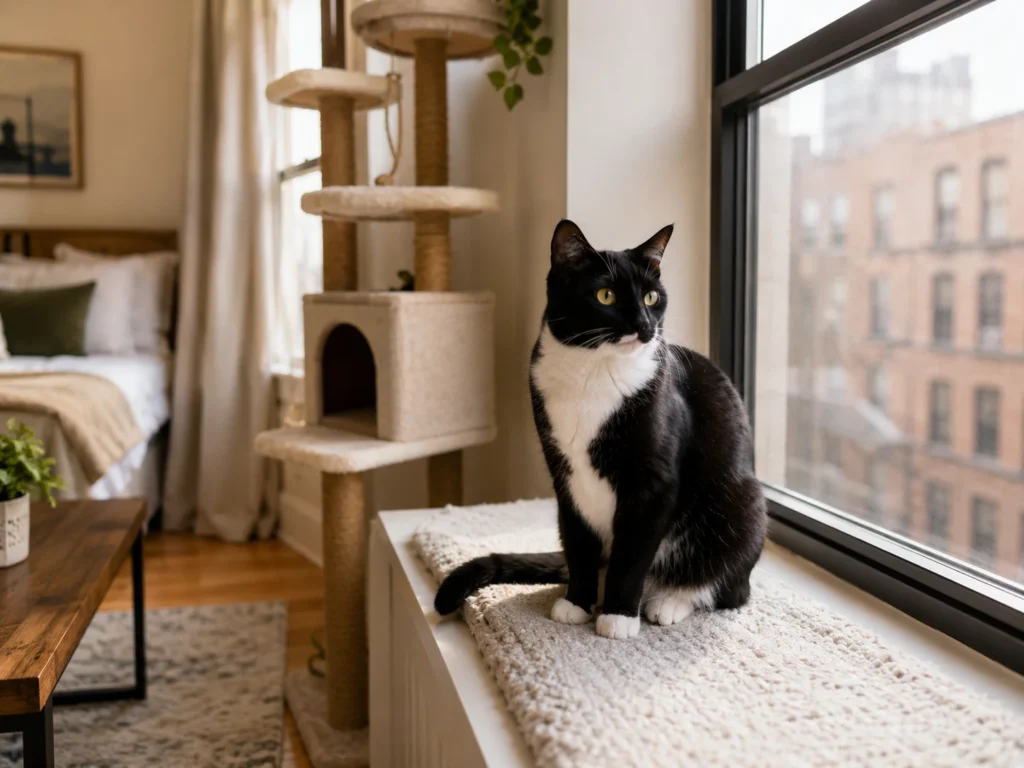
Choosing a litter-box location is not simply a matter of finding an empty corner or hiding the box from view. The location must feel calm, accessible, and safe to the cat using it.
A good litter-box location is quiet without being isolated, easy to reach without obstacles, and positioned so the cat cannot be trapped or blocked by another cat, dog, child, closed door, or sudden household activity.
The best location will depend on your home and your cat. However, the same basic principles work in most households.
Quick Answer
Put your cat’s litter box in a quiet, accessible part of the home where they can approach and leave without being startled, cornered, or blocked.
The location should normally be:
- away from washing machines, dryers, busy doors, corridors, and other sudden disturbances;
- separate from food and water;
- accessible at all times, including overnight;
- reachable without climbing over furniture or passing another animal;
- open enough for the cat to see what is approaching;
- supported by more than one exit route where possible;
- close enough for kittens, older cats, and cats with limited mobility;
- distributed across different areas and floors when you have multiple boxes.
Several boxes grouped together in one room may still function as one toileting location. If you are deciding how many boxes your household needs before choosing their locations, start with our guide to how many litter boxes cats need.
What Makes a Good Litter-Box Location?
A suitable location should pass six practical tests.
1. Is it quiet?
Your cat should be able to use the box without being repeatedly disturbed by people, pets, doors, machinery, or sudden movement.
Quiet does not mean completely silent. Normal household sounds may be acceptable if they are predictable and do not make the cat feel threatened. The problem is usually abrupt or unavoidable activity, particularly when the cat is in a vulnerable position.
2. Is it always accessible?
The box should remain available whenever your cat needs it.
A location is unreliable if:
- someone regularly closes the door;
- furniture blocks the route;
- a child gate prevents access;
- another pet sleeps beside the entrance;
- the cat must wait for someone to let them into the room;
- the route becomes unavailable at night;
- stairs are difficult for the cat;
- household clutter narrows the approach.
Think about access from the cat’s perspective, not only whether you can physically see a path.
3. Can your cat approach safely?
A box can be in a calm room but still have an unsafe route.
A cautious cat may avoid the box if they must pass another cat’s resting place, walk beside a dog’s bed, cross a busy hallway, or enter through a narrow doorway where another animal often waits.
The entire journey matters—from the places where your cat normally rests to the box and back again.
4. Can your cat see what is approaching?
Cats can feel vulnerable while urinating or defecating. A location that allows them to notice people or animals approaching may feel safer than a cramped dead end.
The Feline Veterinary Medical Association’s house-soiling guidance advises avoiding locations where a cat could be cornered, blocked, or unable to flee.
This is why a hidden closet, narrow utility room, or space beneath low furniture is not automatically private or comfortable.
5. Can your cat leave easily?
Where possible, choose a location that does not depend on one easily controlled exit.
The ASPCA’s litter-box guidance recommends locations where cats can see what is approaching and have more than one way to leave if they become anxious.
Not every home offers two literal doorways. The practical goal is to avoid placing the box at the end of a narrow, enclosed route where another animal can trap the cat.
6. Is it separate from food and water?
Cats generally prefer to keep toileting areas apart from places where they eat and drink.
Avoid placing the litter box directly beside food bowls, water bowls, or a feeding station. If space is limited, create as much separation as the room allows and avoid arranging everything in one congested corner.
For the water side of the layout, Where Should You Put Your Cat’s Water Bowl? explains how to create practical separation without relying on a rigid distance rule.
Quiet and Private Should Not Mean Hidden and Trapped
People often assume that cats want their litter boxes hidden in the most isolated part of the home. Privacy is useful, but isolation can create other problems.
A box may be visually discreet while still being suitable. For example, it might sit in a quiet corner with an open view of the room or behind a partial screen that does not obstruct access.
A location becomes more concerning when the cat must:
- squeeze through a narrow gap;
- enter a cupboard or closet with one exit;
- use the box beneath low furniture;
- pass through a door that may close;
- walk into a room occupied by another pet;
- turn their back on the only approach;
- remain beside a noisy appliance.
The goal is not to hide the cat while they eliminate. It is to give them calm surroundings without removing their awareness or ability to leave. The box design can affect the same tradeoff, so compare covered and uncovered litter boxes if a hood may limit visibility or leave one main exit.
Avoid Sudden Noise and Busy Household Areas
Laundry rooms are common litter-box locations because they have washable floors and keep the box away from living areas. Unfortunately, they can also contain some of the least cat-friendly conditions.
Washing machines and dryers can start suddenly, vibrate, change cycles, or make loud alarms. A cat startled while using the box may become hesitant to return.
The Ohio State University Indoor Pet Initiative recommends keeping litter boxes away from appliances and air ducts that may suddenly activate.
Other potentially disruptive locations include:
- beside frequently used exterior doors;
- next to a slamming cabinet;
- near a loud television or speaker;
- in a busy entranceway;
- beside a child’s play area;
- near a dog’s feeding or sleeping area;
- in a corridor with constant foot traffic;
- beside a cat flap used by unfamiliar or competing cats.
A laundry room is not automatically unsuitable. It may work if the room is spacious, the machines do not frighten the cat, access is never blocked, and the household provides another box elsewhere. The cat’s behavior should decide whether the compromise is working.
Check the Complete Route to the Box
Owners naturally focus on the immediate box area, but cats also evaluate how they must get there.
Walk the route mentally from your cat’s usual resting areas. Ask:
- Must the cat pass another animal?
- Is there a doorway where one cat regularly sits?
- Does the route narrow behind furniture?
- Could a dog follow the cat into the room?
- Does the cat need to cross a busy family area?
- Are stairs involved?
- Can doors close along the way?
- Does the route change at night?
- Is the floor slippery or difficult for an older cat?
A box that looks perfectly positioned may go unused because the approach feels unsafe.
In multi-cat homes, blocking does not always involve fighting. One cat may stare, follow, wait in a doorway, occupy the route, or pounce when the other cat leaves. The more cautious cat may begin waiting, rushing, or avoiding the area without an obvious confrontation.
Distribute Multiple Boxes Throughout the Home
When a household has several litter boxes, they should normally be placed in genuinely different areas.
Three boxes lined up in one room still depend on:
- the same doorway;
- the same route;
- the same noise;
- the same household activity;
- the same relationship between the cats.
The Feline Veterinary Medical Association notes that cats may treat boxes positioned close together as one large litter box rather than independent resources.
Separating them gives cats alternative routes and makes it harder for one cat, dog, closed door, or disruptive event to remove access to every box.
The locations do not need to be at opposite ends of a large house. In a smaller home, meaningful separation might mean placing one box in a quiet bathroom and another in a calm corner of the living area rather than grouping both in the bathroom.
Put a Litter Box on Each Regularly Used Floor
A multi-level home should normally have an accessible litter box on every floor the cat uses regularly.
This prevents every toileting trip from depending on stairs or one distant location. It also provides an alternative if a door closes, another pet blocks the route, or the cat’s mobility changes.
Floor-by-floor access is especially important for:
- kittens;
- senior cats;
- cats with arthritis or stiffness;
- cats recovering from an injury or illness;
- cats with impaired vision;
- cats with weakness or poor coordination;
- cats that avoid another pet on the stairs.
A healthy adult cat may be physically capable of using stairs, but that does not mean a box on another floor is equally accessible at every moment.
If an older cat spends most of the day on one level, keep an accepted box on that floor. Do not expect them to climb stairs whenever they need to eliminate simply because they could do so in the past.
Placement for Kittens, Older Cats, and Cats With Limited Mobility
Accessibility changes throughout a cat’s life.
Kittens
Kittens have smaller bladders, less experience navigating the home, and a greater chance of becoming distracted or shut away from a distant box.
Place a box close to the area where a kitten spends most of their time. As their access to the home expands, make sure they can find another suitable box without crossing an intimidating or confusing route.
If the kitten is still developing reliable litter-box habits, How to Litter Train a Kitten provides the complete starter-room, supervision, accident-cleaning, and gradual-expansion process.
Older cats
Older cats may become stiff, slower, weaker, or less willing to travel long distances. They may also find stairs and slippery floors more difficult.
Keep essential resources within easy reach and avoid suddenly moving a familiar box farther away. For a senior-specific assessment of the complete route, stable approach, entrance, usable interior, familiar litter, and gradual transition, see How to Set Up a Litter Box for a Senior Cat.
Cats with mobility limitations
A cat with arthritis, injury, weakness, impaired vision, or another mobility limitation may need:
- a shorter route;
- a box on the same floor as their resting area;
- non-slip flooring around the box;
- an entrance that does not require climbing or jumping;
- additional boxes in the areas they use most.
For guidance on box design and usable space, see our guide to what size litter box your cat needs; for placement purposes, the location and route must remain comfortably usable.
Protect Access From Other Cats, Dogs, and Children
A quiet location can stop feeling safe when another household member controls it.
Other cats
Watch for subtle monitoring or guarding around:
- doorways;
- hallways;
- stairs;
- the box itself;
- the route leading away from the box.
A cat that waits for long periods, approaches cautiously, scans the room, or rushes away may not feel secure.
Dogs
A friendly dog can still make a litter-box location uncomfortable by following the cat, investigating the box, sleeping beside the route, or approaching while the cat is eliminating.
A barrier may help only if the cat can pass through it comfortably and reliably. It should not create a difficult jump or narrow trap. If the dog raids the box or eats litter or waste, see How to Keep a Dog Out of the Cat’s Litter Box for a cat-first decision path covering room barriers, doorway controls, box-design limits, cleanup, and veterinary boundaries.
Children
Young children may unintentionally disturb a cat by following them, touching the box, blocking the exit, or making sudden noise.
Place the box where the child cannot repeatedly approach it but the cat can still enter and leave freely. Supervision and calm household rules are more reliable than expecting the cat to tolerate interruptions.
Choosing Locations in an Apartment or Small Home
Small homes rarely provide several perfect unused rooms. The goal is to choose the safest workable compromise.
Possible locations include:
- a quiet bathroom that remains open;
- a calm corner of a living area;
- a spacious bedroom corner;
- an open utility area away from operating appliances;
- a discreet area behind furniture that does not restrict the route;
- a ventilated alcove with an open approach.
Evaluate each option using the same questions: Is it quiet? Is it always available? Can the cat approach and leave safely? Is it separated from food and water?
Can the box go in a bathroom?
Yes, if the bathroom remains accessible, the door is not regularly closed, and showers, fans, or household activity do not frighten the cat.
A bathroom that is unavailable for long periods is not a reliable sole location.
Can the box go in a bedroom?
It can, provided the cat can access the room at all times and the arrangement is practical for the household. Avoid positioning it directly beside food, water, or the cat’s bed.
Can the box go in a hallway?
A quiet, wide hallway may work, but a busy corridor or narrow route may leave the cat exposed or easily blocked.
Can the box go in a closet?
An open, spacious closet may work in some homes, but enclosed closets often have one narrow entrance and poor ventilation. Never depend on a closet if its door can close and remove access.
Human convenience still matters because the box must be cleaned consistently. However, a convenient location that the cat avoids is not a successful compromise. For practical advice on maintaining boxes throughout the home, see how often you should clean a cat litter box.
If litter scatter makes an otherwise suitable location difficult to maintain, our guide to why cats kick litter everywhere explains the physical setup changes that may help.
How to Add or Move a Litter Box Gradually
If your cat already uses a litter box reliably, do not abruptly remove their accepted location.
Add the new location first
Place an additional box in the proposed location while keeping the familiar box available.
Use the litter and basic setup your cat already accepts. This allows you to test the location without simultaneously asking the cat to accept a different box, litter, scent, and route.
Let your cat investigate voluntarily
Do not carry your cat to the new box, repeatedly place them inside it, or confine them with it.
Forced placement can make the box or location feel less safe. Allow the cat to discover it without pressure or attention.
Maintain both boxes
Keep both locations clean during the transition. A new box that quickly becomes dirty will not provide a fair test of whether the location works.
Watch how your cat uses the new location
Look for relaxed use rather than simply counting visits.
A cat may prefer one box for urine and another for stool. Uneven use does not necessarily mean the less-used box has no value. It may still provide backup access when the preferred route is unavailable.
Move an established box slowly if necessary
The ASPCA’s general cat-care guidance recommends moving a necessary litter-box relocation by only a few inches each day.
For a larger move, adding a second box at the destination and preserving the old one until the new location is accepted may be less disruptive.
Avoid changing the location, litter, box design, litter depth, and cleaning routine all at once. If your cat objects, you will not know which change caused the problem.
Signs That a Location May Not Be Working
Your cat cannot tell you that a hallway feels unsafe or that the washing machine frightened them, but their behavior may provide clues.
Watch for a cat that:
- approaches the box cautiously;
- repeatedly scans the room before entering;
- waits until another pet leaves;
- uses the box only at quiet times;
- runs away immediately after eliminating;
- leaves waste uncovered after previously covering it;
- eliminates beside the box;
- avoids one box but uses another;
- pauses or turns back along the route;
- is followed or watched by another cat;
- stops using the box after a household change;
- suddenly chooses a quieter area of the home.
A cat that rushes away may leave waste uncovered because they feel exposed, although discomfort, litter, cleanliness, and individual habit can also contribute. Our guide to why cats sometimes do not cover their poop examines those possibilities more closely.
Do not assume that every accident proves the location is wrong. Medical discomfort, stress, cleanliness, litter preference, and the box itself may also affect use.
If your cat is settling down or sleeping inside the tray, Why Does My Cat Sleep in the Litter Box? explains the urgent signs to check and how to assess resting options without assuming the location is the only cause.
When Placement Changes Are Not Enough
Changing or adding a litter-box location cannot treat pain, urinary disease, constipation, diarrhea, arthritis, or another medical problem.
Contact a veterinarian if your cat:
- suddenly avoids an accepted litter box;
- urinates or defecates outside the box unexpectedly;
- strains to urinate or defecate;
- cries or appears painful in the box;
- has blood in their urine or stool;
- makes repeated visits to the box;
- produces unusually small amounts of urine;
- develops persistent diarrhea or constipation;
- drinks or urinates much more than usual;
- appears lethargic, hides, loses their appetite, or seems unwell.
Our guide to why cats pee outside the litter box explains the medical, environmental, stress-related, and setup-related possibilities in more detail.
Treat little or no urine as urgent
A cat repeatedly trying to urinate while producing little or nothing needs urgent veterinary care.
The Cornell Feline Health Center identifies urethral obstruction as a genuine medical emergency. An affected cat may strain, make frequent attempts, cry, and produce little or no urine.
Male cats have a higher risk of obstruction, but any cat showing these signs needs immediate veterinary attention. Do not wait to see whether moving or cleaning the box solves the problem.
Common Mistakes to Avoid
Choosing solely for human convenience
A hidden box may look tidier, but the location fails if the cat cannot reach or use it comfortably.
Assuming quiet means isolated
An isolated closet or dead-end room may make a cat easier to corner. Quiet, open access is usually more important than complete concealment.
Placing every box together
Several boxes in one room still depend on one route and one social area. Distribute them whenever possible.
Using a noisy laundry room without an alternative
A laundry room may work for some cats, but sudden machinery, vibration, and a narrow entrance can make it unsuitable for others.
Ignoring the route
The box itself may be acceptable while another cat, dog, staircase, door, or busy hallway makes the journey difficult.
Moving the only accepted box suddenly
Add the new location first or move the existing box gradually. Do not remove the cat’s familiar option before the replacement has been accepted.
Changing everything simultaneously
Altering the box, location, litter, depth, and cleaning routine together creates unnecessary uncertainty.
Punishing or forcing the cat
Do not scold your cat, carry them to the box, rub their nose in an accident, or confine them with the box. Punishment can increase fear and make the location feel even less safe.
Helpful Related Guides
- How Many Litter Boxes Do Cats Need?
- How Often Should You Clean a Cat Litter Box?
- Why Is My Cat Peeing Outside the Litter Box?
- Why Doesn’t My Cat Cover Their Poop?
- Why Does My Cat Kick Litter Everywhere?
FAQ
Final Thoughts
Put your cat’s litter box somewhere quiet, accessible, and separate from food and water—but do not confuse privacy with isolation.
A good location allows your cat to approach, use, and leave the box without sudden noise, difficult routes, closed doors, or another animal controlling access. In multi-level or multi-cat homes, distribute boxes so that one blocked area does not remove every option.
Keep familiar locations while introducing changes, and let your cat investigate without pressure. If litter-box behavior changes suddenly or your cat shows pain, blood, straining, repeated visits, or difficulty producing urine, treat it as a possible health problem rather than continuing to experiment with placement.