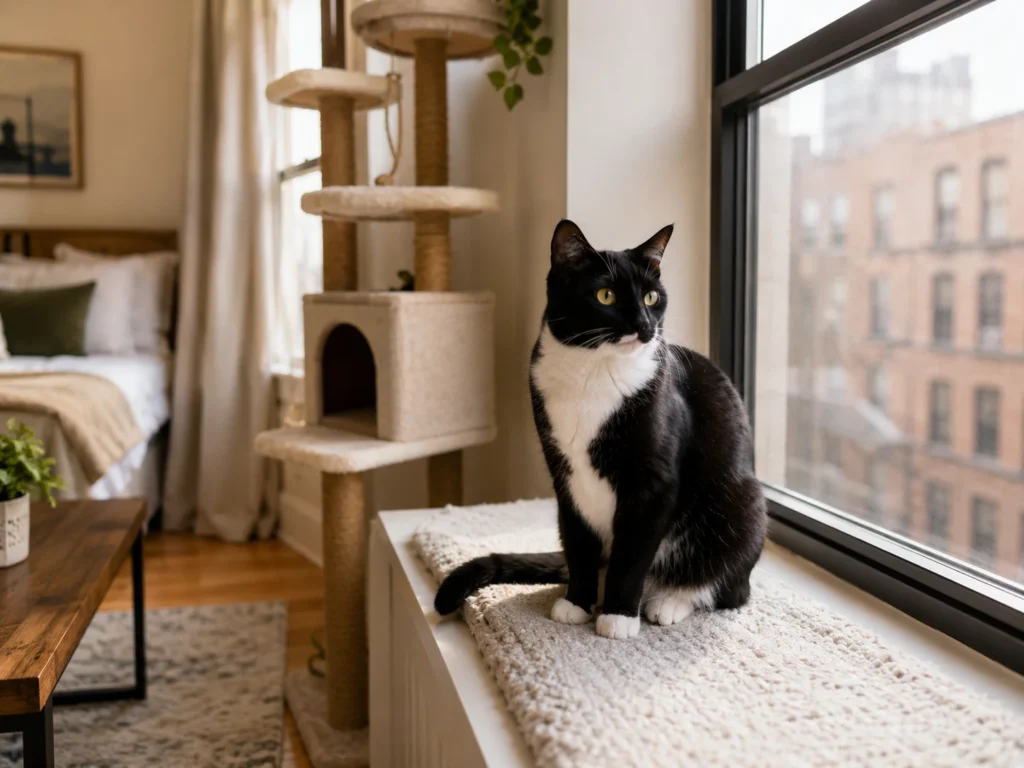
Your cat sleeps through much of the day, ignores the toy you bought and then suddenly races around the house, meows for attention or interferes with whatever you are doing. Does that mean they are bored?
Possibly—but no single behavior proves it.
Boredom or insufficient stimulation is more plausible when there is a repeated pattern of frustrated activity-seeking or limited engagement, your cat has few suitable opportunities to play, explore, climb, scratch or observe, and carefully chosen enrichment produces an improvement.
The same behavior can also reflect normal feline rest, individual temperament, stress, pain, illness, reduced mobility or conflict with another cat. The safest approach is to observe the whole pattern rather than deciding from one sign.
Quick Answer
Your cat may be bored or under-stimulated if they repeatedly seek activity, redirect hunting or play behavior toward unsuitable targets, seem restless when awake or have few meaningful ways to interact with their environment.
Before blaming boredom, ask:
- Is this different from my cat’s normal behavior?
- Does my cat have suitable opportunities, not merely a collection of unused objects?
- Could stress, pain, illness, age or another cat be affecting the behavior?
- Does one small, appropriate change lead to voluntary improvement?
Sleeping frequently, resting calmly, spending time alone or rejecting one toy does not automatically mean a cat is bored. A sudden or substantial behavioral change—especially one accompanied by physical symptoms—deserves veterinary attention.
Boredom Is a Possibility, Not a Diagnosis
Cats cannot tell us that they are bored, and there is no single posture, sound or behavior that confirms it.
What looks like boredom can have several explanations. A cat that wanders and vocalizes may be seeking play, anticipating food, responding to a disrupted routine, experiencing stress or feeling unwell. A cat that no longer jumps onto a favorite perch may have lost interest—but they may also be in pain or less mobile. A cat that sleeps more could simply have a calm routine, or their activity may have changed because of illness.
This is why it is better to treat boredom as a hypothesis to investigate rather than a diagnosis.
The question is not merely, “Does my cat do something associated with boredom?” It is:
“Does this pattern make sense when I consider my cat’s normal behavior, health, environment, opportunities and response to change?”
Look for Patterns, Not Isolated Signs
Possible under-stimulation becomes more convincing when several observations fit together.
Repeated Activity-Seeking
Your cat may follow you, vocalize, interrupt activities or repeatedly approach places where play or food normally appears. This is more informative when it happens regularly and your cat settles after an appropriate activity.
Attention-seeking alone does not prove boredom. Your cat may want food, reassurance, access to a room or a familiar social routine.
Frustrated or Misdirected Play
Some cats stalk ankles, pounce on hands, chase household objects or play roughly when they lack suitable outlets for predatory behavior.
However, these behaviors can also be learned, accidentally encouraged or triggered by movement. They require a safe response, not simply more excitement. Hands and feet should not be used as toys.
Repeated Investigation or Interference
A cat with little available activity may repeatedly open cupboards, knock objects down, climb onto work surfaces or interfere with whatever receives your attention.
These actions may provide movement, sound, novelty or a reaction from you. But investigation is also normal feline behavior, and one curious incident does not indicate a welfare problem.
Destructive Behavior
Boredom may contribute to chewing, scratching or damaging objects, particularly when the cat lacks acceptable alternatives. It should not be assumed to be the only cause.
Scratching is normal communication and claw-maintenance behavior. Chewing may present a medical or safety concern. House-soiling, excessive grooming and aggression also require a broader assessment rather than a boredom label.
Limited Variety When Awake
A cat may have a narrow daily routine because there are few usable opportunities available. For example, toys may remain untouched in a basket, the only perch may be inaccessible, or another cat may control access to important areas.
Low activity is not automatically boredom. A quiet cat may be content, and an older or less mobile cat may prefer slower, easier forms of engagement.
Repetitive Behavior
Pacing, circling, persistent overgrooming, repeated vocalization or other difficult-to-interrupt behavior should not be casually dismissed as boredom.
Repetitive behavior can have medical, neurological, stress-related or behavioral causes. A veterinarian should assess persistent or harmful patterns, especially if there is hair loss, damaged skin, self-injury or a major change from normal.
What Does Not Prove That Your Cat Is Bored?
Some normal behaviors are easily misinterpreted when owners are worried about stimulation.
Boredom is not established merely because your cat:
- sleeps for much of the day;
- rests calmly while the home is quiet;
- watches rather than immediately joining a game;
- declines a particular toy or puzzle feeder;
- plays in short bursts;
- prefers gentle interaction to vigorous activity;
- spends time alone;
- repeats a familiar daily routine;
- becomes gradually less active with age.
Cats differ in age, health, temperament, confidence and preferred activities. One cat may chase a wand toy enthusiastically, while another prefers to stalk slowly from behind furniture. One may investigate every new object, while another needs several days before approaching it. If toy nonengagement is your specific concern, Why Won’t My Cat Play With Toys? explains how to assess movement, timing, environmental pressure, and changes from normal without assuming boredom.
If sleep is your main concern, Why Does My Cat Sleep So Much? explains how to distinguish normal rest from a concerning change.
Start with What Is Normal for Your Cat
Your cat’s individual baseline is more useful than a generic list of boredom signs.
Before changing the environment, consider:
- When did the behavior begin?
- Is it new, or has your cat always behaved this way?
- How frequently does it occur?
- How long does it last?
- Does it happen at a particular time or in a particular place?
- What happens immediately before and after it?
- Has the household routine changed?
- Have people, pets, noises or outdoor cats appeared or disappeared?
- Is your cat eating, drinking, grooming and using the litter box normally?
- Can your cat still walk, jump, climb and turn comfortably?
- Has their response to touch or handling changed?
A short written or video record can help. Note the time, location, preceding event and what appeared to stop the behavior. Video may also help a veterinarian understand an intermittent problem, provided you can record it safely without provoking the cat.
Look for change over several days rather than relying on one unusually quiet or energetic afternoon.
Check for Explanations That Need a Different Response
Enrichment can improve a cat’s environment, but it cannot safely replace medical or behavioral assessment when something else may be wrong.
Pain or Illness
Cats often show pain through changes in behavior rather than an obvious injury.
Possible warning signs include:
- reduced appetite;
- hiding or withdrawal;
- reluctance to jump or climb;
- stiffness or difficulty moving;
- reduced grooming;
- sensitivity to touch;
- litter-box changes;
- aggression or another marked temperament change.
A cat in pain may stop using a formerly popular perch or toy because reaching, chasing or manipulating it has become uncomfortable. Providing more toys will not address the underlying problem.
Appetite, Weight or Elimination Changes
Changes in eating, drinking, weight, urination or bowel movements should not be attributed to boredom without veterinary guidance.
Repeated litter-box visits, straining, crying while attempting to urinate or producing little or no urine require urgent veterinary attention. Vomiting, diarrhea, persistent constipation or a meaningful change in appetite also deserves appropriate assessment.
Stress, Fear or Environmental Disruption
Restlessness, vocalization, hiding, reduced play, aggression and changes in social behavior can all occur when a cat feels threatened or unable to predict what will happen.
Possible triggers include building work, visitors, a move, altered feeding times, outdoor cats, strong scents, loud noises or conflict with another pet.
How Can I Tell If My Cat Is Stressed? provides a fuller framework for identifying stress-related changes.
Conflict in a Multi-Cat Home
Owning more than one cat does not guarantee companionship or prevent boredom. Some cats enjoy living together; others merely tolerate one another.
Conflict can be subtle. One cat may block a doorway, stare at another, occupy the only high perch or make it difficult for the other cat to reach food, water, resting areas or litter boxes.
The number of resources matters, but so do their locations. Several bowls placed side by side may still function as one feeding station. A toy in a shared room is not a useful opportunity if a less confident cat will not enter while the other cat is present.
Mobility Limitations
A cat may appear less interested because the available activity is physically difficult.
Arthritis, injury, excess weight, weakness or age-related change can make jumping, chasing, bending or balancing uncomfortable. Adaptations might include lower perches, stable steps, nonslip surfaces and slower ground-level play—but a new mobility change should first be discussed with a veterinarian.
Cognitive or Sensory Changes
Older cats can experience changes in vision, hearing, sleep–wake patterns, spatial awareness and cognitive function.
Disorientation, nighttime vocalization, altered interaction, house-soiling or a major change in routine should not be dismissed as boredom or “just old age.” A veterinarian can investigate medical causes and help determine what support is appropriate.
Audit Opportunities, Access and Choice
If your cat appears physically well and the behavior is not sudden or severe, examine what the home actually allows them to do.
The key distinction is between possessing an object and providing a usable opportunity.
Safe Resting and Hiding
Can your cat retreat somewhere quiet without being followed, cornered or disturbed? A secure resting place is not wasted space or evidence that your cat is avoiding life. Rest and privacy are important parts of a suitable environment.
Climbing and Observation
Does your cat have a stable, accessible place from which to observe the room? Some cats value height; others prefer a covered spot or a ground-level view.
If elevation appears to be the missing opportunity, Why Do Cats Like High Places? explains how height can provide observation, distance and greater control over interaction.
Scratching
Is there a stable scratching surface of a suitable material, height and orientation near the places where your cat already wants to scratch?
A small, unstable post hidden in an unused room may technically exist but provide little practical value.
Play and Predatory Behavior
Does your cat have regular opportunities to watch, stalk, chase, pounce and capture something safely?
Play should suit the individual cat. Fast overhead movement may excite one cat and overwhelm another. Some cats prefer prey-like movement close to the floor, pauses behind objects or brief sessions at predictable times.
Food-Related Activity
If appropriate for your cat’s diet and health, part of the normal food allowance can sometimes be used for a simple search or food puzzle.
A puzzle should be introduced at an easy level and should not prevent the cat from obtaining adequate food. How to Use a Puzzle Feeder for Your Cat explains how to begin without creating unnecessary frustration.
If your cat prefers exploring different spots, a simple food hunt offers another way to use part of their familiar food without introducing a feeder mechanism.
Cat-Controlled Social Interaction
Does your cat have opportunities for calm contact while retaining the choice to approach or leave?
More handling is not always better. Some cats enjoy being stroked or spoken to; others prefer sitting nearby or participating in play without being touched. Interaction should respect the cat’s preferences.
Variety Without Constant Disruption
Small changes can make familiar spaces more interesting, but novelty should not overwhelm the cat.
A rotated toy, repositioned box or occasional paper packing material may be enough. Avoid changing every resource at once or repeatedly disturbing the places where your cat feels secure. If toy rotation is the right experiment, How to Rotate Cat Toys to Keep Them Interesting provides a flexible system without requiring every toy or resource to change at once.
Real Access in Multi-Cat Homes
Can each cat reach important resources without passing, confronting or being watched by another cat?
Observe actual use rather than assuming equal access. Separate resources and individual play opportunities may be more useful than simply adding more objects to the same shared area. If play access is the problem, How to Play With Multiple Cats provides a practical system for individual turns, compatible group sessions, and competition control.
Run a Small, Low-Pressure Enrichment Test
Once you identify a plausible gap, make one or two manageable changes.
1. Choose the Most Likely Missing Opportunity
For example, you might notice that your cat repeatedly seeks moving targets but receives little interactive play, or that they climb unsuitable furniture because they have no stable observation point.
Choose the change that most directly matches the pattern.
2. Match It to Your Cat
Consider age, health, confidence and established preferences. An athletic young cat and a stiff senior cat should not be given the same physical challenge.
3. Keep the Starting Point Easy
Let the cat discover the new opportunity voluntarily. Do not push them toward a toy, place their paws on a puzzle or lift them onto a perch they are reluctant to use.
4. Preserve Accepted Resources and Routines
Do not remove a favorite bed, feeding place or hiding spot to force use of something new. Keep the rest of the routine reasonably stable so the change is easier to evaluate.
5. Observe Rather than Persuade
Watch whether your cat approaches, investigates, uses or returns to the opportunity. Brief observation can still be part of engagement, especially with a cautious cat.
6. Record the Original Behavior
For several days, note whether the behavior that concerned you becomes less frequent, less intense or easier to interrupt.
7. Adjust Gradually
If the change is ignored, it may be poorly located, too difficult, uninteresting or physically inaccessible. Simplify or reposition it before assuming your cat dislikes that whole type of activity.
This is an observational trial, not a medical test. Improvement suggests that the change met a need, but it does not prove that boredom was the sole cause.
How to Tell Whether the Change Helped
Useful signs of improvement may include:
- voluntary engagement with the new opportunity;
- more varied use of the home;
- calmer settling after play or exploration;
- fewer attempts to redirect activity toward hands, feet or unsuitable objects;
- reduced frequency or intensity of the original behavior;
- continued normal eating, grooming, movement, sleep and litter-box use.
Do not judge success only by how long your cat plays. Some cats engage intensely for a few minutes and then rest. Others prefer watching, sniffing or investigating at a slower pace.
Research has found associations between owner-reported play behavior and feline welfare, but this does not mean that increasing play will resolve every behavior problem. The response still needs to match the cat and the suspected gap.
If nothing changes, reconsider your explanation. The activity may be unsuitable, the behavior may serve a different purpose, or medical or environmental factors may be involved.
Match the Response to the Gap
Once you know what appears to be missing, use the most relevant response rather than adding random toys.
- For a play gap, see How Much Playtime Does a Cat Need Each Day?.
- For a broader environmental gap, see How Can I Keep an Indoor Cat Entertained?.
- To compare owner-led and independent play, see Interactive or Solo Cat Toys: Which Does Your Cat Need?.
- Before introducing unfamiliar play objects, see How to Choose Safe Toys for Your Cat.
- For food-based activity, see How to Use a Puzzle Feeder for Your Cat.
You do not need to add everything at once. One well-matched, accessible opportunity is more informative than filling the room with objects your cat does not understand or enjoy.
When to Contact a Veterinarian
Contact a veterinarian if the behavior is sudden, substantial, severe, persistent or difficult to interpret.
Veterinary assessment is particularly important when the change occurs with:
- reduced or increased appetite;
- weight loss or gain;
- increased thirst;
- vomiting, diarrhea or constipation;
- urinary changes or litter-box difficulty;
- reduced jumping, stiffness or altered movement;
- sensitivity to touch;
- hiding, weakness or marked withdrawal;
- poor or excessive grooming;
- damaged skin or self-injury;
- breathing changes;
- persistent repetitive behavior;
- disorientation or a major sleep–wake change in an older cat.
Seek urgent veterinary help if your cat has trouble breathing, collapses, cannot stand, appears to be in severe pain or repeatedly strains to urinate while producing little or no urine.
If medical causes have been assessed and a serious behavior problem continues, your veterinarian may recommend a suitably qualified feline behavior professional. This can be especially helpful for persistent fear, intercat conflict, aggression or repetitive behavior.
Common Mistakes to Avoid
Do not label a naturally quiet cat as bored simply because they do not behave like another cat.
Do not assume that buying more toys automatically creates enrichment. Location, movement, accessibility, difficulty and the cat’s preferences all affect whether an object becomes useful.
Avoid forcing interaction or play. A cat that walks away is communicating that the activity is not suitable at that moment.
Do not change the entire home at once. Large changes can create stress and make it impossible to tell what helped.
Do not get another cat as a simple cure for boredom. A second cat introduces new social and resource needs and may create conflict rather than companionship.
Most importantly, do not use enrichment to explain away a behavioral or physical change that needs veterinary attention.
Helpful Related Guides
- How Can I Keep an Indoor Cat Entertained?
- How Much Playtime Does a Cat Need Each Day?
- Interactive or Solo Cat Toys: Which Does Your Cat Need?
- How Can I Tell If My Cat Is Stressed?
- How to Use a Puzzle Feeder for Your Cat
Sources
- FelineVMA: Your Cat’s Environmental Needs
- FelineVMA: How Do I Know if My Cat Is in Pain?
- AAFP/ISFM Feline Environmental Needs Guidelines
- AAHA/AAFP: Behavior and Environmental Needs
- Cornell Feline Health Center: Loving Care for Older Cats
- Merck Veterinary Manual: Behavior Problems of Cats
- Henning et al.: Cats Just Want to Have Fun—Associations Between Play and Welfare in Domestic Cats
- Ellis: Environmental Enrichment—Practical Strategies for Improving Feline Welfare
Final Thoughts
Your cat may need more stimulation, but one quiet afternoon, long nap or rejected toy does not prove boredom.
Start with what is normal for your cat. Check their health, routine, environment, access and relationships. If a suitable opportunity appears to be missing, introduce one manageable change and observe what happens.
A voluntary, sustained improvement can help you understand what your cat needed. A sudden, persistent or worrying change deserves a broader assessment—not a quick label.