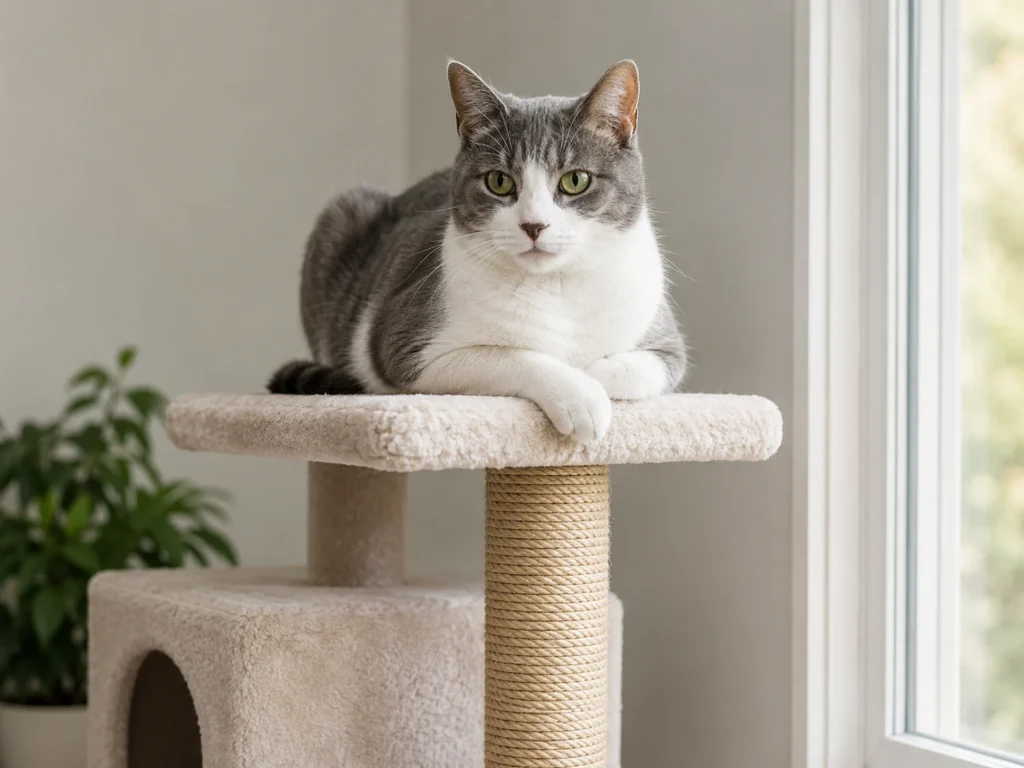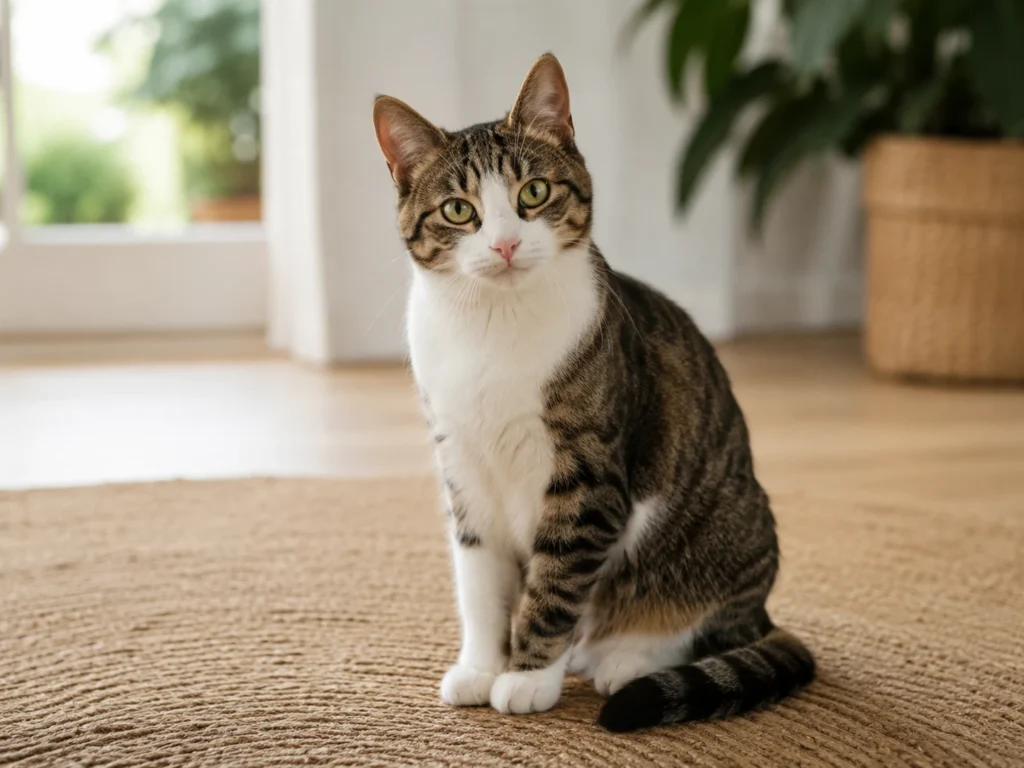
Cats use their tails to help with balance during movement and to communicate. A tail can act as a movable counterweight, and its position can contribute to a cat’s body language. But it is neither the whole balance system nor a message you can interpret on its own. That is why a tail can be useful without being essential to every cat’s ability to balance or communicate.
What a Cat’s Tail Is Made Of
A tail is not one solid bone. Its framework continues from the spine as a series of bones called vertebrae. Discs between them allow flexibility, while muscles and nerves make movement possible. Think of two connected features: a structure that can bend, and the means to change its position. VCA’s veterinary anatomy introduction describes these components; its injury-treatment advice is outside this explanation.
Cats Protection also describes the tail as an extension of the spine and confirms that cats can move it voluntarily. That supports the simple point that a cat can position its tail. It does not establish that every small flick or twitch is a conscious choice. Nor does calling the tail part of the spine mean the spinal cord runs through its entire length.
How the Tail Helps With Balance and Movement
A counterweight is weight positioned to help balance something else. In a cat, the useful idea is movable weight: the tail can be held in different positions while the rest of the body moves. Its flexible structure allows those adjustments. Both Cats Protection and PDSA describe this contribution to steadiness.
For a supported illustration, picture a cat already walking along a narrow ledge. Cats Protection describes the animal adjusting its tail position in that situation to help reduce the risk of falling; PDSA gives the similar example of movement along a fence or wall. This illustrates a moving part helping a moving body, rather than a tail providing balance simply by being present. It is an explanation, not an activity to arrange: never put your cat on a narrow or elevated surface to watch this happen.
An everyday analogy is a person extending their arms to steady themselves. The comparison helps you picture how changing the position of an attached body part can be useful. It does not mean human arms and a cat’s tail perform identical mechanics, or that the tail works as a steering wheel.
The evidence has an important limit: these educational sources describe a counterweight whose position changes, but do not establish which way a domestic cat’s tail moves, when it moves, or the exact tail mechanics during a particular turn. They also do not measure how much it helps. A visible swing is therefore not enough to assign one balancing purpose to that movement, and a helpful tail never makes a fall safe.
The broader question of a whole jump belongs in How Can Cats Jump So High? Here, the important distinction is between helping with balance and explaining every part of the movement.
Why Balance Involves More Than the Tail
Moving a counterweight is different from detecting a change in position and coordinating a response. Cats have a vestibular system, a sensory and control system involving the inner ear and brain. Cornell Feline Health Center’s explanation describes fluid-filled structures and receptors inside the inner ear that send the brain information about head position and movement.
The connection is a sequence: head movement changes the fluid’s movement; receptors respond; signals carry information to the brain; and the system helps coordinate muscular adjustments. Cornell gives turning as an example, explaining that muscles automatically adjust when the cat changes position. This is a description of the vestibular system’s role, not evidence that the tail initiates a turn or swings in a particular direction.
The tail’s mechanical assistance and the body’s sensing and coordination are therefore different contributions. A cat does not rely on a tail alone to know which way it is moving or to organize a muscular response. Keeping those roles separate helps explain why a cat without a full tail can still have balance: having less of one structure is not the same as lacking the entire system.
There are other anatomical questions to explore without making them part of the tail’s job. Why Do Cats Walk on Their Toes? explains the foot arrangement you see when a cat crosses the floor.
How the Tail Becomes Part of Communication
A tail also gives visible clues during an interaction. PDSA’s feline body-language guidance describes an upright tail as commonly associated with confidence, and a puffed-up tail with feeling frightened or threatened. These are possible meanings to consider, not labels that settle what a cat feels.
For example, if your cat approaches with its tail upright, that position may fit a friendly interaction. You still need to notice its ears, eyes, overall posture, and what is happening around it. Likewise, a puffed tail in a tense encounter may fit a threat response, but the tail is only part of that observation. PDSA specifically advises reading the whole animal rather than using tail movement or position alone.
This is why interpreting a signal and deciding to touch a cat are separate decisions. A raised tail does not give permission to handle the tail, pick the cat up, or continue an interaction. If you are unsure, give the cat room rather than pressing for contact. For individual movements and their context, see Why Does My Cat Wag Their Tail?
What About Cats With Short Tails or No Tail?
A short or absent tail does not, by itself, mean a cat cannot balance or communicate. Cats Protection and PDSA describe cats with little or no tail using other parts of those systems. The inner-ear contribution to balance remains relevant, while posture, other body-language signals, and sounds such as meows remain ways to communicate.
VCA’s Manx profile provides a narrow example of balance without a tail. It is a breed description, not a controlled comparison of cats with different tail lengths. It supports rejecting the idea that no tail means no balance; it does not prove identical ability in every individual or show that a particular cat has no health concerns.
A cat’s usual anatomy is also different from a new change. If tail movement suddenly changes or you suspect an injury, contact your veterinarian rather than treating the short-tail explanation as reassurance. PDSA advises veterinary contact for sudden tail changes, especially with other changes. If your cat suddenly loses its balance, seek veterinary advice immediately, as Cornell advises. Do not try to identify the cause by moving or testing the tail.
Watch Without Testing
You can notice your cat’s tail during ordinary, voluntary movement on a flat floor without turning observation into an experiment. Let the cat choose where to go. Do not lift, bend, hold still, or pull the tail to see what changes; Cats Protection warns against pulling it. Watch the whole cat, and allow an ordinary movement to remain just that rather than a test of balance or a message you must decode.
Sources
View Sources and References
All five source pages were accessed on October 20, 2026. These are veterinary or animal-welfare educational resources, not direct measurements of tail mechanics. Similar descriptions do not establish independent experimental confirmation. Article-specific funding was not established for these pages.
Malcolm Weir, Krista Williams, and Lynn Buzhardt. First Aid for Tail Injuries in Cats. VCA Animal Hospitals; updated July 18, 2025. Used for the introductory anatomy only, not treatment. LifeLearn content; VCA identifies itself as a Mars affiliate.
Cats Protection. Why do cats have tails? | Cat tail meanings. June 6, 2024. Feline welfare education on tail structure, positioning, balance, communication, and safety. Numerical trivia, genetics, and categorical emotional interpretations are not adopted.
PDSA. Tail meaning: What your pet’s tail is trying to tell you. Displayed date: March 13; year not established. Used for cat-specific material and general whole-body observation guidance, not its dog examples or post-injury adaptation claims.
Cornell Feline Health Center. Vestibular Syndrome. No article date displayed. Quotes veterinary academic Marnie FitzMaurice. Used for the normal inner-ear/brain mechanism and prompt veterinary-help boundary, not diagnoses, treatment, or recovery expectations.
VCA Powder Paws Animal Hospital. Manx. No author or article date displayed. Used only as a bounded balance example. This breed profile is not a performance study and shares VCA’s Mars affiliation with the anatomy source.