
Yes, cats can breathe under a loose blanket when enough air can reach their nose and mouth. Open edges and gaps in the bedding allow air to move, and some fabrics let air pass through them. But being under a blanket is not automatically safe: thick layers, trapped heat, restricted movement, or fabric covering the face can create problems.
If your cat is panting, breathing with an open mouth, or struggling for breath, gently lift away the covers and contact a veterinarian immediately. Do not wait to see whether removing the blanket fixes it. PDSA’s breathing guidance treats these signs as urgent.
How Do Cats Breathe Under Blankets?
Your cat breathes the air around them; the blanket does not provide oxygen. A loosely draped cover can leave openings where air moves in and out. In contrast, tightly tucked bedding or a pile of heavy covers can restrict both airflow and the cat’s ability to move.
Veterinarian Rhiannon Koehler’s guide to suffocation in cats explains that ordinary blankets generally allow air exchange during a brief snuggle, while thick blankets, multiple layers, and loose strings can be hazards. That is general veterinary guidance, not proof that a particular blanket or sleeping arrangement is safe.
An air pocket around the face is not a lasting oxygen supply. Fresh air still needs to reach that space. A fabric label such as “cotton” or “breathable” cannot tell you how a blanket will behave when folded, tucked in, or covered by another layer.
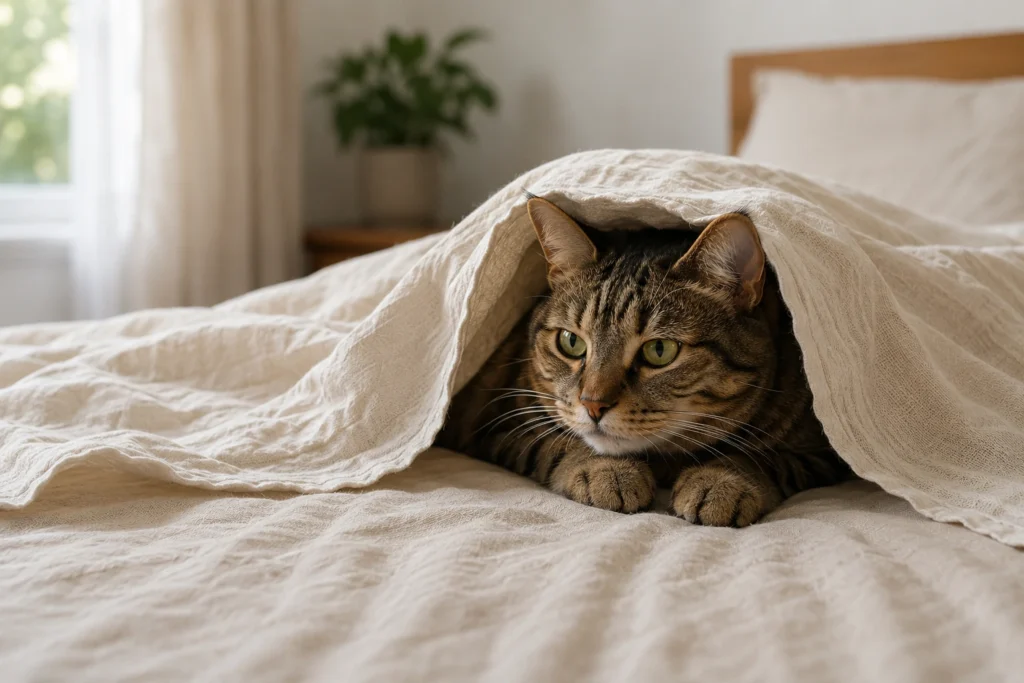
Can Cats Suffocate Under the Covers?
Yes. Cats can suffocate if their breathing is obstructed or they become trapped without enough air. Their small size and ability to squeeze into spaces do not protect them. Do not rely on a cat always recognizing danger and getting out in time.
A cat resting at the open edge of a light cover is in a different situation from one buried beneath a duvet or pinned under a sleeping person. For overnight sleep, an accessible bed beside yours avoids those particular hazards. Past uneventful nights do not establish that an arrangement is safe.
How to Make a Covered Resting Spot Safer
These precautions reduce avoidable risks; they cannot guarantee safety:
- Keep the face and exit clear. Leave the nose and mouth uncovered and a generous opening beside the cat. Do not tuck the edges around them or wrap them into the bedding.
- Use one light, loose layer. Avoid heavy duvets, weighted blankets, and piles of covers over a cat. Do not put plastic bags, storage covers, or waterproof layers over their resting space.
- Check the whole arrangement. Make sure a folded edge cannot pin the cat down and that the route out is not blocked by pillows, furniture, your body, or another pet.
- Avoid extra heat. Choose a comfortable room with an uncovered resting option. Do not add an electric blanket or heating pad to this setup; a cat that needs supplemental warmth should have a veterinarian-recommended arrangement.
- Inspect the fabric. Put away bedding with dangling threads, fringe, or holes that could catch around the neck or limbs. Remove it if your cat chews off pieces.
- Know where your cat is. Check before sitting or lying on a bed, moving bedding, or starting the washer or dryer. When you cannot keep an eye on the setup, offer an open bed or a stable covered bed with a clear entrance.
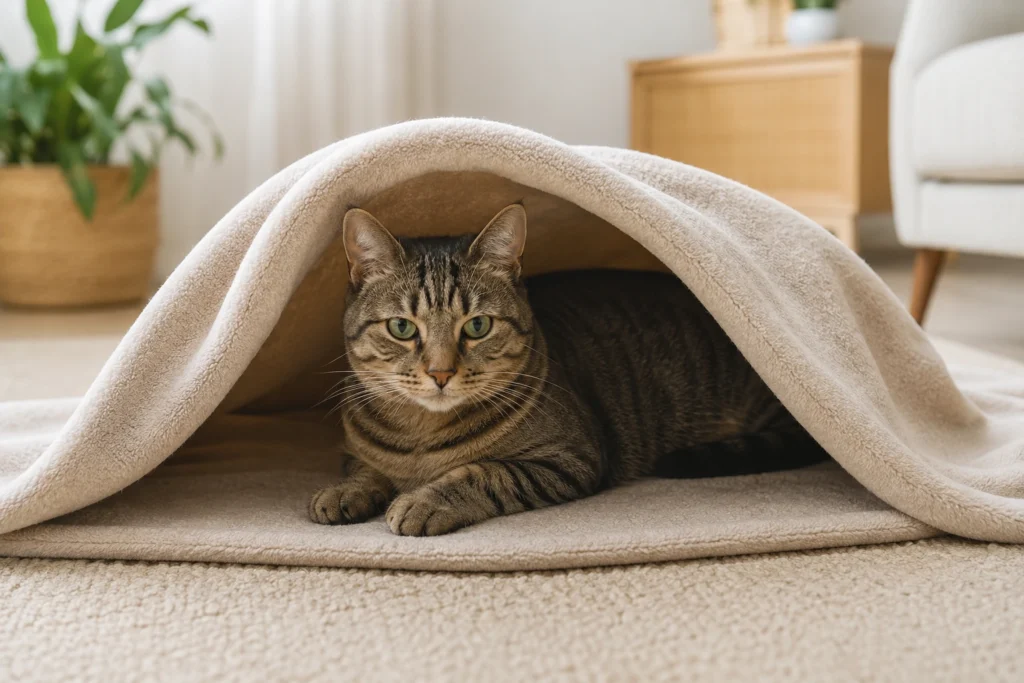
A covered bed or sturdy box with soft bedding on the bottom can provide a sheltered resting place without loose covers over the face. Position it somewhere quiet and easy to reach, with enough room for your cat to turn around and leave. In a home with several pets, make sure another animal cannot corner them there.
Cats That Need Extra Caution
Consider your cat’s mobility and health, as well as the bedding. Very young kittens and cats that are weak or have difficulty moving should have an accessible resting space where they cannot be buried or rolled on. An older cat with arthritis may need a low entrance rather than a deep bed or a jump onto your mattress.
PDSA identifies very young and very old cats, overweight cats, flat-faced cats, and cats with heart or lung disease among those at greater risk of heatstroke. Warmth-seeking behavior does not mean a cat is protected from overheating.
Some flat-faced cats have narrowed or obstructed airways. According to VCA’s guidance on brachycephalic airway syndrome, affected cats may have noisy breathing, reduced exercise tolerance, and signs that worsen in hot or humid conditions. Ask your vet about persistent snoring or noisy breathing rather than assuming it is harmless for the breed.
If your cat has a known breathing condition, heart disease, or limited mobility, ask your veterinarian about suitable bedding. Choose an uncovered resting place while you clarify what is appropriate.
Why Do Cats Like Going Under Blankets?
A blanket may offer warmth, softness, familiar smells, and somewhere to hide from household activity. The Feline Veterinary Medical Association’s home-environment guidance supports providing soft bedding, familiar scents, and places where a cat can retreat. This helps explain the appeal of a covered spot, although it cannot tell you exactly why your individual cat chooses it.
Some cats enjoy being near you; others simply want a quiet nap. You can meet those preferences with a resting place nearby. A cat that prefers sleeping on top of the blanket does not need encouragement to burrow underneath.
Warning Signs and What to Do
Breathing difficulty is an emergency, whatever appears to have caused it. Warning signs include:
- Panting or breathing with the mouth open.
- Obvious effort with each breath, including the belly heaving.
- Rapid, shallow breathing with distress, or stretching the head and neck forward to breathe.
- Blue, gray, or unusually pale gums, collapse, or loss of consciousness.
Maddie’s Fund describes these breathing signs and advises avoiding additional stress. You do not need to see every sign, and you should not force your cat’s mouth open to check gum color.
Gently remove any covering that is restricting them, keep handling to a minimum, and contact your vet or nearest emergency veterinary clinic immediately. Follow their instructions for getting your cat there. Do not delay care to count breaths, take a temperature, or try a home remedy.
Cornell’s Feline Health Center emphasizes that breathing difficulty has many possible causes and needs prompt veterinary assessment. Removing a blanket does not rule out an underlying problem.
For a cat that is comfortable and breathing normally, you can quietly observe the chest or sides while they rest. Breathing should look easy, without marked effort. If you notice a new persistent change, coughing, or wheezing, contact your vet for advice; if breathing becomes difficult, treat it as urgent.
When a New Hiding Habit Needs Attention
A familiar blanket nap and a sudden tendency to hide are different patterns. VCA’s guidance on recognizing illness notes that sick cats may withdraw or hide and show changes in appetite, energy, grooming, or litter box habits.
Contact your vet if blanket hiding is new or increasing, especially alongside eating less, reluctance to move, or other changes. If your cat has also stopped grooming normally, mention that too. A change in sleeping place alone does not diagnose stress or illness, but it is worth describing rather than dismissing.
Helpful Related Guides
- Why Does My Cat Sleep in Weird Places?
- Why Does My Cat Hide Under the Bed?
- Why Does My Cat Sleep Next to Me?
FAQ
How long can my cat stay under a blanket?
The sources reviewed for this guide do not establish a universal safe number of minutes. A timer cannot make restrictive bedding safe. If you cannot tell whether your cat’s face and exit are clear, gently lift the cover and check. For a long or unattended sleep, provide a resting place that stays open without your help.
Should I put a blanket over my cat?
There is no need to cover a cat that has not chosen to burrow. Offer soft bedding to lie on instead. If your cat moves away, tenses, or tries to escape when you approach with a blanket, stop. Watch their body language and respect their preference.
Sources
View Veterinary and Welfare Sources
- PetMD — Suffocation in Cats, by Rhiannon Koehler, DVM
- PDSA — Breathing Problems in Cats
- Maddie’s Fund — Difficult or Labored Breathing in Cats
- Cornell Feline Health Center — Dyspnea (Difficulty Breathing)
- PDSA — Heatstroke in Cats
- VCA Animal Hospitals — Brachycephalic Airway Syndrome in Cats
- Feline Veterinary Medical Association — What Your Cat Needs to Feel Secure
- VCA Animal Hospitals — Recognizing the Signs of Illness in Cats
