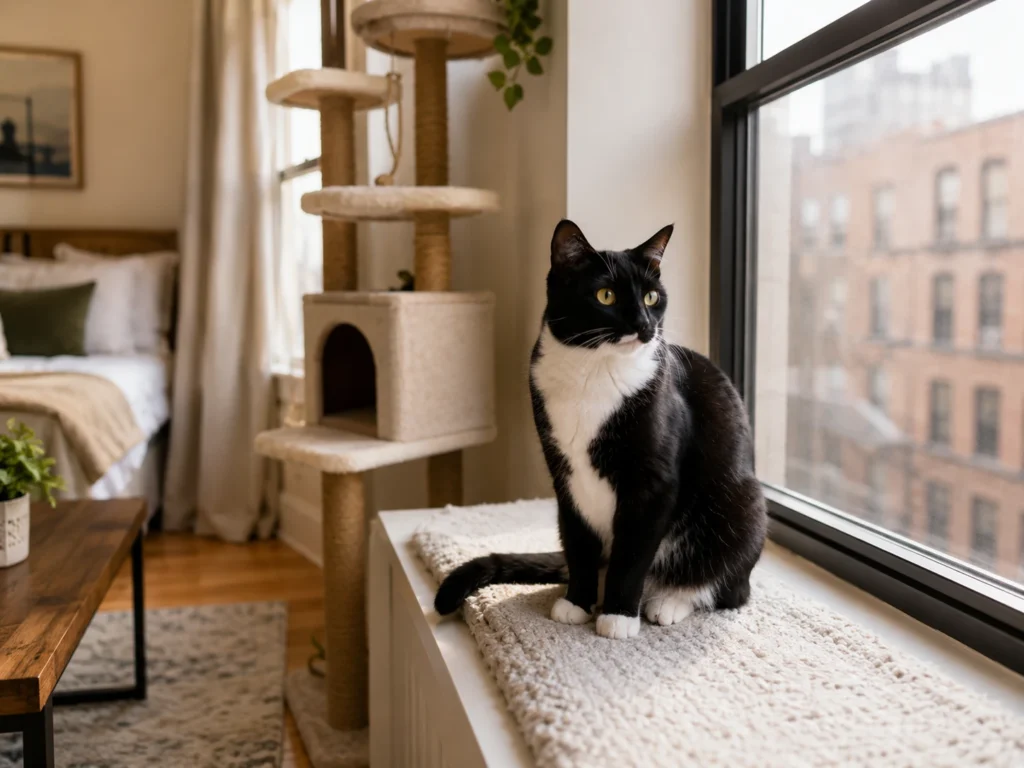
Consider a second cat when your resident cat is comfortable in their current life and your household can provide separate space, individual care, and a workable plan if the cats do not become companions. Resolve health, behavior, access, or care concerns first. Waiting, or keeping a one-cat household, can be the better choice.
The question is not simply whether another cat could fit in your home. It is whether you can protect a good daily life for both cats without depending on friendship. This guide helps you make that decision before searching for a particular cat.
Start With What You Want Another Cat to Change
Wanting to adopt another cat is a reasonable starting point. Assuming your resident cat needs one is different.
The 2024 AAFP Intercat Tension Guidelines explain that cats do not necessarily need feline companionship. Some form close relationships; others do not benefit from sharing their home with another cat. There is no universal rule that cats should live alone or in pairs.
Write down your main reason for considering another cat. Then ask what happens if the new arrival does not provide the benefit you imagine:
- If you hope they will play together, can you still provide suitable play for each cat separately?
- If you want company for your resident cat while you work, can you meet both cats’ needs even if they prefer different rooms?
- If you picture a cuddling pair, would you be content with two cats who live comfortably but choose little contact?
A second cat should not be the plan for reducing the care your first cat receives. Nor should adoption be an experiment to fix unexplained withdrawal, restlessness, or a change in sociability. Those concerns need attention in their own right.
Assess the Cat Already Living With You
Start With Their Current Comfort
Think about your cat’s usual eating, resting, play, grooming, toileting, and movement around the home. Are those patterns comfortable and stable, or have you noticed a change you have not explained?
New irritability, avoidance, or aggression deserves veterinary attention before you attribute it to needing a companion. Cornell’s feline-aggression guidance and the ASPCA’s intercat-aggression guidance both emphasize checking for medical contributors to behavior changes. Ask your veterinarian about the concern rather than postponing care until after an adoption.
If your cat is unwell or their care is not yet stable, pause the adoption decision and get individual veterinary advice. Known health or mobility needs do not automatically rule out another cat. They do affect what you must preserve: accessible resources, manageable routes, rest, and the resident cat’s existing care. Discuss those individual needs with the veterinarian before making a commitment.
Separate Relationship Evidence From Assumptions
If your cat has lived with another cat, describe what actually happened:
- Voluntary companionship: they repeatedly chose close contact, such as resting together or grooming one another.
- Comfortable independence: they shared the home without seeking much contact and could use their resources freely.
- Tension: one repeatedly avoided the other, was pursued or blocked, or struggled to use parts of the home.
- Unknown: you know they shared an address, but not how they lived together.
These are descriptions to discuss, not a compatibility score. Cats Protection’s guidance on getting another cat distinguishes friendship from tolerance and warns that a previous relationship does not establish how a cat will respond to a new individual.
If your cat has always lived alone, keep that uncertainty visible. Do not fill the gap with “must be lonely” or “will never accept another cat.” Equally, being affectionate with people does not answer the cat-to-cat question.
Do not borrow a cat or arrange a forced encounter to find out. An unfamiliar meeting adds risk without giving you a dependable prediction of shared life. Discuss significant past conflict with your veterinarian or a qualified feline behavior professional before restarting the search.
Check Whether the Home Can Support Two Separate Lives
A spare room is useful, but it is only the beginning of the capacity check. The household must work while the cats are apart and, if appropriate, while they later share more space.
The AAFP guidelines and Cats Protection both emphasize separate resources and opportunities to avoid unwanted contact. Apply that principle by walking through your home and considering these questions:
- Separation: Is there a secure area for the newcomer with their own everyday necessities, without displacing the resident cat from essential care?
- Access: Could each cat reach food, water, litter, resting places, hiding options, scratching surfaces, and play without having to approach the other?
- Routes: Would a doorway or narrow passage become the only way to reach everything important?
- Retreat: Can each cat move away and remain undisturbed, using routes suited to their abilities?
- Household use: Will the arrangement still work when doors open, visitors stay, or someone needs the room for another purpose?
Sketching the locations can reveal a problem that a shopping list misses. Extra equipment grouped in one corner does not necessarily create independent access. Count usable options, but also look at where they are and how a cat reaches them.
Do not rely on a larger home, more products, or an introduction technique to compensate for an arrangement you cannot maintain. If a necessary space is only available temporarily, resolve what happens afterward before committing.
Plan for the Work Even If Friendship Never Develops
Prepare for caring for two individuals, not just adding another bowl.
Discuss who will feed, clean, play, provide attention, arrange veterinary care, and notice changes in each cat. Include backup care. A helper who can visit one freely roaming cat may not be able or willing to manage separate areas and different routines.
Your budget needs to accommodate both cats’ ongoing care and unexpected veterinary needs, plus professional behavior support if needed. There is no useful universal dollar threshold. The question is whether the actual commitments fit your household without reducing either cat’s care.
Agree on expectations with everyone who shares responsibility. If one person will only accept the arrangement if the cats quickly share all their space, you have an unresolved limit, not an introduction plan.
Make the Fallback Concrete
Before adopting, establish what you could do if the cats cannot live comfortably together:
- Can you maintain suitable separation while obtaining veterinary and behavior advice?
- Who can help with the additional care?
- What support does the adoption organization offer?
- If the placement cannot continue, what are its actual return arrangements and responsibilities?
This is planning, not a recommendation to give up at the first difficulty. It also is not a promise that indefinite separation will be workable or fair in every home. The ASPCA recognizes that some cats cannot live peacefully together and that long-term arrangements may need reconsideration.
Do not make “they will eventually get used to it” your only fallback. Neither cat should have to endure persistent fear, restricted access, or repeated conflict to preserve the adoption plan. Resolve an unworkable fallback before bringing another cat home.
Choose Your Next Step
The following is Catcredo’s practical decision aid, not a validated test or a prediction of compatibility.
| Decision | What It Means Now |
|---|---|
| Proceed to Candidate Assessment | Your resident cat’s needs are understood, essential space and care are available, and you can accept uncertainty without depending on friendship. Begin discussing suitable individuals with an adoption organization. |
| Resolve First | A specific concern could change the decision: an unexplained behavior change, an access problem, an unconfirmed caregiver, or unclear fallback support. Name the issue and obtain the assessment or arrangement before choosing a cat. |
| Wait or Decline | You cannot currently protect both cats’ daily welfare, sustain the extra care, or accept the possible outcome. Keep the household as it is rather than hoping a particular cat will remove those limits. |
A strong point in one column cannot cancel a serious problem elsewhere. Previous friendly relationships do not make missing care manageable; ample space does not explain a new behavior change.
A Hypothetical Decision: A Room Is Available, but the Plan Is Not
Leah wants another cat and has a secure spare room. Her resident cat is settled, and she has budgeted for another cat’s care. At first, she considers herself ready.
Then she checks the plan with the person who looks after her cat during work trips. That helper can manage the existing routine but cannot provide separate care in different parts of the home. Leah had assumed the cats would share space by her next trip.
Her decision is resolve first. She needs a confirmed care arrangement that works even if the cats remain separate. Once that is in place, she can begin discussing suitable candidates. It still does not tell her which cat will be a good match or promise that the cats will become friends.
The useful change is practical: Leah has removed a deadline that might otherwise put pressure on both cats.
If You Proceed, Take Your Limits Into the Adoption Conversation
Bring a short account of your resident cat’s current routine, known relationships, individual needs, available space, and care limits. Be explicit about uncertainty and about the arrangements you can actually sustain.
Use What to Ask a Shelter Before Adopting a Cat for the separate task of evaluating a particular candidate’s history and needs. Once a suitable placement is agreed, How to Introduce a New Cat to Your Resident Cat covers the introduction process.
Proceeding here means you are ready for that next conversation, not that you have proved compatibility. If the conditions are not right, choosing not to add a cat is a complete, responsible decision.
Helpful Related Guides
Sources
View Sources and References
2024 AAFP Intercat Tension Guidelines: Recognition, Prevention and Management. Research-informed veterinary guidance on individual social needs, relationships, resource access and welfare. The decision aid in this article is Catcredo’s practical synthesis, not a validated compatibility test.
Cats Protection: Getting Another Cat. Welfare guidance on previous relationships, household capacity and separate resources. Broad solitary-cat statements, fixed resource formulas and product recommendations are not adopted here.
Cornell Feline Health Center: Feline Behavior Problems: Aggression. Supports veterinary assessment of possible medical contributors to changed behavior. Treatment and confrontation-management instructions are outside this article’s scope.
ASPCA: Aggression Between Cats in Your Household. Supports medical assessment, avoiding forced conflict and recognizing that some shared-living arrangements are not workable. Aversive techniques in the source are not used.