To measure cat food accurately, start with the daily amount already established for that cat and that exact food. Keep the amount in its controlling unit, use a digital scale and the tare function when weighing is appropriate, divide the total without changing it, and record every portion served through meals, treats, training, or enrichment.
The aim is a repeatable household system—not deciding how much your cat should eat. If no daily amount has been established, or the food label and veterinary instructions conflict, clarify the plan before trying to measure it.
Start With the Daily Amount You Already Have
Before filling a bowl, identify the amount that controls the day. It may come from the exact food’s feeding directions, a veterinary plan, or another written feeding instruction.
Record the following in one place:
- The cat’s name.
- The exact food or foods being measured.
- The total amount allowed for the full day.
- The unit used, such as grams, ounces by weight, cups, cans, pouches, pieces, or kilocalories.
- Whether treats, training rewards, or puzzle-feeder food are already included.
- The source and date of the instruction.
Pet-food feeding directions are useful starting information, but AAFCO explains that they are general guidelines and may need to be modified for an individual animal. Do not use this article to calculate a calorie target, change a veterinary plan, or turn a package guideline into a precise prescription for your cat.
If the plan uses more than one food, each food needs its own established allocation. Equal weights of two different foods are not necessarily interchangeable because their calorie density and composition may differ.
Match the Measuring Method to the Controlling Unit
The safest approach is to preserve the unit already used in the plan. Convert only when the exact food’s label, manufacturer, or veterinary instructions provide the information required.
| Controlling Amount | Practical Measuring Method | Important Limit |
|---|---|---|
| Grams or ounces by weight | Use a suitable digital scale set to the required unit. | Do not confuse weight ounces with fluid ounces. |
| Cups, tablespoons, or another volume | Use the specified standard measuring tool consistently, or convert only with information for the exact food. | There is no universal cup-to-gram conversion for cat food. |
| Whole cans, pouches, trays, or pieces | Count the exact package units or pieces named in the plan. | Check the product size; similarly named packages may contain different amounts. |
| Kilocalories | Use the calorie statement for the exact food to calculate the corresponding weight or package portion. | The calorie target must already have been established. |
| Scoops or automatic-feeder portions | Follow the equipment instructions and check the actual output by weight. | A programmed “portion” is not automatically a fixed number of grams. |
For dry food, weighing is generally more repeatable than relying on a cup or scoop. The AAHA nutrition guidelines recommend using a gram scale to improve precision, and a study involving cat and dog owners found substantial variation when participants measured dry food with cups rather than scales.
How to Weigh Cat Food With a Digital Scale
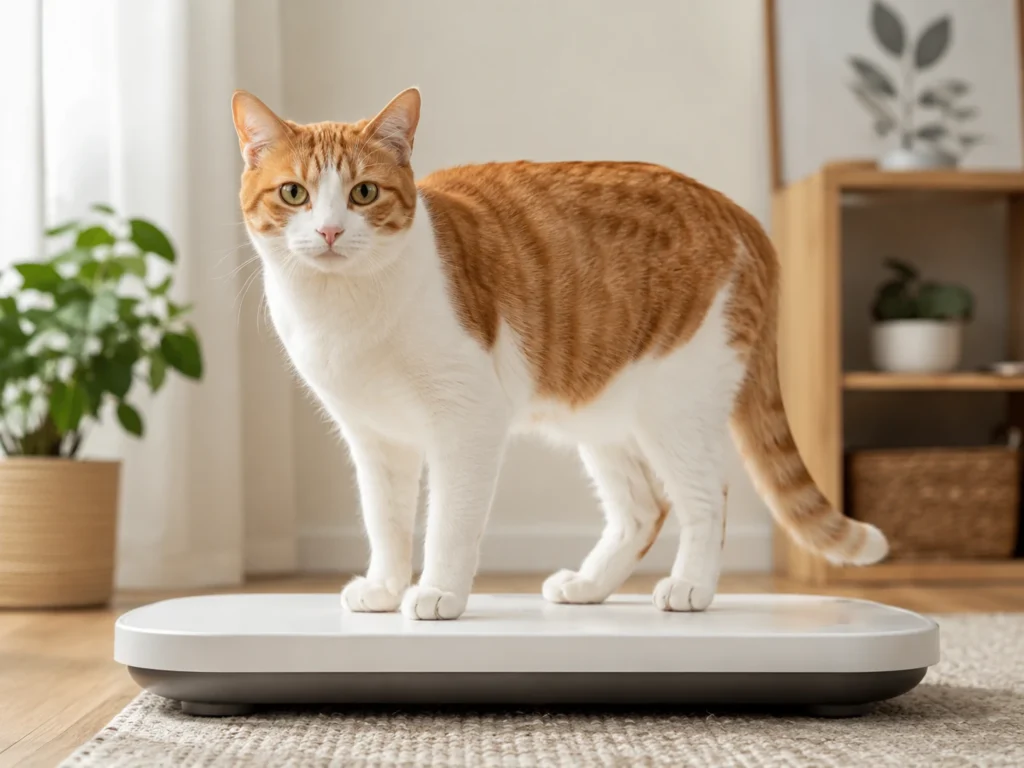
Use a scale whose capacity can accommodate the bowl and food and whose display shows the unit required by the feeding plan. Follow the instructions for the exact scale because buttons, capacity limits, calibration procedures, and cleaning directions vary.
- Place the scale on a stable, level, dry surface.
- Turn it on and select the required unit, preferably grams when the plan is expressed in grams.
- Place the empty bowl or clean food-contact container on the scale.
- Press the tare or zero button. The display should return to zero while the empty container remains in place.
- Add the food gradually and allow the display to settle.
- Stop when the display reaches the required amount. If you add too much, remove the excess with a clean utensil and check the display again.
- Record the portion before serving it or transferring it elsewhere.
Taring removes the container’s weight from the displayed result. If you change containers, the scale switches off, or the display no longer reads zero before food is added, repeat the tare step.
When several foods are going into one bowl, weigh and record each food separately. You may tare between ingredients, but write down each result before resetting the display. Otherwise, the final combined weight will not show how much of each food was served.
Keep the scale surface, bowl, and measuring utensils clean and dry. Follow the scale manufacturer’s cleaning instructions and avoid letting food or liquid enter parts of the scale that are not designed for food contact.
Measure Dry and Wet Food Without Assuming Universal Conversions
Dry Food
If the established amount is in grams, weigh the dry food directly. A scoop can be useful for transferring kibble, but the scale should determine the final amount.
One practical household method is to weigh the entire day’s dry-food allocation into a clean, labeled container. Household members then take meals, training food, and puzzle-feeder portions from that one supply. An empty container shows that the allocation has already been used.
Keep the premeasured food protected from pets, moisture, contamination, and accidental mixing. For broader guidance, see How to Store Cat Food Safely.
If the instruction is given only in cups, use a standard dry measuring cup rather than a mug, glass, or unmarked scoop. Do not borrow a grams-per-cup figure from another food. Kibble size, shape, density, coating, and moisture can all affect how much a given volume weighs.
Wet Food
If the plan is expressed in whole cans, pouches, or trays, count the exact package units and check their stated size.
If only part of a package is required and the instruction gives a weight, tare the bowl and weigh the food placed in it. If the instruction calls for a fraction of the package, weighing the contents can make that split more consistent: weigh the food removed from that particular package, then multiply that amount by the required fraction.
This is a way to divide one package—not a universal can-to-gram or can-to-calorie conversion. Food left inside the package, spilled during transfer, or remaining on utensils can also make the amount served slightly different from a simple calculation.
Store any unused portion according to the exact food’s directions and appropriate food-safety guidance.
Divide the Daily Total Across Meals
The full-day amount and the amount in one meal are different numbers. Decide the feeding schedule separately, then divide the established daily total across it without adding to or reducing the total.
For example, if a hypothetical established plan says:
60 g/day ÷ 3 meals/day = 20 g/meal
The units show that the result is grams per meal. This arithmetic illustrates division only; 60 grams is not a recommended amount for any particular cat.
Meals do not have to be equal unless the controlling plan says they do. If portions differ, write down each planned portion and confirm that they add up to the daily total. Avoid rounding every meal upward, because several small increases can create an unintended extra amount across the day.
For help choosing a schedule rather than an amount, see How Often Should You Feed Your Cat?
When a Calorie-to-Weight Conversion Is Required
Some plans establish an amount in kilocalories while the food is easiest to weigh in grams. Make this conversion only with the calorie statement for the exact food.
Pet-food calorie statements commonly provide kilocalories per kilogram and may also provide kilocalories per familiar unit, such as a cup, can, or treat. If the label supplies kilocalories per kilogram:
kcal/g = labeled kcal/kg ÷ 1,000 g/kg
Then:
grams/day = established kcal/day ÷ kcal/g
The calorie amount in the second formula must already have been established. The formula does not determine how many calories the cat needs.
Preserve the units exactly and use the food’s “as fed” calorie information. Do not substitute a figure from a similar flavor, package, website, or previous formulation. If the label is unclear or the required unit is missing, ask the manufacturer to confirm the current information for that exact product. Questions about the amount prescribed for the cat belong with the veterinarian.
Account for Treats, Training, and Puzzle-Feeder Food
Every piece of food served during the day must appear somewhere in the established plan. This includes:
- Food placed in regular bowls.
- Treats and training rewards.
- Dry food used in puzzle feeders or food-dispensing toys.
- Food used to hide medication, when this is part of a veterinary plan.
- Hand-fed pieces and small “extras” from household members.
When regular food is being used for training or enrichment, take it from the measured daily allocation rather than filling the activity from an untracked supply. Keep the reserved amount in a labeled container or record it before loading the feeder.
If separate treats are part of the established plan, record their allocated number, weight, or calories using the unit provided. Do not invent a food-for-treat substitution or reduce the main food by guesswork when the plan does not explain how treats fit.
For purée extras, the lickable-treat guide applies that same accounting principle to the exact package, shared household use, and leftovers.
For the strategy behind these activities, see How to Use Treats for Cat Training Without Overfeeding and How to Use a Puzzle Feeder for Your Cat.
Use One Household Feeding Record
Accurate portions can still become an inaccurate daily total if two people serve the same meal. Choose one record that every household member can see and update immediately.
A simple record can include:
- The date and cat’s name.
- The exact food.
- The established daily total and unit.
- Each planned meal or allocated extra.
- The amount actually served.
- The time and the initials of the person who served it.
- Any measurable leftovers, spills, missed feeder delivery, or unplanned food.
The record may be a paper checklist, a whiteboard, a shared note, or an app. The format matters less than having one authoritative record.
For dry food, a single premeasured daily container can provide a physical check alongside the written log. For cans or pouches, label partial packages and mark whole packages as they are opened. Avoid keeping several independent notes that household members may update differently.
If an accidental extra portion is served, record what happened. Do not automatically withhold or sharply reduce later food to compensate. Seek veterinary advice when the amount may be consequential, the cat has a medical condition or therapeutic diet, or symptoms develop.
Distinguish Food Offered From Food Eaten
A measured serving tells you how much food was offered. It does not prove that the cat ate all of it.
When measuring leftovers is useful, record the empty bowl’s weight. After the meal:
- Weigh the bowl with the remaining food.
- Subtract the recorded empty-bowl weight to estimate the leftover food.
- Subtract the measurable leftover from the amount served to estimate how much disappeared from the bowl.
In unit form:
estimated amount eaten = amount served − measurable leftover
Treat this as an estimate. Food may have been spilled, carried away, dried onto the bowl, or eaten by another animal. The calculation is most meaningful when one cat had exclusive access to the bowl and the feeding area remained observable.
If several cats can reach the same food, an empty bowl cannot identify which cat ate it. Use an appropriate separation arrangement before drawing conclusions about individual intake; How to Feed Multiple Cats Separately covers that setup.
When precise intake monitoring is medically important, follow the veterinarian’s measurement and observation instructions rather than relying on a general household estimate. If your veterinarian also asks you to track weight, use a repeatable home weighing method and record its limitations.
Check Scoops and Automatic Feeders by Weight
A scoop’s label or appearance does not guarantee a repeatable food weight. To check one:
- Place an empty bowl on the scale and tare it.
- Fill the scoop in the same way it is normally used.
- Transfer the food to the bowl and record the weight.
- Repeat the check several times.
If the results vary, use the scoop only to transfer food and let the scale determine the portion. If you record an average household result, treat it as applying only to that scoop, that food, and that filling method—not as a manufacturer-approved universal conversion. Recheck after changing food or scoop.
Automatic feeders also need an output check. Following the exact machine instructions:
- Confirm the programmed schedule and portion setting.
- Dispense food into a tared bowl and weigh the result.
- Repeat the test to see whether delivery is consistent.
- Check that all scheduled portions are released rather than jammed or retained.
- Recheck after changing food, cleaning the mechanism, changing settings, or investigating a missed delivery.
Some feeder manufacturers define a programmed portion by volume and warn that its weight can vary with kibble size, shape, thickness, and condition. Do not assume that one feeder portion equals a fixed number of grams across foods or machines.
If the real output does not match the instructions or is inconsistent, consult the manufacturer before relying on the feeder. Do not create an unverified correction factor for a prescription or medically managed feeding plan. For the broader decision beyond measurement, Should You Use an Automatic Cat Feeder? covers food compatibility, individual access, cleaning, reliability, and failure planning.
When General Measuring Instructions Are Not Enough
Pause the household workflow and seek appropriate guidance when:
- No daily amount has been established.
- The food label, veterinary plan, and equipment instructions appear to conflict.
- The food’s calorie statement or required conversion unit is missing or unclear.
- The cat eats a therapeutic, prescription, homemade, or otherwise individualized diet.
- A kitten, pregnant or nursing cat, senior cat, or cat with a medical condition needs a plan changed.
- There has been a meaningful measuring or dispensing error and you are unsure how to proceed.
- You cannot determine which cat ate the food.
Contact the food or equipment manufacturer for product-specific label information and operating instructions. Contact the veterinarian for questions about the cat’s amount, health, therapeutic diet, or response to the plan.
Changes in appetite or intake should not be dismissed as measuring problems. Seek veterinary advice for unexplained weight change, repeated vomiting or diarrhea, difficulty eating, a change in general condition, or a cat that stops eating. Cornell’s Feline Health Center notes that sustained loss of appetite can seriously affect an adult cat’s health.
Once the correct daily amount has been established, accurate feeding comes down to a controlled system: preserve the unit, measure the actual food, make every portion part of the same daily total, and leave a record that the whole household can follow.
Helpful Related Guides
- How Often Should You Feed Your Cat?
- How to Feed Multiple Cats Separately and Stop Food Stealing
- How to Slow Down a Cat That Eats Too Fast
- How to Use Treats for Cat Training Without Overfeeding
- How to Use a Puzzle Feeder for Your Cat
Sources
- 2021 AAHA Nutrition and Weight Management Guidelines
- AAHA: Prevention of Obesity
- AAFCO: Reading Labels
- FDA: Pet Food
- German et al.: Imprecision and Inaccuracy of Measuring Food Portions Using Measuring Cups
- WSAVA Global Nutrition Guidelines
- Cornell Feline Health Center: Anorexia
- OXO: How to Measure Ingredients With a Kitchen Scale
- Example Automatic-Feeder Manufacturer Portion Guidance