To keep your cat safe around open windows, use protection confirmed suitable for the exact window and the way it opens, or keep your cat out of that room while the window is open. If neither arrangement is workable, leave the window closed and latched.
Start with the window you want to open today. What will physically keep your cat away from the opening, and will that still work if someone enters the room or changes the window’s position? A familiar window deserves the same check as a new one.
Recognize the Different Window Risks
Window safety involves more than preventing a fall:
- Falls: An open window can lead to serious or fatal injuries. The ASPCA’s window-fall guidance warns against assuming that a cat will land safely.
- Escape: A ground-floor window can still give your cat an uncontrolled route outside. Include it in your checks even when a high fall is not the concern.
- Entrapment: A tilted window can leave a narrowing, V-shaped gap in which a cat becomes stuck. Cats Protection describes potentially fatal entrapment in tilted windows, and FOUR PAWS also warns about cats becoming trapped in the window slot.
A small-looking gap is not proof of safety. In particular, tilt mode should not be treated as a safe ventilation setting simply because the window is only partly open. Protection needs to suit that opening, including its narrowing gaps, rather than just another position of the same window.
The room checks and household routines below are Catcredo’s practical application of these precautions. They are not tests that certify a window or protective product.
Check Every Window You Use
Walk through your home, including the bathroom window opened after a shower, the bedroom window opened at night, and windows opened only for cleaning. Keep cats away from unprotected openings while you check them.
For each window, answer four questions:
- How does it open? Consider every position you use: a raised lower sash, a lowered upper sash, a sliding panel, an outward-opening casement, or a tilt setting. Identify the openings created in that position, not just the gap that is easiest to see.
- What keeps your cat inside? Is there an appropriate protective system for that exact arrangement, or will a reliably closed room door keep the cat away while you air the room? If you cannot establish either, keep the window closed.
- What changes during normal use? A screen may be removed for washing, or someone may open the window differently to get more air. Include those situations in the plan rather than assuming the everyday position covers them.
- Who operates it? Include housemates, visitors, cleaners, and anyone staying overnight. Agree who checks the window before cats regain access.
Do not count an upper opening or a chair moved away from the sill as proof that your cat cannot reach it. Likewise, being in the room or watching a camera does not replace a suitable barrier or reliable separation.
Look Beyond the Screen Itself
Seeing mesh across a window does not tell you whether the whole arrangement will contain a cat. The Animal Medical Center explains that a loose screen can give way, while the ASPCA advises secure screens and warns against relying on childproof window guards. Cats can pass through gaps in those guards.
Consider the screen, its frame, attachment, edges, condition, and intended use together. An ordinary insect screen being present is not enough to establish cat containment; neither is a product label without instructions that cover your window.
If you want to open a window while your cat can reach it, ask the manufacturer or a qualified installer:
- Is this exact system intended to contain cats, and what limitations apply?
- Does it fit this window and every opening position I intend to use?
- How are all openings and edges protected, and what attachment requirements must be met?
- What inspection, cleaning, removal, and replacement instructions apply?
These are questions to resolve before use, not a home strength test. Do not let your cat try the arrangement to find out whether it holds. If the answers are unclear, keep the opening closed or keep cats out of the room while it is open.
If installation would change the property, obtain any needed permission and appropriate installation advice. A proposed cat barrier also must not compromise a required human escape route; ask the relevant professional if you are unsure. This guide cannot approve a particular installation.
Air a Room While Your Cats Are Elsewhere
You do not have to buy a screen to use every window. In a home with suitable separate space, you may be able to air a room while your cats stay comfortably elsewhere, then close the window before letting them back in.
The routine below adapts Cats Protection’s secure-room guidance for moving home, including a comfortable room, essentials, and telling other people which door must stay closed. Cats Protection gives that advice for moving day; the airing sequence is our practical adaptation.
- Prepare the cats’ space first. Choose a comfortable area with its own windows secured. Keep water, litter, a resting place, somewhere to hide, and other essentials available. Do not put cats who cannot comfortably share into one room simply to make the window routine easier.
- Locate every cat and close the separating door. Seeing one cat settle down does not account for another who may still be in the room you want to air. Confirm where all of them are before opening the window, and make sure everyone understands which door must remain closed.
- Open the window only once separation is established. Keep the door arrangement in place throughout airing. If someone needs to let the cats through, close and latch the window first.
- Finish in the same order every time. Close and latch the window, check that any other windows opened during airing are also secured, and only then restore cat access. Tell anyone taking over that this check has been completed rather than assuming they know.
When Other People Are Coming and Going
A note on a door can be a useful reminder, but it cannot make an unreliable door routine work. If the room is a busy passageway or people cannot keep the agreed door closed, choose a different room or do not use that opening.
Brief a cleaner or repair worker before they start, especially if screens will come off. Keep cats separated throughout the work and until the window has been closed or its protection correctly restored and checked. A screen back in its usual place still needs its fittings and edges checked before access resumes.
Overnight and in Small Homes
Plan for the whole period the window will be open. If you leave a bedroom window open overnight, can the cats remain comfortably separated, with their essentials available, even when someone gets up and opens a door? If not, do not use that unprotected opening overnight. Sleeping nearby is not an alternative to containment.
This routine may not fit a studio or a home without a suitable separate area. Do not shut your cat in a hot, uncomfortable, or inadequately equipped space to make it work. Use an already suitably protected opening if one is available, or seek a workable ventilation arrangement for your home before allowing access to an open window. A room-separation plan that fails your cat’s comfort or depends on a door nobody can reliably keep closed needs a different solution.
Pause Access When Something Changes
Before allowing access to a window that will be open, look for visible damage, loose fittings, detached edges, or a change in how the window or protection sits. Follow the exact system’s maintenance instructions rather than inventing a weekly schedule or a force test.
Repeat the suitability check after:
- a screen or guard has been removed, cleaned, or reinstalled;
- window repairs, new hardware, or a change of opening mode;
- an impact, weather damage, or any other visible change; or
- the arrival of a kitten or another cat smaller than the cats the arrangement was assessed for.
These are reasons to reassess, not evidence that a particular gap is safe for a larger cat. If anything is loose, damaged, missing, or uncertain, close the opening or prevent access until it has been resolved. Previous uneventful use is not a substitute for checking the current arrangement.
If Your Cat Falls or Becomes Trapped
After a window fall, call your veterinarian or an emergency veterinary clinic immediately and arrange urgent assessment, even if your cat appears unhurt. The Animal Medical Center warns that serious injuries may not be obvious, and the ASPCA recommends immediate veterinary care after a fall. Follow the clinic’s transport instructions; do not wait for symptoms.
For a cat trapped in a tilted window, call an emergency veterinarian immediately for case-specific help. Do not pull the cat or force the sash against them. Ask how to arrange appropriate rescue assistance if needed. The cat needs immediate veterinary assessment after release, even if they seem to recover; Hannover Veterinary University’s first-aid guide and Vetmeduni Vienna’s emergency guidance identify tilted-window entrapment as requiring immediate veterinary attention.
If your cat has escaped and is missing, our guide to what to do when your cat goes missing covers the wider search. A possible fall or injury still calls for immediate veterinary advice, not only a missing-cat plan.
Keep the View With the Window Closed
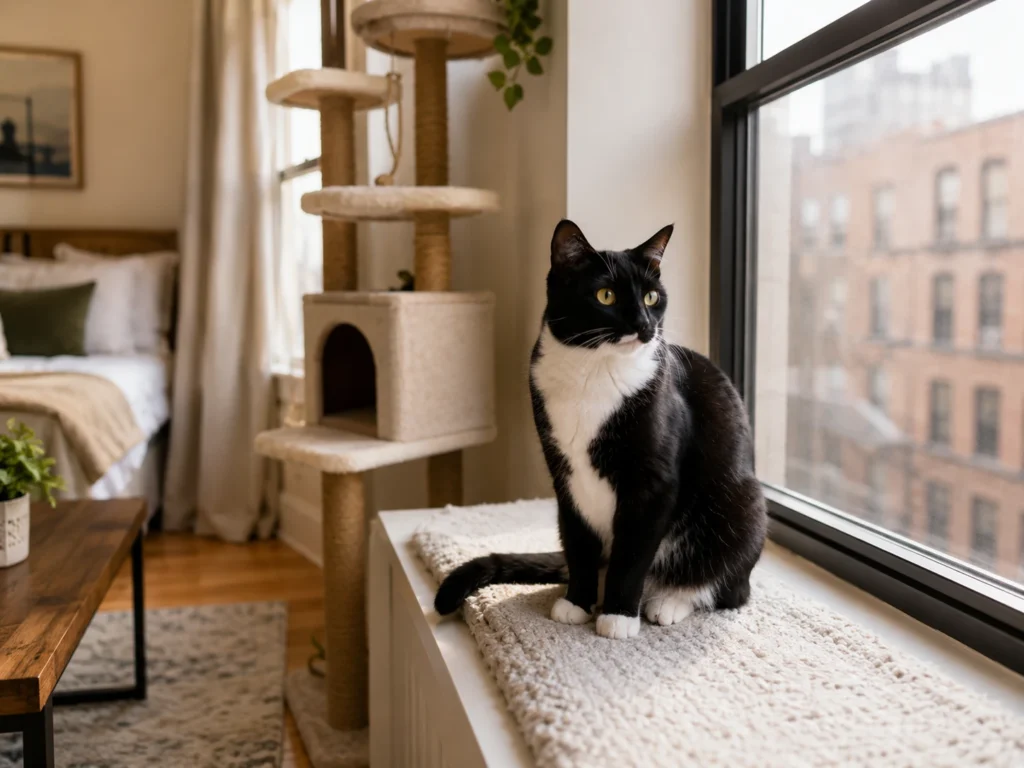
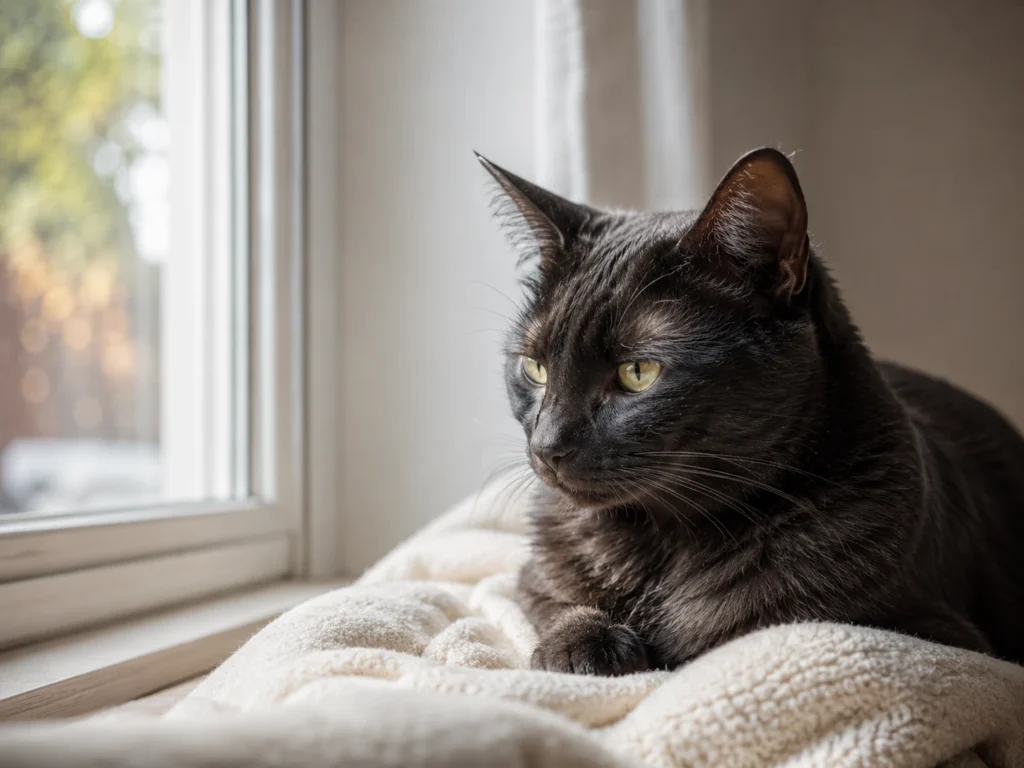
A closed, latched window can still offer a view. If your cat enjoys watching outside, an existing stable indoor resting spot may be enough; a new perch is optional. If you do choose one, our guide to cat window perch safety and setup covers its separate mounting and access needs.
You do not need to encourage window watching if your cat does not enjoy it. For a cat who becomes tense at the view, why cats sit by windows and when to look more closely can help you consider a different resting or activity area instead.
Your household plan might be simple: the living-room window stays closed while the cats enjoy the view, and a bedroom is aired while they remain comfortably elsewhere. Before the bedroom door opens again, someone closes and latches its window. Decide who that person is and make sure everyone using the room knows the order.
Sources
View Sources and References
ASPCA: High-Rise Syndrome: Lifesaving Tips for Cat Parents
Cats Protection: Keeping Cats Safe Outside, including Tilt-and-Turn Windows
FOUR PAWS: A Cat-Friendly Home
Schwarzman Animal Medical Center: High Rise Syndrome in Cats
Cats Protection: Moving Home With Your Cat
Hannover Veterinary University: First Aid for Your Cat, “Kippfenstersyndrom,” PDF page 14 (German)
Vetmeduni Vienna: Recognizing Emergencies and First Aid for Cats (PDF, German)