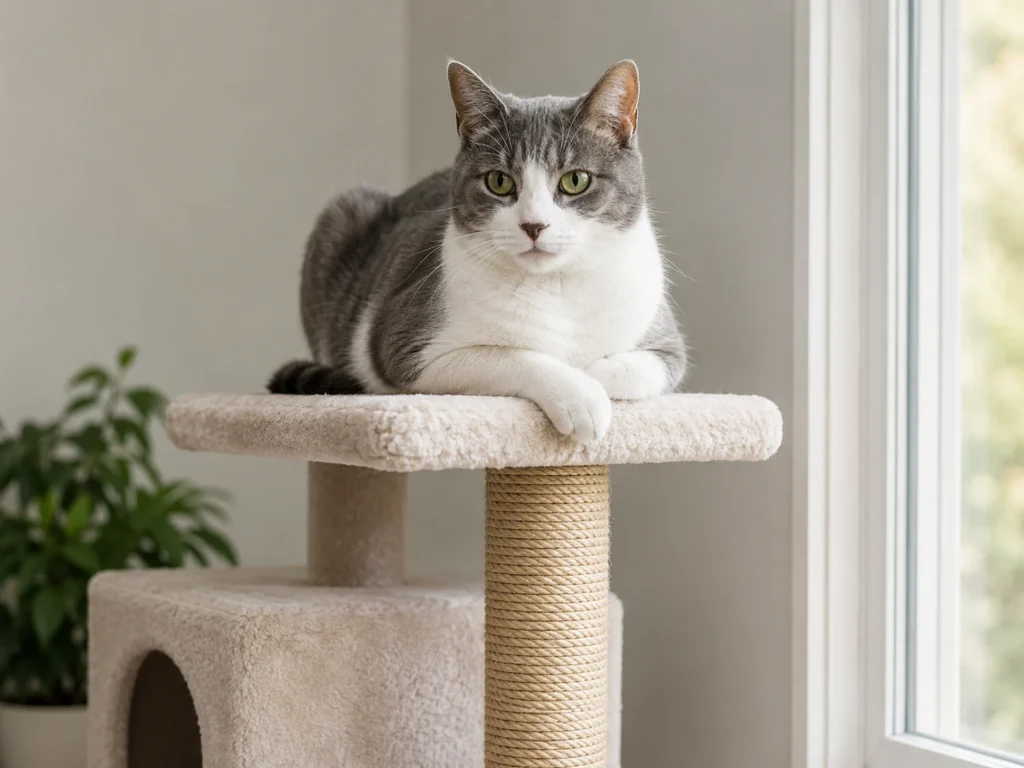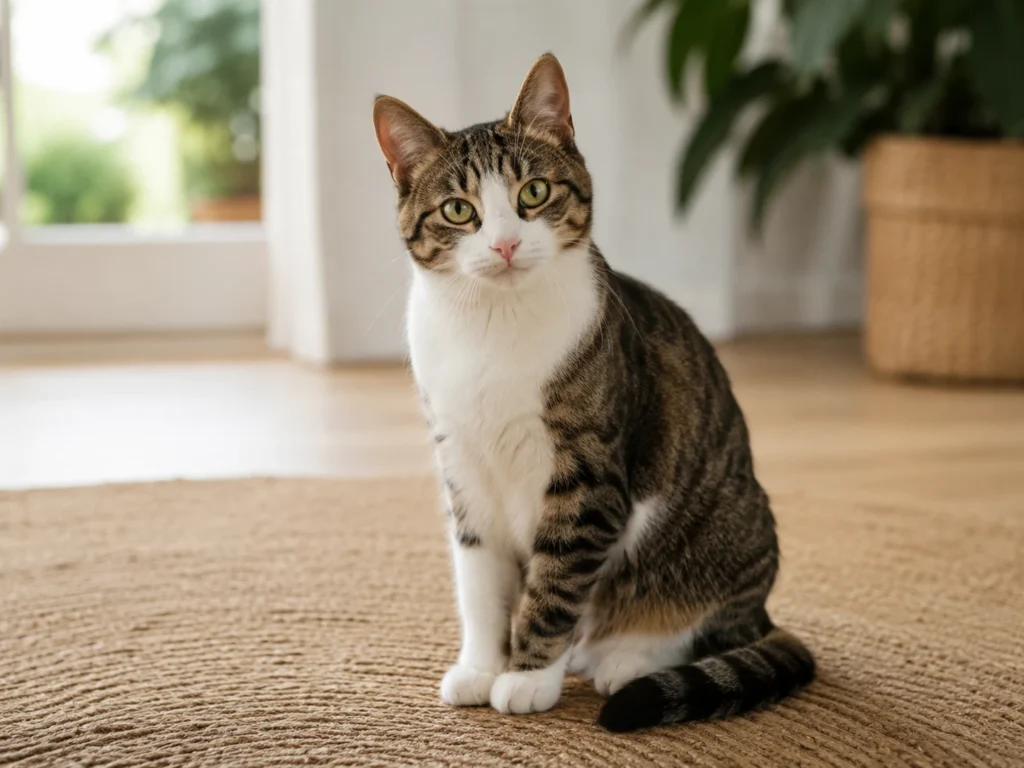
Cats hear by collecting sound with the outer ears, passing its vibrations through the eardrums and tiny middle-ear bones, and converting movement inside the inner ears into signals for the nervous system. The brain processes that information, including clues about where a sound came from. The visible ear flaps are the beginning of this connected process, not the whole hearing system. MSD Veterinary Manual explains the main ear structures.
An ear turn is one part you can see. Much of hearing happens out of sight, and neither an ear movement nor a lack of response tells you everything your cat has heard.
Pitch and Loudness Describe Different Things
Airborne sound consists of pressure changes traveling through the air. Frequency describes how rapidly those changes repeat. For a simple tone, a higher frequency corresponds to a higher pitch: the sound seems higher rather than lower. Everyday sounds can contain a mixture of frequencies, so their pitch is not always described by one frequency alone.
Loudness concerns how soft or loud a sound seems. Think of the difference between a low hum and a high whistle: either can be quiet or loud. Physical sound level contributes to loudness, but frequency and duration matter too. The Acoustical Society of America’s definition of loudness distinguishes that sensation from a sound’s physical properties.
Cats can detect very high-frequency sounds, but that ability does not mean every sound seems louder to them. It also does not tell you the range an individual cat can hear. MSD’s feline hearing overview supports the general capability, not a hearing measurement for your cat.
Follow Sound Through the Ear
The useful way to picture hearing is to follow what happens to a sound as it travels inward. Air-pressure changes first produce movement in the ear; that movement then leads to nerve signals.
The Outer Ear Guides Sound Inward
The visible ear flap is called the pinna; together, the two flaps are the pinnae. Each helps guide sound into the ear canal, the passage leading toward the eardrum. The left and right pinnae can move separately, so the two ears do not have to hold matching positions. These are established features of feline outer-ear anatomy.
The Eardrum and Middle Ear Pass On Vibration
The eardrum is a thin membrane that vibrates in response to sound. Three tiny bones in the middle ear carry that movement onward to the inner ear. This provides the mechanical connection between sound arriving through the canal and movement inside the hearing organ. George Strain’s veterinary review describes this pathway. The conversion into nervous-system signals happens farther inward.
The Cochlea Turns Movement Into Signals
The cochlea is the coiled, fluid-filled hearing structure in the inner ear, often described as snail-shaped. Incoming vibration produces movement of its fluid and an internal membrane. That movement bends tiny projections on sensory cells called hair cells.
Signaling from those cells activates auditory-nerve fibers, which carry information toward the brain. The process has now linked physical vibration to neural activity that the brain can process. The anatomy and physiology section of Strain’s review supports this connection from vibration to neural information.
The inner ear also contains separate structures involved in balance, distinct from the cochlea’s hearing role. MSD’s inner-ear description separates these functions.
How Cats Work Out Sound Direction
Hearing a sound and locating its source involve related information, but detecting it does not by itself supply a location. The nervous system combines clues from both ears with the changes made to sound by the head and outer ears.
The Two Ears Receive Different Clues
Consider a sound coming from one side of a cat. It can reach the nearer ear slightly earlier because the route to that ear is shorter. The head can also partly shadow the farther ear, producing a difference in the sound level reaching the two ears.
Those small timing and level differences provide clues about direction. The important comparison is between the information from the ears, rather than each ear independently determining a complete location. Keating and King’s review of spatial hearing explains these established cues.
The differences do not resolve every possible direction. Sounds arriving from different positions can give similar two-ear information, so the nervous system also uses clues supplied by ear shape.
Ear Shape Changes the Sound That Arrives
The head and outer ears alter the balance of frequencies reaching the ear canal. Depending on the direction of the incoming sound, some frequency components become more prominent relative to others. This is acoustic filtering: a change in the mixture of frequencies, not simply a change in overall volume.
Those direction-dependent patterns provide additional clues, including information useful for distinguishing sounds from above and below. Tollin, Ruhland, and Yin’s paper on sound localization explains the importance of this filtering by the head and pinnae.
These clues do not guarantee perfect accuracy for every sound or let us predict an exact response to a household noise.
What Moving Ears Can Tell You
Moving a pinna can change the sound entering it, but direction finding involves more than swiveling the ears. The nervous system still has to use the available timing, level, and filtering clues. A particular movement does not reveal exactly how much it helped the cat locate a sound.
Ear movements also accompany orientation toward visual targets. Populin and Yin’s research on pinna movements therefore provides an important limit: an ear movement is not specific to hearing.
For example, you might see a resting cat change its ear positions while its body stays still. That is an observable movement. On its own, it does not identify the sound, prove that there was a sound, or reveal a precise feeling.
A Visible Response Is Only Part of the Picture
Detecting a sound, attending to it, recognizing it, and making a visible response are different questions. This is a useful distinction, not a sequence you can check off by watching your cat.
If a cat continues grooming while someone speaks, the observation is simply that grooming continued. It does not establish that the cat failed to hear, recognized the speaker, or deliberately ignored them. Recognition is a separate topic, explored in Do Cats Recognize Their Owner’s Voice?.
Likewise, a visible reaction cannot establish the full extent of a cat’s hearing. Strain’s veterinary review emphasizes the limitations of behavioral hearing assessment. There is no need to provoke a reaction to make an everyday observation more informative.
When Apparent Hearing Changes
If you notice a new change in your cat’s apparent hearing, speak with your veterinarian. An everyday response or nonresponse is not a reliable hearing test.
For a cat whose hearing loss has already been assessed and who has usable vision, How to Play With a Deaf Cat covers a visible, voluntary play invitation. That guidance adapts play to an established need; it is not a way to test hearing.
Sources
View Sources and References
Roman, N.; peer reviewer Hess, L. Ear Structure and Function in Cats. MSD Veterinary Manual. Reviewed/updated February 2026. Veterinary reference for feline anatomy and the assessment boundary. Its veterinary authorship does not mean this Catcredo article received veterinary review.
Strain, G. M. (2017). Hearing disorders in cats: Classification, pathology and diagnosis. Journal of Feline Medicine and Surgery, 19(3), 276–287. DOI: 10.1177/1098612X17695062. Veterinary review. Relevant anatomy, clinical-challenges, and diagnosis sections used; clinical treatment and genetic detail are outside this article’s scope.
NASA. The Science of Sound. Quesst educational resource. Used for physical sound and frequency terminology, not cat-specific hearing measurements.
Acoustical Society of America / ANSI Acoustical Terminology Database. Pitch, definition 12.01. Used for the distinction between frequency and perceived pitch.
Acoustical Society of America / ANSI Acoustical Terminology Database. Loudness, definition 11.03. Used to distinguish perceived loudness from physical sound properties.
Keating, P., and King, A. J. (2013). Developmental plasticity of spatial hearing following asymmetric hearing loss: context-dependent cue integration and its clinical implications. Frontiers in Systems Neuroscience, 7:123. DOI: 10.3389/fnsys.2013.00123. Review used for established spatial-hearing cues in its normal-acoustical-conditions section, not for clinical advice.
Tollin, D. J., Ruhland, J. L., and Yin, T. C. T. (2013). The role of spectral composition of sounds on the localization of sound sources by cats. Journal of Neurophysiology, 109(6), 1658–1668. DOI: 10.1152/jn.00358.2012. Abstract, introduction, and relevant discussion passages checked during source review. No full methods, results, or figure audit was performed; no numerical performance claims are used.
Populin, L. C., and Yin, T. C. T. (1998). Pinna Movements of the Cat during Sound Localization. Journal of Neuroscience, 18(11), 4233–4243. DOI: 10.1523/JNEUROSCI.18-11-04233.1998. Abstract, introduction, Summary/conclusions, and circuit discussion checked during source review. No full methods, results, or figure audit was performed; ear movement is not presented as a hearing test or a proven specific reflex.