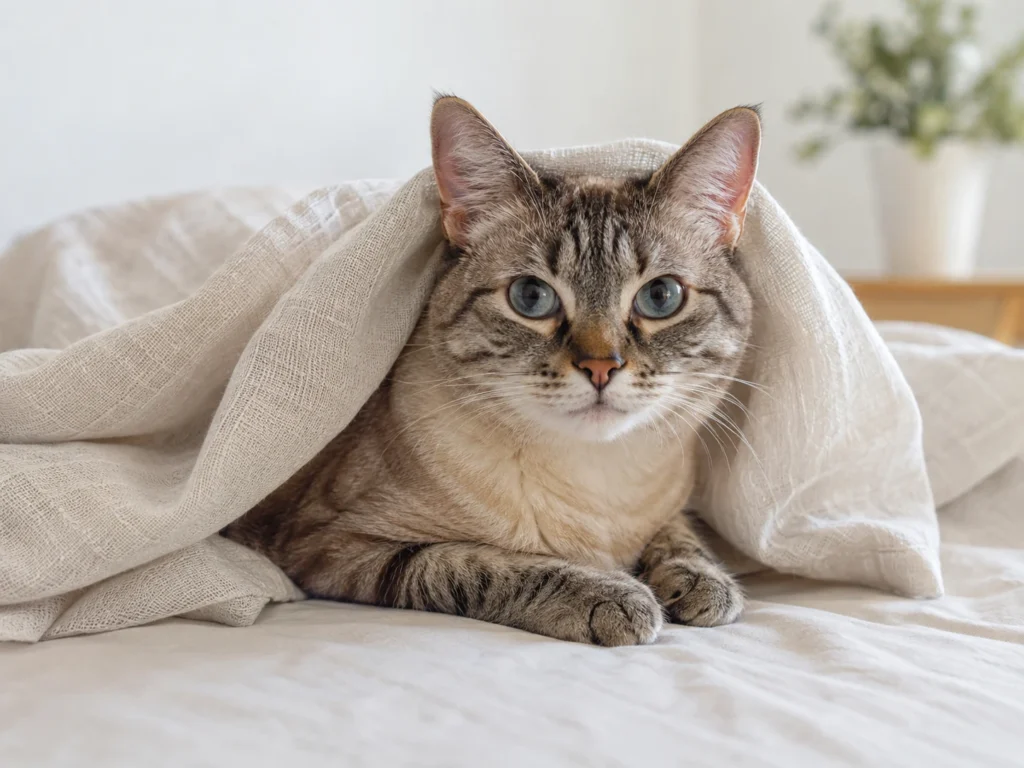
Cats use their sense of smell to gather information about their surroundings, investigate food, and communicate through scents they leave behind. A sniff is the receiving side of that process; rubbing against a surface can be part of the depositing side. Together, these help explain why smells matter even in an ordinary, familiar room.
For an owner, the useful distinction is between noticing what a cat does and deciding what it means. You can see a cat investigate a blanket or pause beside a food bowl. That observation alone cannot tell you the cat’s thoughts, certify the food as safe, or explain a new change in eating. Understanding the role of scent helps you respect familiar smells without treating every sniff as a message to decode.
How Smell Gives Cats Information
Olfaction is the sense of smell. The basic process connects something outside the cat to activity in its nervous system. A companion-animal anatomy review describes this general mammalian pathway, with feline anatomy included in its discussion:
- Air carries odor molecules into the nose as the cat inhales.
- Odor molecules reach smell-sensitive tissue. They must enter the mucus covering that tissue before they can interact with its receptors.
- Receptors on smell-sensitive nerve cells respond to the molecules, starting signals that travel into the nervous system.
- Those signals reach processing areas in the brain.
The neural part of that explanation comes from the review of mammalian physiology, not a cat-specific experiment measuring brain responses. Wu and colleagues’ study of the domestic cat nose helps explain odor transport and access to receptors, but its computer model, based on one cat, did not test what cats think or feel when they smell something.
This makes an ordinary sniff easier to understand: it is an opportunity to sample airborne chemical information. Smelling and tasting are different sensory contributions, so sniffing a bowl is not the same observation as tasting its contents or eating a meal. Nor does the mechanism tell us why one particular smell holds an individual cat’s attention. For the separate question about an open mouth after sniffing, see Why Does My Cat Open Their Mouth After Sniffing?
Recognizing Familiar Surroundings
A home contains scent cues as well as visible objects. According to Battersea’s explanation of a cat’s sense of smell, cats detect scents in their environment and produce scents of their own. Their own deposited scent can contribute to the familiarity of that environment.
Receiving and leaving scent are separate actions. A cat investigating the corner of a chair is sampling information there. Rubbing against a surface can deposit scent, and scratching can leave scent from between the toes. These are examples of scent deposition, not a complete explanation of rubbing or scratching, and neither action has one universal meaning. For the specific behavior, see Why Does My Cat Rub Against Me?
For a hypothetical example, imagine a familiar resting blanket after it has been washed. It can look much the same while carrying different smells. The cat’s visual surroundings have not obviously changed, but some scent cues may have. Cats Protection’s behavior guide discusses how household changes can remove familiar smells; its indoor-cat leaflet also notes that cleaning and unfamiliar household scents may affect some cats.
That does not mean the cat in this example must become anxious, or that washing the blanket was a mistake. The guidance describes a possible response, not how often it happens or how strongly every cat reacts. Familiarity also is not proof of safety: an object can carry familiar smells and still need cleaning. A sniff by itself cannot establish comfort, fear, or a claim of ownership.
Investigating Food
Smell is thought to contribute to cats’ appetite and enjoyment of food. That qualified explanation appears in VCA’s kitten-senses guidance. Wu and colleagues also discuss the relevance of smell to feline feeding in the background and framing of their paper, rather than as a result of their nasal-airflow model.
There are limits to this evidence. VCA’s statement is owner education written in a kitten context and does not cite a primary study in that passage. The feeding references behind Wu’s discussion were not independently examined for this article. VCA is affiliated with Mars, while the Wu study received partial Mars Petcare funding and included a Mars-employed author. These sources share an industry connection and are not independent corroboration of an appetite effect.
Consider a simple hypothetical observation: your cat approaches a food bowl, sniffs, and then either eats or walks away. The approach is something you saw; it does not establish that odor caused the approach. During the sniff, the cat is sampling odor information. Whether the cat then eats, and how much, are separate observations. This sequence alone cannot explain a choice or refusal.
Keep these distinctions in mind: detecting an odor is not the same as tasting food; showing interest is not the same as eating it; and eating it is not proof of nutritional suitability or safety. The Merck Veterinary Manual notes the narrower point that smell and taste do not always establish food quality. Do not use a cat’s sniff, acceptance, or rejection as a food-safety test, or assume a cat will reliably refuse spoiled or harmful food.
If your cat has a concerning new eating change, seek veterinary advice instead of deciding that it has lost its sense of smell or simply dislikes an odor. If your cat stops eating, contact your veterinarian immediately, in line with Cornell Feline Health Center’s guidance. Do not delay that contact while trying a home smell test or waiting for hunger to solve the problem.
Communicating Through Scent
Scent can provide information after the animal that deposited it has left. That is the important difference between a lingering chemical cue and an interaction that requires two cats to be present together. Cats Protection describes this kind of remote scent communication. It does not establish a fixed duration for a scent message or guarantee how another cat will respond.
Battersea and Cats Protection explain that some feline scent deposits contain pheromones, described in these sources as chemicals involved in communication between cats. Those descriptions are useful at this broad level, but they do not mean every deposit expresses the same emotion or is a deliberate message to a human.
A pheromone is a substance released by one animal that serves social communication with another animal of the same species. This simple definition follows UCLA’s organic-chemistry glossary, a limited general reference rather than a feline behavioral study. Not every odor a cat detects is a pheromone: detecting a smell and receiving a same-species chemical signal are different categories.
Context matters. Cats in an actual social group may share a scent profile through rubbing, as Cats Protection’s indoor-cat leaflet explains. That does not mean all cats living in the same house are socially bonded, or that an owner should transfer scents between them to create a bond. Scent communication is part of the explanation, not a way to read every relationship or guarantee that cats will accept one another. If your question concerns mutual grooming, Why Do Cats Groom Each Other? covers that behavior separately.
Respecting Familiar Smells at Home
One direct piece of advice comes from Battersea: when taking a cat to an unfamiliar setting, such as a veterinary practice, a boarding facility, or a new home, bring a blanket the cat regularly uses. The purpose is to retain a familiar scent cue. This is organizational advice, not evidence that a blanket guarantees calm. Use only a clean, appropriate item that meets the destination’s rules and any veterinary, laundering, or infection-control requirements.
The FelineVMA and ISFM environmental-needs guide also discusses preserving deposited scent on areas where cats have rubbed, especially during changes at home. It is guidance about those marked areas, not a tested blanket-retention or cleaning protocol. The guide acknowledges sponsorship by Ceva Animal Health; its adjacent product claims are not part of this advice.
Keep a Familiar Item Only When Appropriate
As an unvalidated Catcredo editorial application of that guidance, you could keep an appropriate, clean, familiar resting item available during a household change, where hygiene, item-care instructions, and veterinary directions allow. For example, while furniture is being replaced, an existing resting blanket might remain available if it is suitable to keep in use. The rationale is continuity of a familiar cue, not a demonstrated calming benefit.
This is not a recommendation to stagger cleaning, preserve every smell, or follow a special timetable. It does not establish that cleaning items separately is better than cleaning them together. Necessary cleaning comes first. Never retain spoiled food, urine, feces, infectious contamination, or other hazards for the sake of scent, and never disregard prescribed care or an item’s cleaning directions. Battersea’s spraying guidance, for example, explicitly advises cleaning urine-marked areas.
Let Investigation Be Voluntary
Another modest Catcredo application is to let your cat choose whether to investigate an ordinary, safe household object. If it approaches, allow it to sniff and leave freely. If it shows no interest or moves away, leave it alone. Do not restrain the cat, move the object against its nose, intensify an odor, or add scents to provoke a response.
This extends Cats Protection’s guidance about allowing cats to initiate interaction and explore voluntarily; those sources did not test object-sniffing exercises. It is not a training method, an enrichment claim, or a way to test how well a cat can smell. Do not add scent products, oils, or other substances for this purpose or apply them to the cat.
If behavior changes in an out-of-character or concerning way, discuss your observations with your veterinarian, as Cats Protection advises. Do not assume an unfamiliar smell explains it. Respecting scent means recognizing one source of information in a cat’s life while leaving room for what a sniff cannot tell you.
Sources
View Sources and References
Battersea. A cat’s sense of smell. Published September 22, 2023; updated July 17, 2026. Organizational guidance on environmental scent, deposition, communication, and familiar blankets; product and scent-transfer advice is not adopted.
Cats Protection. Managing your cat’s behaviour. Relevant sections: The importance of scent, Scratching, Managing shy cats, and veterinary-help guidance. The source’s treatment, training, and product material is not adopted.
Battersea. Cat spraying. Published June 1, 2023; updated July 6, 2026. Used only for scent persistence and the instruction to clean urine-marked areas, not for a spraying-management plan.
Cats Protection. Pheromone therapy. Used only for its broad description of natural feline chemical communication. This article does not adopt or evaluate its product or therapy claims.
Cats Protection. Caring for your indoor cat. 2022, especially pages 4–6. Written for cats entering UK homes after displacement or quarantine; used for bounded communication, social-group, voluntary-exploration, and help-seeking guidance, without its waiting thresholds.
Wu and colleagues. Domestic cat nose functions as a highly efficient coiled parallel gas chromatograph. PLOS Computational Biology, June 29, 2023. The single-cat model concerns nasal airflow and odorant transport; feeding statements are author background and framing, not feeding results. Partly funded by Mars Petcare UK, with a Mars-employed author; shares an industry link with VCA.
Alvites and colleagues. The Olfactory Bulb in Companion Animals—Anatomy, Physiology, and Clinical Importance. Brain Sciences, 2023, section 4. A review of companion-animal and general mammalian physiology with feline anatomy context, not cat-specific neural experiments.
VCA Animal Hospitals. How your kitten’s senses differ from yours. Smell section. Undated veterinary-owner education in a kitten context; the appetite statement has no primary citation in the passage. VCA identifies itself as an affiliate of Mars.
Feline Veterinary Medical Association and ISFM. Your Cat’s Environmental Needs: Practical Tips for Pet Owners. Copyright 2024, especially pillar 5 on page 2. Sponsored by Ceva Animal Health. Its product claims are excluded; it does not test the Catcredo resting-item application.
Cornell Feline Health Center. Anorexia. No article publication or update date exposed. Used only for the immediate veterinary-contact boundary, not diagnostic, treatment, or waiting-period advice.
UCLA-hosted Illustrated Glossary of Organic Chemistry. Pheromone. Undated generic glossary with no named author on the captured page. A limited definition source, not feline experimental evidence; its territorial-ownership interpretation is not adopted.
Patricia M. Dowling. Drugs Used to Control or Stimulate Vomiting in Monogastric Animals. Merck Veterinary Manual, full review May 2023. Only the opening food-quality caveat is used, in its broad monogastric context. Drug, dose, and treatment content is not adopted.