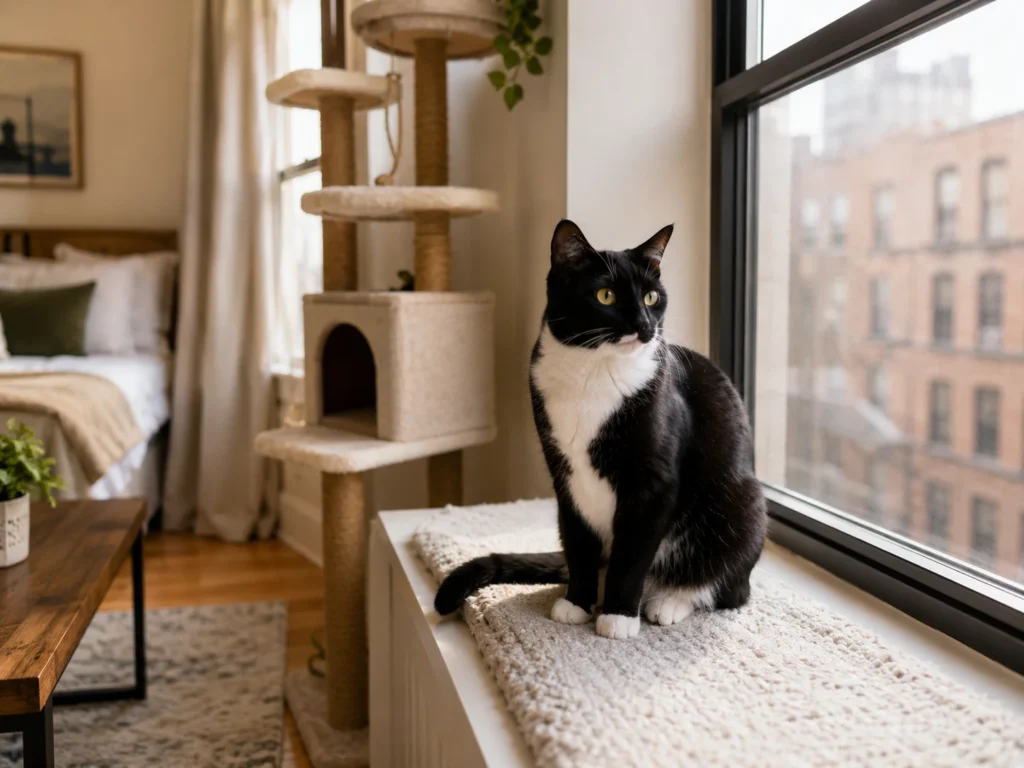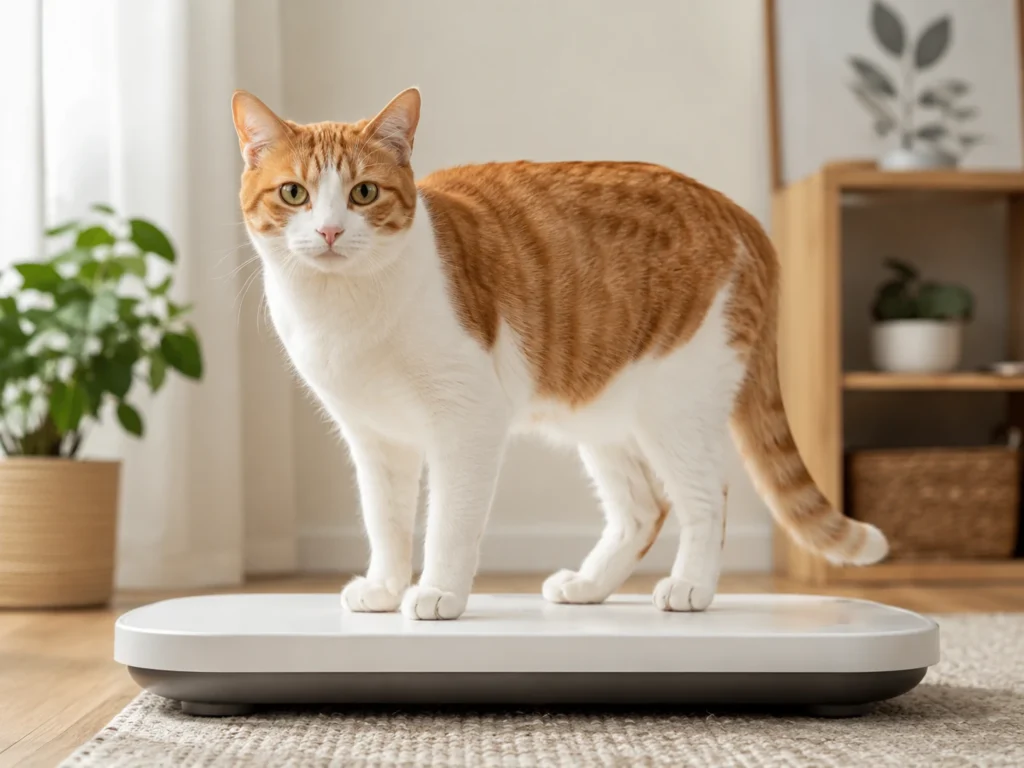
Place your cat’s food bowl in a calm, predictable, accessible location where they can approach, eat, and leave without being repeatedly startled, crowded, or blocked.
The best spot is not necessarily a particular room. A quiet kitchen corner may work for one cat, while another may prefer a separate dining nook. What matters is how the location functions for your cat.
The bowl should sit on a stable, level, easy-to-clean surface. You should be able to monitor normal eating, while children, dogs, and other cats cannot repeatedly disturb the meal or control access.
Quick Answer
A good food-bowl location should:
- be calm and predictable without making your cat unnecessarily isolated;
- provide a clear, comfortable route to the bowl;
- allow your cat to leave without being trapped by a person or another animal;
- stay away from litter equipment and obvious contamination sources;
- sit on a stable, level, easy-to-clean surface;
- avoid repeated noise, foot traffic, and sudden door movement;
- remain accessible for your cat’s age and mobility;
- prevent other pets from stealing food or controlling access; and
- let you monitor how much your cat actually eats.
There is no universal room, minimum distance, or feeding height that suits every cat. Use these checks to choose a sensible starting point, then watch how your cat approaches, eats, and leaves.
What Makes a Good Food-Bowl Location?
Calm Without Complete Isolation
Cats generally benefit from a feeding area that is calm and predictable. They should not have to eat while people step over them, a washing machine changes cycles beside them, or another pet repeatedly approaches.
Calm does not mean every cat must eat alone behind a closed door. A confident cat may eat comfortably in a quiet part of the kitchen, while another may pause, scan the room, carry food away, or leave when anyone passes.
Look at your cat’s response rather than assuming that a room is quiet enough. Signs that the location may be uncomfortable include:
- repeatedly looking up or turning around while eating;
- crouching tensely or keeping the body ready to move;
- waiting until the room is empty before approaching;
- taking food elsewhere to eat;
- rushing through the meal when another pet appears;
- approaching, retreating, and returning several times; or
- leaving when a door, appliance, child, dog, or other cat moves nearby.
These behaviors do not prove that location is the only problem, but they justify testing a calmer setup. If your cat routinely carries food elsewhere, Why Does My Cat Drag Food Out of the Bowl? explains the other factors worth checking.
A Clear Approach and Safe Exit
Your cat should be able to reach the food without squeezing past another animal, crossing a slippery obstacle, or entering a narrow space that can be blocked.
A bowl pushed into a corner may look protected but become uncomfortable if the only exit is behind the cat. The same applies at the end of a narrow hallway, between furniture, or behind a moving door.
In a calm single-cat home, one open route may cause no difficulty. Where pets compete, more than one practical direction of escape can matter. Feline environmental guidance emphasizes separated resources and access that other cats cannot easily control.
Watch the whole route, not just the space around the bowl. Another cat may never stand beside the food yet still control the doorway, staircase, or corridor leading to it.
A Stable, Level, Easy-to-Clean Surface
Place the bowl where it remains flat and steady. A rocking floorboard, uneven tile edge, thick rug, or narrow shelf can make the dish slide or tip.
The surrounding surface should also be practical to clean. Food crumbs, gravy, and dropped pieces are easier to manage on sealed flooring or a flat washable mat than on deep carpet or an absorbent surface. A mat can help with grip and cleanup, but it should lie flat rather than curling under the cat’s paws.
A stable bowl on a sound, wipeable surface is enough. Keep the area free from sharp edges, loose cords, cleaning chemicals, and objects that could fall. The feeding surface and the bowl itself are separate choices; What Type of Food Bowl Is Best for Your Cat? explains how to compare bowl material, condition, size, shape, and stability.
The U.S. Food and Drug Administration advises washing pet-food bowls and feeding utensils with soap and hot water after use, discarding old or spoiled food safely, and promptly refrigerating or discarding unused canned or pouched food. Choosing a location that is easy to reach and wipe makes those basic food-safety tasks easier.
For the practical food-bowl schedule and washing method, see How Often Should You Clean Your Cat’s Food and Water Bowls?
If ants are affecting the station, How to Keep Ants Out of Your Cat’s Food explains how to address the surrounding problem while preserving reliable food access.
Visible Enough to Monitor Eating
Privacy is useful only if it does not prevent you from noticing a meaningful appetite change.
You need not stand over every meal, but you should be able to tell whether your cat ate, left most of the food, or was displaced.
This matters especially when:
- several cats eat different amounts;
- one cat needs medication or a prescribed diet;
- a cat is recovering from illness or surgery;
- a kitten is growing;
- a senior cat is losing weight or becoming less mobile; or
- appetite has recently changed.
In a multi-cat home, an empty bowl does not prove that the intended cat ate. A faster cat or dog may have finished it. Separate locations make observation more accurate.
Food-Bowl Locations That Commonly Cause Problems
Busy Walkways, Doors, and Noisy Appliances
Avoid placing the bowl where your cat is likely to be stepped over, bumped, or surprised. Busy hallways, the center of a kitchen work zone, and the space immediately behind a frequently used door are common examples.
Steady background noise may not bother a particular cat, while a dishwasher, washing machine, dryer, or ice maker that starts suddenly may interrupt eating.
You do not need a silent room. You need a predictable location that your cat uses comfortably. If the cat eats normally near a familiar appliance and shows no concern when it operates, the location may be suitable. If they leave whenever it starts, test another spot.
Near Litter Equipment or Other Contamination Sources
Keep food away from litter boxes, litter-tracking zones, and waste bins. Feline environmental guidance treats feeding and toileting areas as separate key resources, and separation also reduces the chance of litter, dust, or waste reaching the feeding area.
There is no evidence-based universal number of feet or meters that every home must follow. Use meaningful practical separation: do not place the food bowl directly beside the litter box, on the same small mat, or where a cat must pass through loose litter to eat.
Avoid locations where cleaners, insecticides, strong fragrances, or waste may reach the bowl. Keep human food hazards and hot cooking areas out of reach.
Separation supports cleanliness and comfortable access, but it does not guarantee that a cat will never become ill. Food handling, bowl condition, the food itself, and the cat’s health still matter.
Narrow Routes and Trapped Corners
A hidden corner is not automatically private. Consider whether your cat can see an approaching animal, change direction, and leave comfortably.
Potentially awkward locations include:
- a dead-end gap between cabinets;
- the space underneath a chair that is frequently moved;
- a closet or room whose door may be shut;
- the end of a narrow passage;
- a high shelf with only one difficult jump down; and
- a station blocked by bags, boxes, or household clutter.
Concern increases when another pet can wait at the only exit or the route is physically difficult.
Places Dogs, Children, or Other Cats Repeatedly Disturb
A dog that steals food, a child who touches the cat during meals, or another cat that stares from nearby can make an otherwise clean location unsuitable.
Change the setup rather than expecting the cat to tolerate repeated interference. Feed in separate rooms, use a safe cat-accessible barrier, supervise young children, or schedule calm meals as appropriate. For the dog-specific feeding routine, see How to Feed Cats and Dogs Separately.
Any barrier must be secure and easy for the intended cat to use. A high surface that stops a dog is not helpful if the cat has pain, poor balance, or difficulty jumping.
How to Arrange Food Bowls in a Multi-Cat Home
Separate Stations, Not a Row of Bowls
One bowl per cat in a row still creates a shared feeding area. Cats can watch, crowd, rush, or block one another despite having separate portions.
Do not force cats to eat side by side. Cats may choose to eat nearby if both remain relaxed, but proximity does not prove comfort.
The AAFP and ISFM Feline Environmental Needs Guidelines recommend individual eating locations and physically separated resources to reduce competition and give cats greater control over access.
Use Distance and Visual Separation
Meaningful separation may involve different rooms, opposite sides of a large room, or a solid visual barrier.
Simply moving adjacent bowls a few inches apart is unlikely to help if one cat can still stare at, reach, or move directly between every dish. Ask whether each cat can:
- approach without passing the other cat;
- eat without being watched from close range;
- leave without crossing another cat’s route; and
- finish at their own pace without losing the meal.
Visual separation is meant to reduce pressure where pressure exists, not hide every cat from every other cat.
Prevent Guarding, Food Theft, and Blocked Routes
Feeding competition is not always a fight. One cat may sit in a doorway, approach as soon as another starts eating, finish quickly and move to the next bowl, or quietly cause a cautious cat to wait.
Observe who enters first, hesitates, changes direction, or checks other bowls. If one cat consistently loses access, increase distance, add a barrier, close a door during meals, or supervise separate feeding.
Microchip-controlled feeders can help in some households, but a device does not correct a guarded route or an intimidating location. The surrounding access still has to work.
Monitor Each Cat’s Intake
Individual stations make it easier to know who ate what, especially with medical diets, weight plans, appetite changes, or food theft.
Serve and collect bowls individually when practical. When cross-access must be prevented at every meal, How to Feed Multiple Cats Separately explains how to assign meals, secure rooms or barriers, supervise intake and collect bowls before shared access resumes.
If food is left available, check whether you can genuinely identify which cat used it. When accurate monitoring matters medically, ask your veterinarian how to structure feeding for that cat rather than relying on guesswork.
If a cat suddenly seems much more food-focused, Why Is My Cat Always Hungry? explains how to assess hunger alongside weight, thirst, digestion, and other changes.
Adapt the Location to Your Cat
Kittens and Newly Arrived Cats
A kitten needs a station they can reach without difficult climbing or crossing a hazardous area. Keep the route clear, use secure footing, and make sure larger pets cannot take over the meal.
A newly arrived cat may eat more comfortably near their established safe area. Avoid repeated moves while they learn the home, then assess the long-term location.
Do not place food so deep inside a hiding place that you cannot check intake or remove leftovers. The cat should have privacy without the feeding area becoming unmanageable.
Senior Cats and Cats With Reduced Mobility
Arthritis, weakness, pain, poor vision, and other changes can make a previously acceptable location harder to use. The Feline Veterinary Medical Association’s guidance on home environment modifications recommends placing food and water where they are easy to reach, ideally on the level where the cat spends most of their time rather than requiring unnecessary stairs.
Check whether your cat must:
- climb or jump to reach the bowl;
- cross a slippery floor;
- step over a high threshold;
- travel far from their main resting area;
- crouch in an awkward confined space; or
- compete with a faster, more mobile animal.
Moving the station closer and improving footing may help. New reluctance to walk, climb, lower the head, chew, or eat can also indicate pain or illness.
When an Elevated Location May or May Not Help
An elevated station can keep food from a dog or suit a mobile cat, but it is not universally better and there is no single ideal height.
Before using an elevated location, check that:
- the platform is broad, stable, and non-slip;
- the bowl cannot be pushed over the edge;
- the cat can get up and down comfortably;
- another animal cannot trap the cat there;
- there is no dangerous fall or hot surface nearby; and
- you can still remove leftovers and clean the area.
Floor level is often the simpler and safer choice, especially for kittens, senior cats, and cats with reduced mobility. Choose elevation only when it solves a real access problem for that individual cat.
Should Food and Water Bowls Be Together?
Food and water can share a room, particularly in a small home, but they need not form one combined station.
Separation lets the cat approach each resource independently and may keep water available when the feeding area is busy.
Do not become preoccupied with achieving a particular distance. A useful separation might mean opposite sides of a room, different quiet corners, or different rooms. Watch whether your cat uses both resources comfortably.
For the complete water-location framework, see Where Should You Put Your Cat’s Water Bowl?.
How to Move a Food Bowl to a Better Location
If the current location is unsuitable, make the change in a way that keeps food easy to find.
- Observe the present setup. Note when your cat approaches, what interrupts them, whether another pet is involved, and how much they actually eat.
- Choose one specific improvement. Select a place with better access, less disturbance, greater separation, safer footing, or easier monitoring.
- Prepare the new station. Use the familiar bowl and familiar food so location remains the main change.
- Show your cat where it is. Let them approach voluntarily. Do not carry them to the bowl, restrain them beside it, or wait until they are extremely hungry.
- Move gradually when needed. If the new location is some distance away and your cat is uncertain, shift the bowl in stages or briefly provide food at both locations.
- Protect the meal. Keep other pets and household activity from interrupting while your cat learns the new route.
- Monitor intake closely. Confirm that your cat is finding the station and eating a normal amount.
- Reassess the result. If the cat remains reluctant, check access, noise, competition, bowl stability, food freshness, and health rather than continuing to move the bowl without a plan.
If you use part of a meal in an enrichment device, place that device in a similarly calm and accessible area. How to Use a Puzzle Feeder for Your Cat explains how to introduce one without making normal food intake unnecessarily difficult.
When the Bowl Location Is Not the Whole Problem
A better location may help when a cat is disturbed, crowded, or unable to reach the station comfortably. It cannot explain every change in eating.
Contact a veterinarian promptly if your cat:
- eats much less or refuses food;
- appears hungry but has trouble chewing or swallowing;
- drops food, drools, or paws at the mouth;
- vomits repeatedly or has diarrhea;
- loses or gains weight unexpectedly;
- becomes unusually tired, weak, withdrawn, or painful;
- develops a marked increase in hunger or thirst; or
- shows another sudden, meaningful change in behavior.
Cornell Feline Health Center describes sustained appetite loss as a clinical sign with many possible causes. Cats that eat little or nothing can become seriously unwell, so do not keep relocating the bowl while waiting.
If your cat has not eaten properly for around 24 hours, contact a veterinarian. Seek advice sooner for a young kitten, senior cat, diabetic cat, cat with an existing illness, or any cat showing worrying symptoms. Why Is My Cat Not Eating? When to Worry provides a fuller appetite-loss safety guide.
Location can also influence food-related habits without being their only cause. If your cat paws around leftovers or tries to hide them, see Why Does My Cat Cover Their Food? for the broader explanation.
Common Mistakes to Avoid
- Assuming one room is always best. A kitchen, utility area, bedroom, or dining nook is suitable only if it functions well for that cat.
- Confusing a hidden corner with a safe location. Privacy is not helpful when the route can be blocked or the cat feels trapped.
- Lining up bowls for several cats. Separate dishes in one row still create one shared feeding area.
- Ignoring subtle competition. Staring, waiting, following, doorway blocking, and food theft can matter even without fighting.
- Putting food directly beside litter equipment. Use practical separation rather than inventing a universal minimum distance.
- Choosing elevation by default. A raised bowl or shelf is useful only when it remains stable, accessible, and safe for the individual cat.
- Making the station impossible to monitor. You need enough visibility to notice reduced intake, theft, or food left behind.
- Changing food and location together. Multiple simultaneous changes make it harder to understand your cat’s response.
- Moving the bowl repeatedly without checking intake. A cat that cannot find or comfortably use the new station may eat less.
- Treating appetite change as a preference. Sudden or persistent eating changes may require veterinary assessment.
Helpful Related Guides
- Why Does My Cat Drag Food Out of the Bowl?
- Why Does My Cat Cover Their Food?
- Why Is My Cat Always Hungry?
- Why Is My Cat Not Eating? When to Worry
- How to Use a Puzzle Feeder for Your Cat
- Where Should You Put Your Cat’s Water Bowl?
Sources
- AAFP and ISFM Feline Environmental Needs Guidelines
- Feline Veterinary Medical Association: How to Feed a Cat
- Feline Veterinary Medical Association: What Your Cat Needs to Feel Secure
- Feline Veterinary Medical Association: Home Environment Modifications
- U.S. Food and Drug Administration: Tips for Safe Handling of Pet Food and Treats
- Cornell Feline Health Center: Anorexia
FAQ
Final Thoughts
The best place for your cat’s food bowl is a calm, predictable, accessible location that works for the individual cat and the realities of the household.
Start with stable footing, a clean surface, practical litter separation, manageable traffic, and a route another animal cannot control. In multi-cat homes, provide genuinely individual feeding options.
Then observe. Your cat should approach, eat, and leave without repeated interruption while you can monitor intake. If the location passes those tests, the room label does not matter.
And if eating changes suddenly or remains abnormal, look beyond placement. A better feeding station can improve access and comfort, but it cannot replace veterinary assessment when appetite, weight, digestion, pain, or general behavior changes.