Prepare your cat for a new baby by keeping everyday care dependable, making necessary household changes gradually, and giving your cat somewhere to withdraw. Introduce unfamiliar items and sounds at a level your cat can comfortably choose to investigate or ignore. Start by writing down what will actually change in your home, rather than trying to complete a fixed training timetable.
Your cat does not need to meet, sniff, or touch the baby on arrival. A quiet first encounter does not establish that later contact is safe. Never leave your cat and baby alone together, and plan their sleeping arrangements before homecoming.
Start With the Changes Your Cat Will Notice
Walk through an ordinary day with your cat in mind. Which routines can stay familiar, and which genuinely need to change? You might need someone else to serve meals, move supplies out of a future sleeping room, or keep a new stroller away from a route your cat uses. Leave arrangements that already work alone where possible.
- Care: who will provide meals, fresh water, litter care, and familiar play or quiet company?
- Access: will a closing door cut off a resting place, litter box, or route to water?
- Activity: where will visitors gather, equipment be stored, and the baby sleep during the day and at night?
Notice your cat’s usual eating, drinking, litter use, movement, rest, and interest in company. A few plain notes can help another caregiver recognize a change: where the cat normally eats, which resting spots they choose, and whether they usually greet people or keep their distance. FelineVMA recommends getting to know your individual cat’s routine so changes can be discussed with a veterinarian.
If your cat already seems unwell, a health problem is worsening, or fear or behavior is concerning you, contact your veterinarian before adding optional sound or equipment exercises. Keep arranging essential care, accessible resources, and infant separation while you seek advice. Those necessities do not have to wait for a training exercise or appointment to be completed.
Keep Daily Care Dependable
Choose a cat-care arrangement that can continue when you are occupied with the baby or away from home. The ASPCA’s preparation guidance notes that a cat may need time to adjust to a different caregiver. When possible, let that person learn the existing routine alongside you, then take over the duties they will actually handle.
A simple handoff note is useful. Write the usual food and feeding arrangement, where supplies are kept, the litter-care routine, the cat’s preferred ways to interact, and anything the helper should report. Name a backup for times when the first person cannot come. This is a practical way to organize care, not another program your cat must complete.
For example, one household member might take over the usual evening meal and litter care while another checks water and offers the play or company the cat enjoys. If the main caregiver will be away, the backup needs to know those same duties. Check that the arrangement is actually happening and that your cat can still eat, rest, and use the litter box normally. Change an impractical division of work rather than allowing a task to go uncovered.
Keep familiar attention available without insisting on it. Quiet company may be more welcome than play on a particular occasion. Do not withhold meals or affection to make the baby seem rewarding, or deliberately ignore a cat who asks for ordinary contact. If long periods together will become difficult, plan manageable opportunities and another familiar person’s help instead.
Arrange a Retreat and Workable Room Boundaries
Give Your Cat Somewhere They Can Actually Use
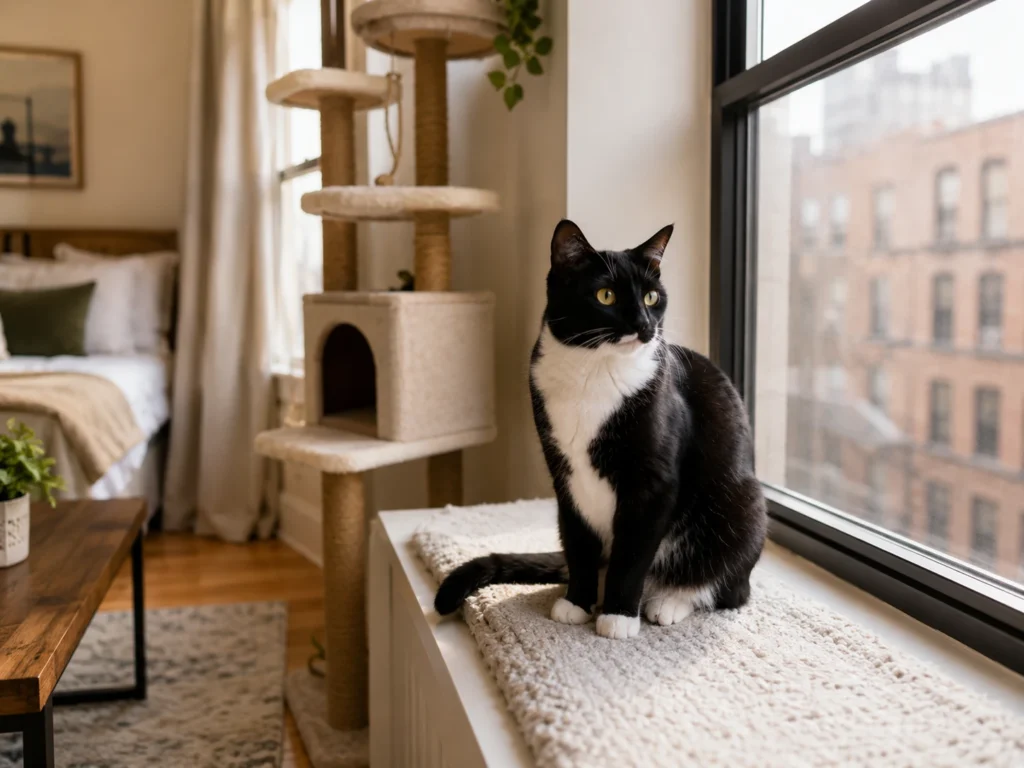
Choose a quiet resting place outside the areas that need to be cat-free. Start with somewhere your cat already chooses, and preserve a clear approach and a way to leave. Keep food, water, and litter accessible in suitable separate locations rather than crowding them into the retreat. FelineVMA’s environmental guidance emphasizes both protected resting places and access to essential resources.
A high perch is not a requirement. If jumping is difficult, choose a quiet floor-level den or resting spot your cat can enter and leave comfortably. Without a spare cat room, a low-traffic part of an existing living area may serve this purpose, provided it is outside any room being used for the baby’s sleep. A retreat gives your cat an option to withdraw; it does not physically separate the cat from the baby.
Offer the space without placing your cat inside it. Watch whether they can reach it comfortably, settle if they choose, and leave without someone blocking the route. If it goes unused, compare it with a spot they prefer: is the new place noisier, harder to enter, or beside a busy walkway? Change the inconvenient feature rather than closing every alternative. Our guide to creating safe hiding places for your cat covers the detailed setup.
Replace Lost Access Before It Becomes a Problem
If your cat currently sleeps in a room that will become cat-free, arrange an accessible alternative before changing access when time permits. Familiar bedding can make the alternative less of a change. For ordinary laundry, rotate cat bedding rather than washing every resting item at once; wash soiled material when needed rather than preserving its smell at the expense of cleanliness. PDSA includes familiar bedding and dependable routines in its environmental advice.
When a bowl or litter box must move, choose a usable destination and make the transition gradually where possible. Check actual use, not just whether the item fits. A bowl beyond a busy visitor area or a litter box behind a newly closed door does not provide dependable access. If the route is awkward, simplify it. Do not reopen the baby’s sleeping room as the solution, and seek veterinary advice for concerning eating or toileting changes rather than waiting for your cat to accept the layout.
Keep the Cat Out Without Moving the Baby Away From You
Whenever your cat and baby share a room, an adult needs to be within reach and directly supervising. PDSA gives the within-reach rule, and NHS maternity guidance explicitly says not to leave a baby alone in a room with a cat. Being somewhere in the house is not direct supervision. Separate them if you leave, might fall asleep, or cannot actively watch.
For every sleep, keep your cat outside the room being used for the baby’s sleep, not merely out of the crib. Your baby should still sleep in their own separate, appropriate infant sleep space in the room with you for at least the first six months, day and night. The Lullaby Trust explains this room-sharing arrangement; the American Academy of Pediatrics also recommends separate-space room-sharing. Do not move your baby to solitary sleep to preserve the cat’s access.
In a home with a suitable room boundary, an existing closed door can keep the cat outside while you and your baby share the room. Check where your cat is before closing it, and keep their essentials accessible on their side. Plan daytime naps as well as nights: a living room used for the baby’s sleep also needs cat exclusion. A monitor cannot replace caregiver room-sharing or the separation that prevents unsupervised cat–baby contact.
If you live in a doorless studio or cannot maintain that separation, a cat den or quiet corner does not solve the problem. Ask your baby’s healthcare professional and your veterinarian or qualified cat behavior professional for help planning around the actual layout. This guide cannot establish a safe workaround for every home; do not rely on a net, crib cover, gate, or improvised barrier as a substitute.
Let New Equipment Become Familiar Without a Forced Inspection
A manageable starting point is one stationary item, such as a stroller, while the house is quiet. Set it up while your cat is elsewhere, keep their usual routes clear, and supervise any investigation. Let your cat look from a distance or ignore it. Cats Protection advises supervising exploration of baby equipment and preventing the cat from climbing onto it. Infant sleeping surfaces remain off-limits even before the baby arrives.
Voluntary investigation means your cat can choose both the approach and the departure. Carrying them over, bringing the item toward them, cornering them, or blocking the exit removes that choice. There is no need to tempt a hesitant cat closer. Keep the item inaccessible when you cannot supervise; if the cat climbs into it, calmly encourage them away toward their own resting place rather than punishing them.
Watch what happens around the item. Continuing ordinary activity, choosing to investigate, and walking away freely are reasons to leave the easy arrangement in place. You can introduce another small change later if your cat remains comfortable. If they freeze, crouch, hiss, or avoid a route to food or litter, reduce the change or stop the exercise. Move a nonessential item out of that route rather than making the cat pass it. Repeated concern or a wider change in daily activity calls for veterinary advice, not more determined introductions.
Start Baby Sounds Quietly and Follow Your Cat’s Response
Recordings are optional preparation, not a test your cat must pass. Use a familiar setting at a quiet time, with an open route away from the sound. First test the recording while your cat is elsewhere and set it barely audible, as Cats Protection recommends. Do not start during another unsettling household change.
- Begin at that very low level when your cat has chosen to be in the area. Observe without holding them there or drawing them toward the speaker.
- If they appear comfortable and continue ordinary activity, keep the exercise easy. Repeat the same low level rather than assuming every occasion needs to be louder.
- Only consider a small increase after your cat is comfortable at the current level. There is no requirement to reach a particular final volume before homecoming.
- If your cat becomes tense, freezes, crouches, hisses, or moves away from the sound, lower it or stop and let them leave. Do not keep it playing to make them get used to it.
After an uncomfortable attempt, return to ordinary quiet conditions. A later attempt can be easier, but repeating an exercise that keeps upsetting your cat is not useful preparation. Pause and seek veterinary advice if concern recurs or normal eating, toileting, movement, or behavior changes. A cat who tolerates a recording may still respond differently to a real baby and a busy home; recordings do not remove supervision or separation requirements.
Make Homecoming Low-Pressure
Before bringing the baby home, confirm who is covering cat care, where the cat can retreat, and how supervision and separation will work. If a quiet greeting with your cat is practical while another adult cares for the baby, offer it. If it is not, do not turn it into another obligation or leave the baby unattended to arrange it.
A first meeting can simply be your cat noticing the baby from a distance. Keep it brief and quiet, with an awake adult within reach and actively supervising. Let the cat choose whether to approach or leave; do not carry them toward the baby or arrange face-to-face sniffing. Battersea’s baby-introduction guidance emphasizes choice, calm meetings, supervision, and a retreat.
If your cat stays away, let that be the outcome. Continue their ordinary care without bringing the baby to the hiding place. If the cat becomes unsettled, end the encounter, allow withdrawal, and return to your separation arrangement. You can postpone another meeting. Even after an apparently relaxed encounter, the same adult-supervision and cat-free sleeping-room rules still apply.
A Scent Item Is Optional
If a baby-worn garment is available and you want to offer it, put it in a quiet cat-accessible area at a distance from your cat, without blocking the retreat or essentials. Let the cat choose whether to investigate. FelineVMA’s baby guidance includes this voluntary scent introduction. Ignoring the item is fine; you do not need to obtain one before the baby comes home.
Do not hold the cloth against your cat, rub it on them, add fragrance, or put it in the baby’s sleep space for this exercise. Keep normal laundering and hygiene needs ahead of preserving a scent. If your cat avoids the area or seems uncomfortable, remove the optional item rather than pursuing the introduction.
Let Visitors Leave the Cat Alone
Tell visitors where the cat’s retreat and resource routes are. Ask them not to follow, reach into the retreat, or bring the cat out to meet anyone. Keep bags and new equipment away from those routes. If your cat prefers to hide during visits, protect that choice while continuing to notice eating, litter use, and ordinary activity. Why cats hide when visitors come over explains that separate issue in more detail.
Know When to Stop Adjusting the Plan and Call Your Vet
Contact your veterinarian for concerning changes in eating, drinking, toileting, movement, activity, or behavior, including new or increasing withdrawal. Do not assume the baby caused the change, or wait for it to persist before asking for advice. PDSA notes that signs associated with stress can also have medical causes. Tell the vet what changed, when you noticed it, and which ordinary activities are affected.
If your cat has difficulty passing urine, contact your veterinarian immediately for an emergency appointment. PDSA’s urinary-emergency guidance is explicit about this urgency. Do not wait to see whether changing the room or stopping a recording resolves it.
Pause optional familiarization while you get advice. Continue normal care, accessible resting places, and infant separation. Your veterinarian can advise on health concerns and whether qualified behavior support is needed; repeated exposure is not a substitute for that assessment.
If You Have Less Preparation Time Than Expected
Start with the arrangements the household needs now: a named person for cat care and a backup, accessible food, water and litter, a usable retreat, and workable infant supervision and sleeping-room separation. Defer optional recordings or equipment exercises rather than fitting more of them into the remaining time. Make necessary changes as gently as circumstances allow, but do not delay infant boundaries until the cat has practiced. There is no catch-up timetable or deadline for friendship.
Before Your Baby Comes Home
Check the arrangement in the home rather than judging readiness by a sniff or a calm-looking cat:
- Can the main caregiver and backup explain who is doing each cat-care task?
- Can your cat reach and use their essentials when the planned doors are closed?
- Is there a comfortable retreat that visitors will leave undisturbed?
- Can you keep the cat out of every room used for infant sleep while the baby shares a room with a caregiver?
- Does every caregiver know to separate cat and baby when direct supervision cannot happen, and to seek veterinary advice for concerning changes?
Sources
View Sources and References
Sources were accessed on October 21, 2026. The cat-preparation advice comes from veterinary and animal-welfare organizations, not trials of this exact household plan. The care handoff, backup arrangements, small-step examples, and short-notice priorities are practical adaptations. Sources differ on calendars, products, and some infant-care details; those extras are not combined into a single protocol here. Article-specific funding was not established.
FelineVMA / Cat Friendly Homes. What Your Cat Needs to Feel Secure. Environmental and resource-access guidance; modified February 5, 2026.
FelineVMA / Cat Friendly Homes. 5 Steps to Being an Excellent Cat Caregiver. Individual routine observation; modified March 18, 2026.
ASPCA. Cats and Babies. Caregiver transition, optional scent item, and homecoming. Its pregnancy-health advice, fixed timelines, scent application, deterrents, and barrier suggestions are not adopted.
PDSA. Recognising stress in cats. Routine, resources, bedding, and veterinary advice. The page also promotes diffusers; no product recommendation is adopted.
PDSA. Cat fear: how to help a nervous cat. Choice, gradual changes, and observable concern. Its product links and treatment material are outside this guide.
Cats Protection. Cats and your pregnancy. Written preparation and baby-safety sections only. The page promotes FELIWAY and links to Ceva; commercial terms were not established. Pregnancy medicine, product use, deterrents, and calendar schedules are excluded.
PDSA. Pets and babies: preparing for a new arrival. Used for supervision and closed-door guidance, not its dog-specific advice, cot-tent suggestions, or developmental claims.
PDSA. Blocked Bladder in cats. Published June 2019; used only for immediate veterinary contact when urination is difficult.
Battersea. How to introduce your cat to your baby and children. Updated July 27, 2026. Baby-specific preparation and voluntary meetings; not the broader child-handling guidance.
FelineVMA / Cat Friendly Homes. Bringing Home A Baby. Modified September 7, 2021. Also promotes Feliway; blanket wiping, fixed attention periods, and unqualified monitor advice are not adopted.
The Lullaby Trust. Room sharing: Where should my baby sleep?. Reviewed February 1, 2025; updated April 30, 2026. Day-and-night room-sharing and the limits of monitoring devices.
Ashford and St Peter’s Hospitals NHS Foundation Trust. Maternity Leaflet: Safe Sleep for Baby. Sr Liz Jennis; leaflet reviewed September 2024, next review listed as September 2026; webpage updated September 15, 2026. Pet exclusion is corroborated with the other guidance cited here.
NHS. Sudden infant death syndrome (SIDS). Reviewed November 25, 2025. Separate sleep space in the caregiver’s room for every sleep.
American Academy of Pediatrics / HealthyChildren.org. How to Keep Your Sleeping Baby Safe: AAP Policy Explained. Rachel Y. Moon, MD, FAAP; updated September 11, 2026. Accessible parent guidance, not a full-text review of the linked technical report.