
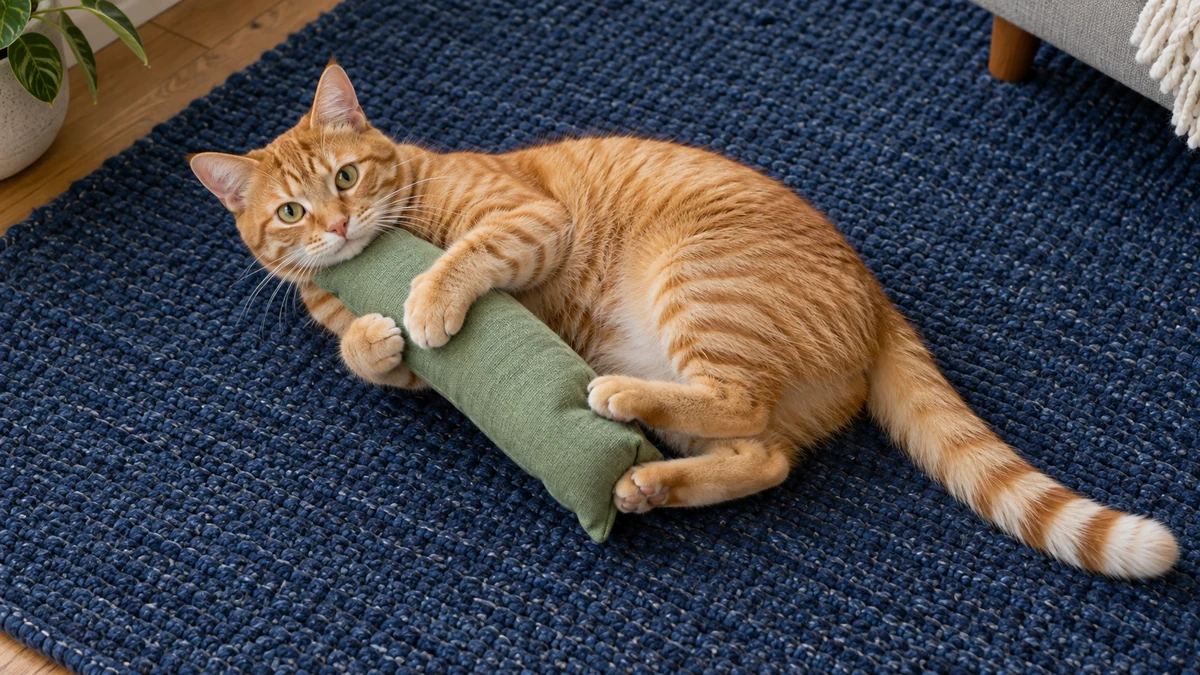
Cats bunny kick toys by holding them with their front legs while repeatedly pushing or kicking with their back legs, often while lying on their side. It is a movement seen in hunting and play. When your cat wraps around a soft toy and kicks it, the toy gives them something to grasp and work against.
The movement alone does not tell you whether a cat is happy, frightened, or aggressive. A cat choosing to wrestle with a toy is in a different situation from a cat grabbing a hand during unwanted contact. Keep your hands out of either game.
What Is Happening During a Bunny Kick?
The front legs hold the object close while the hind legs apply repeated force. Cats Protection’s Behaviour Guide describes this grasp-and-kick pattern, usually in the context of hunting or play.
That helps explain why an elongated soft toy can become a wrestling partner. It offers enough material for the cat to hold with the front paws and contact with the back paws. A smaller toy may invite batting or chasing instead. This is about offering an object that fits the movement, not making every cat play in the same way.
It is reasonable to describe toy kicking as part of hunting-style play. It does not show that your cat is rehearsing one specific attack, learning to hunt successfully, or expressing a single emotion. You do not need a dramatic explanation to make sense of a cat enjoying an object they can grab.
Does Bunny Kicking Mean Aggression?
Not by itself. Look at what was happening before the kick, what the cat is holding, and whether they can choose to disengage. A cat that approaches a toy and wrestles with it is not automatically displaying a problem just because the movement looks forceful.
Do not assume the same thing when the target is your arm or hand. Stop the contact or game rather than encouraging more wrestling with skin. If it happened while you were touching an exposed belly, Why Does My Cat Show Me Their Belly? explains that separate touch-boundary question.
Likewise, a single ear position or tail movement cannot classify the whole interaction. Consider the situation and any change from your cat’s usual behavior. This article is about kicking toys, not diagnosing aggression from a brief movement.
Offer Something Suitable to Hold and Kick
Cats Protection recommends a larger kicker toy as an outlet for this play pattern. International Cat Care also describes soft toys that cats can hold and kick with their hind legs.
Choose an intact soft toy that your cat can comfortably grasp. Check its seams and surface, and avoid accessible strings or small loose parts. Replace or remove a damaged toy before play continues. How to Choose Safe Toys for Your Cat covers broader construction and supervision checks.
- Offer the toy on the floor with room for your cat to approach and move away.
- Let your cat choose whether to grasp it. Do not press it into their belly or pin them into position.
- Keep your hands clear once the cat is holding the toy. Do not hold one end against your cat while they bite or kick the other.
- Pause when your cat disengages. There is no need to put the toy back into their paws to make them continue.
A kicker is an option, not a requirement. If your cat ignores it, try a different play style they already enjoy. You do not need to teach bunny kicking or measure how many kicks make a successful session.
Keep Hands and Feet Out of Play
VCA advises keeping hands away from play toys. A toy held against your wrist does not create much separation, even though there is technically an object between you and the cat.
For interactive chasing, a wand toy can provide more distance. Supervise it and put it away afterward; string and wand toys are not suitable to leave with a cat unattended. How to Play With Your Cat Using a Wand Toy explains how to manage the game.
If your cat repeatedly targets people during play, use How Do I Stop My Cat From Biting During Play? for that broader problem. A kicker alone is not a proven cure for biting hands.
When a Change Deserves Advice
Ordinary toy wrestling does not need to be punished. Cornell warns that physical punishment can worsen fear and aggression and that medical problems can contribute to aggressive behavior.
If kicking appears alongside a new reluctance to be touched, apparent pain, or a sudden troubling change in behavior, ask your veterinary team for advice. Do not keep provoking the movement to see whether it happens again. The reason for seeking help is the wider change or discomfort, not the label “bunny kick.”
Helpful Related Guides
- Why Does My Cat Show Me Their Belly?
- How Do I Stop My Cat From Biting During Play?
- How to Choose Safe Toys for Your Cat
- How to Play With Your Cat Using a Wand Toy
Sources
View Sources and References
Cats Protection — The Behaviour Guide. Bunny-kicking definition and object-play passages inspected.
Cats Protection — Cats and Play. Kicker toys as a play outlet.
International Cat Care — Playing with your cat. Soft toys for grasping and kicking; avoiding hand and foot play.
VCA Animal Hospitals — Cat Behavior and Training – Play and Play Toys. Keeping hands clear and supervising wand toys.
Cornell Feline Health Center — Feline Behavior Problems: Aggression. Medical assessment and avoiding physical punishment; deterrent advice elsewhere on the page is not adopted.
