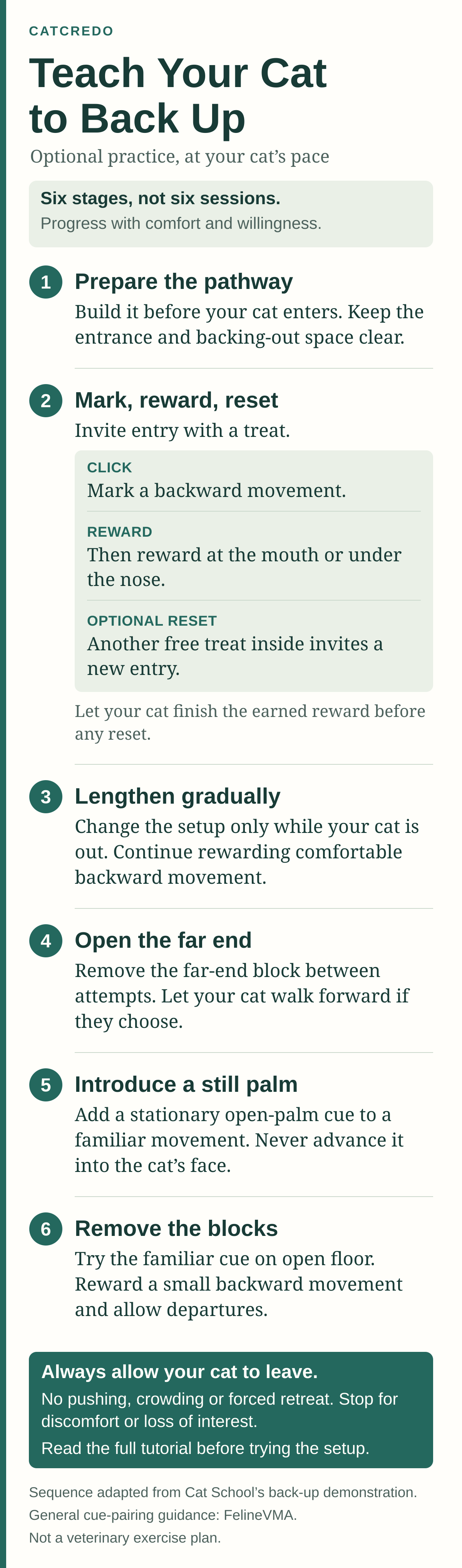
To teach your cat to back up, make a small, voluntary backward movement rewarding before adding a cue. In the pathway method below, your cat chooses to enter a pre-built space, you mark a backward step as they come out, and a reward follows promptly. Later stages make the pathway longer, open its far end, introduce a stationary hand signal, and remove the blocks.
Keep the goal modest. Your cat does not need to cross the room backward, perform on a timetable, or finish every stage. A comfortable movement that they willingly offer is enough. Never create the step by advancing toward your cat, leaning over them, pushing their body, or moving food into their face.
This sequence comes from Cat School’s back-up demonstration. It shows a practitioner explaining the method with a cat who already knows the behavior, rather than documenting a beginner cat learning from scratch. It offers a teaching approach, not a guarantee that your cat will take to it or a veterinary exercise plan.
Check That This Activity Fits Your Cat
Begin only when your cat is awake, comfortable, and interested in interacting. Do not use a training session to test whether a painful or unwell cat can move normally. FelineVMA’s caregiver guidance advises against training cats who are ill, in pain, or showing protective behavior such as hiding, growling, or hissing.
For a cat with mobility limitations, suspected discomfort, or a health condition that could affect movement, ask your veterinarian about suitable activities rather than inventing a modified backing exercise. The ability to learn at a young or older age does not establish that this particular movement is appropriate for an individual cat.
Backing up is optional indoor practice. Do not rely on the cue to stop a cat at an open exterior door, move them away from a hot appliance, or protect them around moving furniture or mechanisms. Keep ordinary physical safeguards in place independently of training.
Prepare the Space, Rewards, and Marker
Choose a quiet, familiar area on a level floor with secure footing. A rug should lie flat without sliding or bunching. Clear the space behind the pathway’s entrance so your cat can back out without meeting furniture, loose objects, another animal, or your legs.
Have small, suitable food rewards ready. The demonstrated method uses food both to invite entry and to reward backing, so count both kinds of treat within the same planned supply. Follow your cat’s existing feeding instructions, including any veterinary restrictions. Our guide to using training treats without overfeeding covers that accounting. Normal food and access to resources must not depend on completing the exercise.
Use a reward marker your cat already understands, such as a click or a quiet, consistent word. If the marker is new, work on establishing that reward signal separately first. Do not introduce an unfamiliar sound while also asking your cat to work out a new movement. Stop if the sound frightens them.
If another cat would compete for food or occupy the backing-out route, arrange comfortable separate training sessions. Separation itself needs to be familiar and comfortable; shutting a distressed cat elsewhere does not create a suitable lesson.
1. Build the Pathway Before Your Cat Enters
Cat School uses a short, narrow pathway between a wall and low blocks, with a block across the far end. The entrance remains open. A treat placed inside gives the cat a reason to walk in; backing out through the same entrance is the movement the arrangement is intended to encourage.
Build the whole structure before inviting your cat over. Use stable, intact materials that will not fall or slide into the cat. Keep the floor-level passage usable without squeezing, and leave the entrance and the space beyond it unobstructed. There is no universal width or length to copy from this demonstration.
Sit near the open end where you can watch the paws and deliver food without leaning over your cat. Keep your body out of the exit route. The far-end block is already part of the setup, not something you close behind a cat who has entered.
Let your cat decide whether to investigate. Do not place them inside, close a gap around them, or keep rebuilding the structure to prevent a departure. If they avoid the setup, turn away, or try to leave over a block, end the attempt and let them go.
You are ready to offer the first food invitation only when the structure is settled, the exit is clear, and your cat is choosing to engage without signs of discomfort.
2. Mark the Backward Movement, Then Reward and Reset
Toss a small treat inside the pathway and let your cat walk in to collect it. Stay still near the open end. Do not push your hand toward their nose or move closer to make them retreat.
Watch the feet as your cat comes back out. The useful action is a paw moving backward while the body backs along the pathway. A lifted head, a rearward weight shift with the feet still planted, sitting down, or turning to walk forward is not the same movement. There is no need to invent a separate weight-shifting exercise before you can recognize a backward step.
Mark once while your cat is moving backward, paying particular attention to the rear paws. Start with a small movement you can clearly see rather than waiting for a long sequence or a complete exit. The marker identifies what has already earned the reward; it is not encouragement to keep backing.
After marking, deliver the food promptly at your cat’s mouth or on the floor directly under their nose, as shown in the demonstration. Bring the reward to an easy-to-reach position without crowding. Do not click for a step and then require more movement, a sit, or a pause before paying.
If you mark at the wrong moment, give the reward anyway. Cats Protection’s clicker guidance specifically advises honoring an accidental click. Improve your timing on the next opportunity rather than changing the meaning of the marker midway through this one.
Keep the Reward and Reset Separate
Allow your cat to finish the earned reward. If they remain interested, toss another small, free treat inside the pathway. That is an invitation to enter again, not payment for an extra unmarked step. Your cat chooses whether another attempt begins.
The sequence is simple: voluntary entry, backward movement, marker, earned reward, then an optional new entry. Do not use a reset treat to pull a cat back after they have left the activity.
Stay at this stage while you are still working out the timing or the cat is only occasionally offering the movement. Readiness to progress looks like willing entries followed by recognizable backing, comfortable movement, and continued interest between rewards. Taking food alone does not establish that the setup is comfortable.
3. Extend the Pathway Without Changing the Other Rules
The next demonstrated stage lengthens the pathway. Try this only after your cat is comfortably backing in the shorter arrangement and the entry–backing–reward sequence has become familiar.
Wait until your cat is out and clear before moving or adding any equipment. Make a modest extension while preserving the same unobstructed entrance, secure footing, and reward arrangement. Do not lengthen or narrow the space around a cat already inside it.
Offer another voluntary entry, then watch for the familiar backward movement. The longer pathway gives room to develop a little more backing; it does not mean you must withhold the marker until your cat reaches the very end. Continue rewarding an achievable backward action and build only as the movement remains clear and comfortable.
If the extension produces hesitation or the familiar response disappears, do not keep waiting for your cat to solve a harder version. End the attempt. The simplification section below explains when an earlier arrangement may be useful on another willing attempt.
There is no required distance, step count, or number of successful repetitions that makes this stage complete. Look for the same voluntary, recognizable movement in the slightly longer setup before making another change.
4. Open the Far End
Cat School next removes the block across the far end, once the cat is beginning to understand the backing behavior. This is the block in front of the entering cat, not a gate behind them. Removing it adds a forward route through the pathway.
Make that change while your cat is outside the setup. Keep the remaining side arrangement and your reward routine familiar rather than also changing rooms or asking for a much longer movement.
Your cat may now choose to walk forward through the opening. Allow it. Do not replace the block while they are inside, follow them with food, or stand in the new opening to force a backward exit. You are looking for backing that your cat offers with the far end open, not proof that they can be prevented from going forward.
Continue marking and rewarding comfortable backward movement when it occurs. If opening the end means the cat no longer offers it, do not move straight on to a new cue. That tells you the easier arrangement and the more open one are not yet interchangeable for this learner.
5. Add the Stationary Open-Palm Cue
Introduce the hand signal when the backward action is already familiar in the open-ended setup. The demonstrated cue is a flat, open palm, fingers pointing up, held still at arm’s length. Present it where your cat can see it without bringing the hand into their face. Do not wave, jab, or advance it toward them.
Keep the remaining blocks in place for this stage. You are adding a signal to a movement your cat already offers, rather than simultaneously removing the setup and asking them to decipher a new gesture.
To connect a new signal with a familiar action, FelineVMA’s cue guidance starts with the behavior already learned and gradually places the cue before it. Applied here, begin showing the stationary palm as a familiar backward movement begins. Mark the actual backward movement, then reward as before. As the connection becomes recognizable, present the same palm before the movement begins.
Keep the three parts distinct: the palm asks for backing, the marker identifies the backward action, and the food pays the earned reward. Holding the palm up is not itself a reason to click, and the click does not ask for another step.
If your cat does not respond, lower your hand and pause. Do not move the palm closer, repeat larger gestures, or follow a departing cat. Before removing the remaining blocks, look for your cat choosing the familiar backward movement after the stationary signal, without you advancing toward them.
6. Remove the Remaining Blocks
The final demonstrated stage removes the blocks so the movement can happen on open floor beside the wall. Make the change between attempts with your cat clear of the equipment. Keep the same quiet area, secure surface, stationary hand signal, and prompt reward delivery.
Begin with a small version of the familiar action. Mark a clear backward movement and reward it; do not demand the distance your cat managed with the pathway present. Removing that setup changes the task even though the cue looks the same.
Your cat may turn, approach you, or choose another activity. Do not reconstruct a passage around them or use your body as a replacement barrier. If the hand signal no longer produces the familiar movement, stop and reconsider the previous stage rather than making the gesture more forceful.
There is no requirement to progress beyond a modest movement on clear floor. Longer distances, stairs, raised surfaces, obstacle routines, and practice near household hazards are outside this lesson.
Make an Easier Next Attempt, Not a More Restrictive One
Returning to an earlier comfortable stage is Catcredo’s practical application of general small-step guidance, not a simplification demonstrated in the Cat School video. Ontario SPCA advises moving forward only after the earlier step is established and returning a step when needed. Fear Free Happy Homes similarly describes lowering the requirement when a learner stops offering a newer version.
For this lesson, that can mean shortening a pathway that was just extended or returning to the previously comfortable arrangement after a later change. Only make such adjustments between attempts, with your cat outside and clear. Never restore a block to stop a cat who is currently trying to leave.
For example, suppose backing was comfortable in the short setup but disappears after you lengthen it. On a later willing attempt, return to that familiar short version rather than changing the cue, reward, and room too. This is an illustrative decision, not a promise that shortening will solve every difficulty.
Simplification is appropriate only while the cat still wants to participate. If they are avoiding the activity, becoming frustrated, or leaving, stop. An easier setup is not a reason to keep presenting a lesson they have declined.
Troubleshoot What You Actually See
Your Cat Sits Instead of Backing
Do not lift the hindquarters, touch the paws, or push the chest to restart movement. Sitting does not meet the backward-movement goal, but it is not defiance. If you have already marked, deliver the reward; otherwise, let that attempt end.
Before another session, check whether you were marking a head lift or reaching for food before the feet moved. Correct your own timing rather than inventing a lure path to make the cat stand. If the pathway has never produced voluntary backing, there is no demonstrated earlier backing stage to return to. You can leave this activity aside.
Your Cat Turns or Goes Over a Block
Allow the departure and finish the attempt. Do not make the space more restrictive to prevent that choice. Turning or going over the setup does not establish why the cat chose that route, and it does not justify trying to make backing the only possible escape.
Your Cat Follows the Food Hand
Keep spare food ready but your reward hand quiet until after the marker. Fear Free’s timing guidance separates the marker from the hand movement that delivers the reward. Here, that helps you keep the backward action distinct from reaching toward food.
If you have clicked, pay the reward without requiring your cat to back away from your hand first. On a future attempt, reduce distracting food-hand movement. Never correct an approach by pressing the food toward the nose.
The Cue Stops Working After a Change
Identify the change: longer pathway, open far end, new hand signal, or removed blocks. Do not assume your cat needs a louder request or a longer wait. If they remain willing, plan an easier next attempt using the last comfortable stage. If they disengage, finish instead.
Your Cat Loses Interest or Looks Uncomfortable
Stop if your cat leaves, avoids the setup, becomes tense or unusually still, crouches, hides, growls, or hisses. You do not need to identify the exact emotion before ending an optional exercise. FelineVMA’s environment guidance advises ending sessions when either the cat or caregiver becomes distracted or frustrated.
New discomfort or abnormal movement calls for veterinary advice rather than further backing practice. Failing to perform this trick alone is not a diagnosis. Put the equipment away when your cat is clear, and allow ordinary rest, food, and attention without requiring a final successful repetition.
Helpful Related Guides
- How to Clicker Train Your Cat
- How to Use Treats for Cat Training Without Overfeeding
- How to Train Cats Separately in a Multi-Cat Home
Sources
View Sources and References
Cat School Clicker Training: Teach Your Cat to Back Up With Clicker Training. Published February 27, 2018. Practitioner demonstration supporting the pathway, reward and reset, setup progression, stationary hand cue, and removal of the blocks. The demonstration uses a cat who already knows the behavior.
FelineVMA / Cat Friendly Homes: Using Positive Reinforcement to Train and Support Your Cat. General feline training principles, marker use, gradual cue association, and limits on training an ill, painful, or fearful cat.
FelineVMA: Setting Up the Environment for Success. General guidance on individual preferences, distress, distractions, and ending frustrating sessions.
Cats Protection: How to Clicker Train a Cat. Published August 11, 2025. Marker timing, honoring an accidental click, health considerations, and individual limits.
Ontario SPCA and Humane Society: Clicker Training Your Cat. Published April 10, 2026. General small-step progression, returning to an earlier step, and respecting a cat’s decision to leave.
Fear Free Happy Homes: Clicker Training Basics. By Rachel Lees, RVT. General marker and reward-hand timing and adjustment of learning criteria; not a feline back-up protocol.
VCA Animal Hospitals: Using Food and Treats for Training Cats. Updated May 22, 2026. Small, individually suitable rewards, food accounting, and veterinary guidance for health-related dietary restrictions.